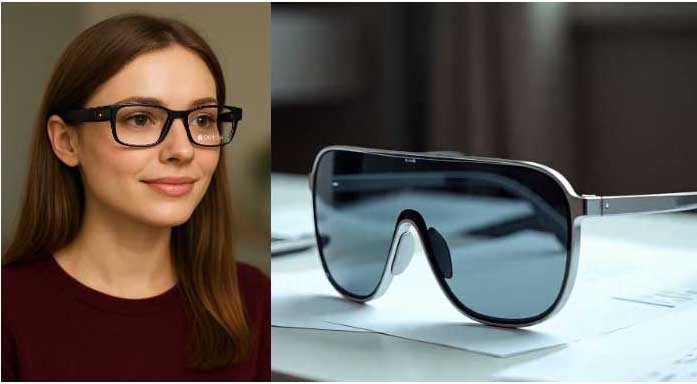
The True Post (Web News) Big technology companies have now reached your face.
Companies like Meta, Google, Apple, Snap, Alibaba and Xiaomi are pushing the next generation of smart glasses that include artificial intelligence (AI). These glasses aim to allow users to perform various tasks without using their hands, such as translating languages, taking reminders, recording videos, identifying objects or suggesting restaurants. Meta’s Ray-Ban smart glasses have been on the market since 2021 and are considered to be the frontrunner so far. The company has announced that it aims to produce 10 million glasses annually by 2026. According to estimates, the global smart glasses market was worth about US$1.9 billion in 2024 and could reach $8.2 billion by 2030.
Experts say that since many people already wear glasses, smart glasses could be a natural choice. These glasses are also being seen as an alternative to mobile phones because they provide AI facilities right in front of your eyes. But there are social and privacy concerns associated with this technology. There have been cases of their misuse in courts, public places and sensitive areas, such as secretly recording videos or using them for surveillance purposes.
Meta’s glasses have a small light that lights up during video recording, but ordinary people may not be able to recognize it. In addition, the company collects user voice and conversation data to improve its AI models. The user can delete some of the data himself, but there is no option to completely opt out of this process. The failure of Google Glass in 2014 is an example of how new technology alone is not enough, but design, price and social acceptance are also important.
Investors are increasingly interested in the global race for artificial intelligence. According to experts, if you don’t talk about AI, the market will not reward you. That’s why companies are calling smart glasses the main device of the future. Meta CEO Mark Zuckerberg has said that in the coming years, these glasses will become our primary computing device, just like contact lenses are common today. According to him, if someone does not have AI glasses in the future, they will suffer from “mental deficiency” compared to others.
Smart glasses can provide new conveniences and high-speed connectivity, but at the same time they are raising big questions such as privacy, data protection and social acceptance. How far this technology will reach ordinary users will become clear in the coming few years.
 Ishtiq Ahmed Send an email August 22, 2025