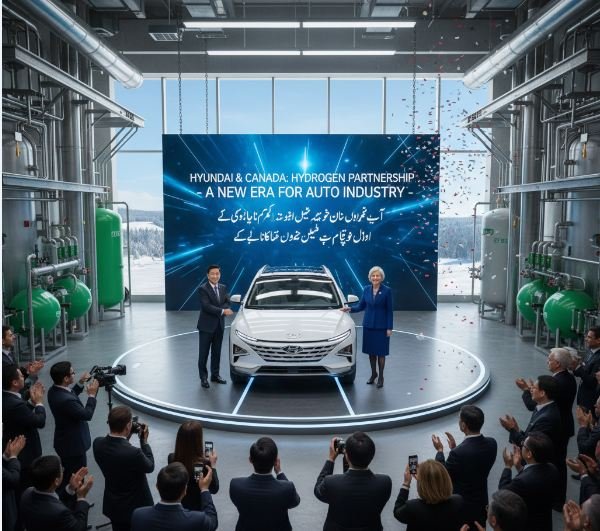
The True Post(Web News) Global climate change, carbon emission reduction, and the race for clean energy have brought the automobile industry to a historic turning point.
While most global automakers are investing in electric vehicles (EVs) as the only solution for the future, South Korean giant Hyundai appears to be taking a different, relatively difficult but long-term path. Its interest in potential collaboration with Canada’s hydrogen energy sector is a clear indication of this strategy. Hyundai’s consideration of collaboration with Canada’s hydrogen energy sector comes at a time when Canada and South Korea have signed a memorandum of understanding to cooperate in several key areas, including auto and battery manufacturing. This development not only marks a strengthening of bilateral industrial relations but also points to new directions for clean energy globally.
The biggest advantage of hydrogen fuel cell vehicles over electric vehicles is their long range and ability to refuel in a short time. While electric vehicles can take hours to fully charge, hydrogen vehicles can be refueled in a matter of minutes, like conventional gasoline vehicles. This feature makes them particularly suitable for commercial transport, trucks and heavy vehicles. However, the biggest obstacle to this technology is infrastructure. The costs of building hydrogen stations, safe storage, transportation and production are factors that are causing most companies to back away from this field. The closure of hydrogen programs by major companies such as General Motors and Stellan Nuts reflects the fact that this path is not only expensive but also uncertain.
Nevertheless, Hyundai continues to invest heavily in this technology. According to auto industry experts, Hyundai has adopted hydrogen not just as an alternative but as a key pillar of the future, especially in the field of heavy vehicles and commercial transport. The introduction of the world’s first heavy-duty hydrogen truck in 2020 was a practical expression of this vision.
Seen from the Canadian perspective, Hyundai’s interest is of exceptional importance. Advances in hydrogen technology in British Columbia and clean energy resources in Quebec indicate that Canada has a suitable foundation for a hydrogen economy. If this partnership becomes a reality, it could become a national project that will give a new direction not only to the auto industry but also to the energy sector. According to statistics, Hyundai and its subsidiary Kia have a strong market share in Canada. Sales of more than 100,000 Hyundai and almost 100,000 Kia vehicles in 2025 are proof that the company has the trust of Canadian consumers. In such a situation, viewing Canada as a laboratory for hydrogen vehicles seems to be a practical strategy.
However, this path is not without risks. In 2024, Hyundai had to recall its NEXO hydrogen fuel cell models, due to concerns about fuel leakage and possible fires. The incident deepened questions about the safety of hydrogen technology. It is also a reminder that investment in modern technology is also necessary with responsibility and caution. The real question is: can hydrogen really be the future of the auto industry, or will it remain limited to a certain segment? According to experts, if just 10% of the global auto market were to switch to hydrogen, it would be equivalent to the annual production of millions of vehicles, which is not something any company can ignore. There is no single path in the race for clean energy. Electricity, hydrogen and other alternative fuels can only lay the foundation for a sustainable future. If the potential partnership between Canada and Hyundai is successful, it could be an important milestone not only for the auto industry but also for global environmental goals.
 Ishtiq Ahmed Send an email January 31, 2026