Muhammad Amanullah | August 15, 2026
OTTAWA — Canada has imposed new sanctions on five senior Iranian officials over alleged activities linked to the Strait of Hormuz, saying their actions pose a threat to international peace, global trade and energy security.
The Canadian government said the latest measures target individuals involved in activities that undermine international maritime navigation and contribute to instability around one of the world’s most important energy corridors.
Canada Announces New Sanctions
Canadian Foreign Affairs Minister Anita Anand said in a statement Friday that freedom of navigation through the Strait of Hormuz is critically important to global trade and energy security.
Anand said the new sanctions target individuals whose actions threaten international shipping principles and global economic and energy security.
Canada also called on Iran to reduce tensions and respect international rights related to maritime navigation.
Five Iranian Officials Targeted
According to the Canadian government, the five individuals targeted by the new sanctions include senior officials associated with Iran’s Islamic Revolutionary Guard Corps.
They include Ali Abdollahi, commander of the Khatam al-Anbiya Central Headquarters and a senior IRGC official.
Another sanctioned individual is Lieutenant Colonel Ebrahim Zolfaghari, spokesperson for the Khatam al-Anbiya Central Headquarters.
The list also includes Ebrahim Azizi, a member of Iran’s parliament and chairman of its National Security and Foreign Policy Committee.
The remaining two individuals are Shahram Irani, commander of the Iranian Navy, and Hamid Hosseini, chairman and spokesperson of the board of directors of Iran’s Oil, Gas and Petrochemical Products Exporters Union.
Scope of Canadian Sanctions Expands
The Canadian government said the latest measures further expand its sanctions regime against Iran.
According to Global Affairs Canada, a total of 232 individuals and 260 entities connected to Iran’s security, intelligence and economic sectors are now subject to Canadian sanctions.
Why the Strait of Hormuz Matters
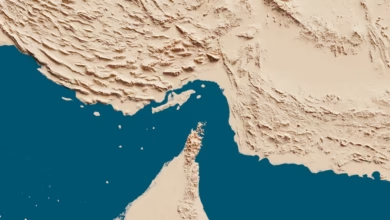
The Strait of Hormuz is one of the world’s most important maritime trade routes and plays a critical role in global energy supplies.
Before the current conflict, roughly one-fifth of the world’s oil and liquefied natural gas passed through the waterway.
Growing tensions in the region and disruptions to maritime traffic have increased pressure on global energy markets.
Iran has been accused of targeting some vessels attempting to pass through the strategic waterway during the conflict, increasing international concerns about the security of the Strait of Hormuz.
Pressure From the United States
U.S. President Donald Trump has repeatedly urged allied countries to contribute to efforts to protect international shipping through the Strait of Hormuz.
In March, leaders from seven countries, including Canada, issued a joint statement calling on Iran to immediately end all attempts to close the Strait of Hormuz to commercial shipping.
The countries also expressed their willingness to cooperate in efforts to restore the waterway to normal maritime traffic.
Diplomatic Pressure to End the War
Canada’s latest sanctions come as diplomatic pressure increases to end the ongoing conflict involving the United States, Israel and Iran.
In June, hopes emerged for a possible peace agreement involving the three sides, but no lasting breakthrough has been achieved so far.
Trump has continued to threaten tougher action against Iran while also repeatedly suggesting that a peace agreement could be within reach.
Impact on the Global Economy
The tensions surrounding the Strait of Hormuz are affecting more than just the Middle East, with the global economy also facing potential consequences.
Higher energy prices and concerns over possible reductions in oil supplies have increased uncertainty around the world.
According to the International Energy Agency, global oil supply is expected to decline by approximately 4.3 million barrels per day this year, equivalent to around 4 percent of total global supply.
Canada says maintaining freedom of navigation through the Strait of Hormuz is essential for global trade and energy security. Ottawa is therefore continuing to pressure Iran to reduce tensions and respect international