Muhammad Amanullah
The True Post (Web News) — What could humanity do if a large asteroid were heading toward Earth and a major city or populated area lay in its path? This question has long been important to astronomers and space scientists.
New computer simulations have revived the debate over whether a nuclear explosion could be used as a last-resort defense option to destroy or divert an extremely dangerous asteroid.
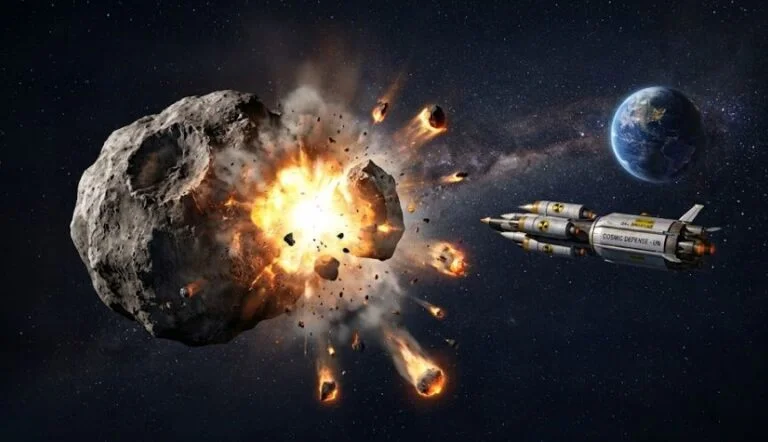
Scientists associated with Lawrence Livermore National Laboratory, led by Isaiah Steven and his team, used supercomputers to model an asteroid approximately 160 metres in diameter. The study examined how a one-megaton nuclear explosion could affect such an asteroid if it were on a collision course with Earth.
Although an asteroid of this size may not initially appear enormous, scientists say an object roughly the width of a football field could cause widespread destruction if it struck Earth, particularly if it hit a major urban area. This makes the early detection of potentially hazardous space objects and the development of planetary-defense strategies an important area of research.
The Goal of a Nuclear Explosion Is Not Simply to Destroy the Asteroid
It is commonly assumed that the objective of using a nuclear explosion against a dangerous asteroid would be to completely destroy it. However, the new research presents a more complicated picture.
Scientists examined how energy released by an explosion could affect an asteroid’s surface and whether the resulting effects could break the asteroid into smaller pieces and reduce the chances of a catastrophic impact.
According to the research, the explosion would not necessarily have to occur inside the asteroid. Even an explosion at some distance from its surface could expose the asteroid to enormous amounts of energy.
X-rays produced by a nuclear explosion could play an important role. This energy could heat the asteroid’s outer surface extremely rapidly, causing some of the surface material to vaporize and be expelled at high speed.
The release of this material could potentially alter the asteroid’s movement.
Ejected Surface Material Could Change the Asteroid’s Path
The rapid expulsion of material from an asteroid’s surface could create a reaction that changes its velocity or direction.
In space, even a very small change in an asteroid’s trajectory can become significant over a long distance. If a large asteroid is diverted slightly millions or even tens of millions of kilometres away from Earth, its trajectory could eventually change enough for it to pass Earth rather than collide with it.
This is why planetary defense does not always require completely destroying an asteroid. In some situations, simply deflecting it enough to avoid Earth could be sufficient.
What Happened When the Explosion Was Simulated 10 Metres Away?
The research team conducted computer simulations under different conditions. In the first model, a one-megaton nuclear explosion was positioned approximately 10 metres from the asteroid’s surface.
According to the simulation, around 98 percent of the asteroid was severely affected and a large portion broke apart and spread in different directions.
The result suggests that, under suitable conditions, an extremely powerful explosion could potentially fragment a large asteroid to a significant degree.
But this raises another critical question: Would breaking an asteroid apart automatically eliminate the danger to Earth?
Not necessarily.
If the fragments spread out in directions away from Earth, the threat could be substantially reduced. However, if large fragments continued moving toward Earth, the danger could remain.
Related: How Safe Are AI-Powered Toys for Children? New Research Raises Questions
Interesting Results at a Distance of 25 Metres
In a second simulation, the distance between the explosion and the asteroid was increased to 25 metres.
It might be expected that increasing the distance would significantly reduce the explosion’s impact. However, the simulation produced an interesting result.
According to the model, X-rays affected a relatively broad area and caused substantial damage to the asteroid during the initial phase.
The findings could help scientists better understand how explosive energy might interact with the surface of an asteroid rather than affecting only a single point.
However, these results should be viewed as part of scientific modelling and further research, rather than as proof that such a method is ready for an actual space mission.
Supercomputers Ran for 59 Days
The complexity of the research can be illustrated by the computational resources required.
For one extremely short portion of the simulation, approximately 1,680 computer processors reportedly operated continuously for around 59 days.
This level of computing power was necessary because the initial effects of a nuclear explosion on an asteroid would occur extremely rapidly.
Surface heating, vaporization, shock-wave propagation and the fragmentation of rock can take place simultaneously.
Understanding events occurring within fractions of a second therefore requires enormous computational resources.
The simulations demonstrate that planetary defense is not simply about determining the explosive power required. Scientists must also understand the complicated physical processes that follow an explosion.
The Real Problem Begins After the Explosion
One of the most important questions is what happens to the asteroid’s fragments after it breaks apart.
The fragments could potentially spread in different directions and reduce the likelihood of an Earth impact. But there is also a possibility that some large fragments could maintain their trajectories and continue moving toward Earth.
The fragments could also be affected by the gravitational pull of other celestial bodies. Over time, their speeds and trajectories could change.
Therefore, simply observing that an asteroid has broken apart would not be enough.
Scientists would need to determine the long-term trajectories of every significant fragment and assess whether any of them could still pose a threat to Earth.
Why Is a Nuclear Explosion Considered a Last Resort?
The concept of using a nuclear explosion for planetary defense is not new, but it is not considered a routine solution.
One major challenge is controlling the direction, speed and size of fragments after an asteroid is disrupted.
If a large asteroid were broken into numerous dangerous fragments and some continued toward Earth, humanity could potentially transform one major threat into multiple smaller but still dangerous threats.
For this reason, scientists generally favor approaches that can alter an asteroid’s orbit without completely destroying it, whenever sufficient warning time is available.
Time Is the Most Important Factor in Planetary Defense
The success of any planetary-defense strategy would depend not only on technology but also on how much warning time is available.
If a potentially dangerous asteroid were detected decades before a possible impact, even a very small change to its trajectory could be enough to ensure that it misses Earth.
By contrast, if an asteroid were discovered only a short time before a predicted collision, scientists would have far less time to make decisions and launch a mission.
That is why space agencies around the world continue to focus on detecting, tracking and predicting the orbits of potentially hazardous objects.
Could a Nuclear Explosion Really Save Earth?
The current research does not establish that a nuclear explosion could reliably save Earth from any dangerous asteroid.
Instead, it demonstrates that under specific conditions, a powerful explosion could severely damage an asteroid’s surface and potentially break much of it into fragments.
In the real world, factors such as the asteroid’s composition, density, shape, rotation, velocity, distance from Earth and the exact location of the explosion could significantly affect the outcome.
The results should therefore be understood as a scientific model exploring a possible planetary-defense strategy rather than as a ready-to-use operational plan.
A Major Question for Humanity
The threat posed by large asteroids may not be an immediate concern in everyday life, but scientifically it is a risk that cannot simply be ignored.
Evidence shows that large celestial objects have collided with Earth in the past, and the impact of a sufficiently large asteroid could be devastating.
Research such as this is helping scientists understand what options humanity might have if such a threat were ever detected.
A nuclear explosion may not be the first choice, but in an extreme emergency it could potentially serve as a last-resort option.
Ultimately, however, the goal of planetary defense is not to destroy an asteroid—it is to protect Earth.
And the most effective tools may not be destructive power at all, but early detection, continuous monitoring, accurate trajectory calculations and decades of advance planning.
- Pakistan Participates in Technology Exhibition, Presents Modern IT Products in Vancouver
- How Safe Are AI-Powered Toys for Children? New Research