Muhammad Amanullah | 25-08-26
The True Post (Web News) — The trade war between Canada and the United States has increasingly taken on a political and personal dimension, with U.S. President Donald Trump and Ontario Premier Doug Ford exchanging increasingly sharp remarks.
Doug Ford has refused to retract his strong comments about Trump, saying he will continue defending Ontario’s interests regardless of how strongly the U.S. president criticizes him.
Ford Delivers a Strong Response
Doug Ford used particularly strong language while speaking to a Toronto radio station on Monday in response to Trump’s threats of imposing additional tariffs on Canada.
Ford said Trump could “do whatever he wants to do” to him and stood by his position rather than backing down.
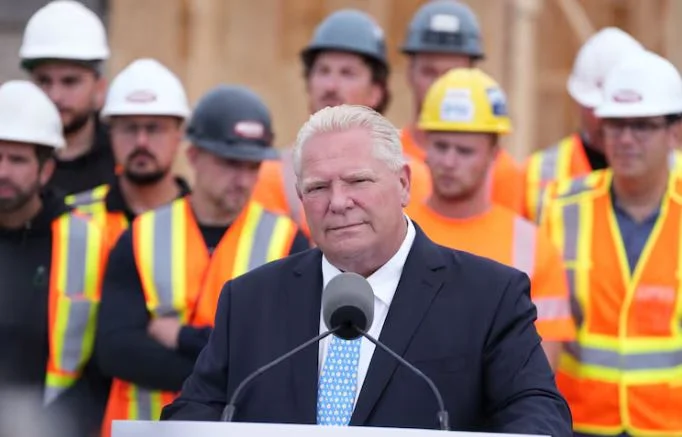
Later, during a press conference in Hamilton, Ford defended his remarks and said his top priority was protecting the jobs and incomes of people in Ontario.
Trump Launches Counterattack
Donald Trump responded on social media, targeting Ford personally. The U.S. president referred to him as “Flunky Ford” and claimed that he was less intelligent and less capable than his late brother, Rob Ford.
Trump also criticized Ford and Prime Minister Mark Carney, questioning their leadership and policies.
In response, Ford described Trump as a dictator and said he would not take advice from someone who had faced multiple business bankruptcies.
Ford Compares Trump to a School Bully
During the press conference, Ford compared Trump’s behavior to that of a school student who intimidates other children and takes their belongings.
Ford said Trump appeared to be someone who would take money from another person’s pocket, steal their hat or take their shoes. He emphasized that Ontario would not bow to intimidation or pressure.
50% Tariffs Take Effect
The exchange comes as the trade dispute between Canada and the United States enters a new phase.
On Saturday, a 50% U.S. tariff came into effect on approximately $28 billion worth of Canadian products. Prime Minister Mark Carney has announced that Canada will impose dollar-for-dollar counter-tariffs on U.S. products beginning September 8.
The situation has placed significant pressure on the strong trade relationship that has existed between the two countries for decades.
Trump Issues New Tariff Threat
Trump indicated on Monday that the trade conflict could escalate further, saying U.S. tariffs on Canadian vehicles, auto parts and steel could reach 50% beginning January 1, 2027.
According to the Canadian government, U.S. tariffs on steel are already at 50%, while vehicles and auto parts currently face a 25% tariff.
Trump has also accused Canada of harming the United States economically and said Washington would continue protecting its interests.
Ford Supports Carney’s Position
Doug Ford has strongly supported Prime Minister Mark Carney’s decision to walk away from recent trade negotiations.
Ford argued that the proposed trade agreement could have harmed Ontario’s steel and automotive industries and that protecting Canadian interests was more important than accepting an unfavorable deal.
He said the government should use “every option” available to respond to Trump’s pressure.
Electricity and Critical Minerals Among Possible Options
The Ontario premier has also taken a tough position on potential retaliatory measures against the United States.
Ford said options including restricting electricity exports to U.S. states and limiting the export of critical minerals could be considered.
Ontario currently supplies electricity to approximately 1.5 million customers in Michigan, New York and Minnesota. Any disruption to electricity exports could therefore have a direct impact on parts of the United States.
Ford Calls for Federal Support
Ford has made it clear that the economic damage caused by the trade war cannot be handled by the provincial government alone.
He has called on the federal government to provide significant financial assistance and introduce changes to business regulations.
According to Ford, federal, provincial and municipal governments will need to work together to minimize the impact of tariffs on industries and employment.
Ontario Expands Business Support Program
The Ontario government has also announced an immediate expansion of its financial assistance program for businesses affected by tariffs.
Ford said the Protect Ontario Financing Program would provide emergency financial support to businesses facing serious difficulties because of U.S. tariffs.
The goal is to provide temporary assistance so affected companies can continue operating and protect workers’ jobs.
Opposition Calls for Provincial Legislature to Reconvene
Meanwhile, Ontario opposition parties have called on Doug Ford to immediately recall the provincial legislature.
Ontario NDP Leader Marit Stiles said the government needs to take immediate practical measures to address the impact of U.S. tariffs.
She has proposed cancelling certain government contracts with U.S. companies and stopping some artificial intelligence data-center projects that could benefit American companies.
Ford Also Faces Criticism
Interim Ontario Liberal Leader John Fraser criticized Ford’s press conference, arguing that strong statements alone do not constitute a complete economic plan.
He called for direct financial assistance and other support for workers who could potentially lose their jobs.
Green Party Leader Mike Schreiner also supported recalling the legislature so all parties could work together to protect Ontario workers and businesses.
The Next Stage of the Trade War
The dispute between the United States and Canada is no longer limited to tariffs. Both countries are exploring new forms of economic pressure, while increasingly personal comments between political leaders have made the situation more sensitive.
Prime Minister Mark Carney is preparing to respond to U.S. tariffs, while Doug Ford is pushing for strong measures to protect Ontario’s industries, jobs and businesses.
If the United States imposes additional tariffs on Canadian vehicles, auto parts and other products from January 1, 2027, Canada could respond with further retaliatory measures. Such an escalation could place additional pressure on North American supply chains, manufacturers and consumers.