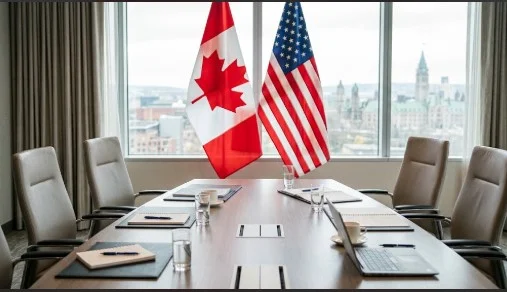
OTTAWA (Web News): Trade tensions between Canada and the United States have intensified once again after Ottawa announced dollar-for-dollar retaliatory tariffs on approximately C$27.6 billion worth of U.S. imports.
The new Canadian tariffs are scheduled to take effect on September 8, 2026, following the collapse of recent trade negotiations between the two countries. The measures come after the United States imposed new tariffs of up to 50 per cent on certain Canadian products.
Canada Announces Retaliatory Measures
The Canadian government said the new tariffs will cover more than 700 U.S. products across several sectors, including steel, aluminum, dairy products, household appliances, agricultural equipment, clothing, seafood, paper products, plastics, electronics and machinery.
The tariffs will range from 15 per cent to 50 per cent, depending on the product. Canadian officials said the measures were designed to match the economic impact of the latest U.S. tariffs while protecting Canadian industries and workers.
Canada’s Finance Minister François-Philippe Champagne said the government’s approach was aimed at creating a level playing field and defending Canadian economic interests.
The latest measures represent another significant escalation in the trade dispute between the two neighbouring countries, whose economies are deeply integrated through cross-border supply chains.
$7.5 Billion Support Package for Businesses and Workers
Alongside the retaliatory tariffs, Ottawa announced a C$7.5 billion support package for Canadian businesses and workers expected to be affected by the trade conflict.
The package includes financial assistance and financing programs designed to help businesses manage cash-flow pressures and other risks resulting from the tariffs.
The federal government is also providing additional support for workers who may face job losses or reduced employment because of the trade dispute.
Some affected businesses will be able to access interest-free financing through the Business Development Bank of Canada (BDC). According to the announced measures, eligible companies could receive loans ranging from approximately C$2.5 million to C$5 million, with repayment deferrals extending for up to 36 months.
The government says the measures are intended to give Canadian companies time to adjust to the changing trade environment.
White House Responds to Canada’s Decision
The latest Canadian announcement comes amid increasingly sharp rhetoric from Washington and Ottawa.
The White House has criticized Canada’s trade policies and accused Ottawa of taking measures that have contributed to longstanding economic tensions between the two countries.
The latest dispute follows the failure of intensive negotiations aimed at reaching an agreement on tariffs and broader trade relations.
Canadian Prime Minister Mark Carney has argued that Canada cannot accept trade conditions that threaten its economic interests or national sovereignty.
The Canadian government has maintained that it remains open to negotiations but wants the United States to treat Canada as an equal trading partner.
Trump Criticizes Mark Carney
U.S. President Donald Trump has also continued to criticize Canadian Prime Minister Mark Carney during the escalating trade dispute.
Trump accused Carney of making misleading statements in an effort to gain political support in Canada.
In another provocative remark, Trump suggested that the United States could consider changing the name of Lake Ontario to “Lake America.”
The comment added to the increasingly confrontational political rhetoric surrounding the trade dispute.
The remarks have attracted attention in both countries as the economic disagreement increasingly becomes intertwined with domestic political issues.
Pierre Poilievre Calls for Lower Taxes
Canada’s Conservative Party Leader Pierre Poilievre has called on the federal government to reduce taxes and ease the financial pressure on Canadian households and businesses.
Poilievre has proposed eliminating the federal fuel tax, reducing the industrial carbon price and removing sales taxes from vehicles manufactured in Canada.
The Conservative leader has argued that Canadian consumers and businesses need immediate relief as the trade dispute creates additional economic uncertainty.
He has also emphasized the need to strengthen Canada’s domestic economy and reduce unnecessary financial pressure on Canadians.
Provinces Encourage Canadians to Buy Canadian
The escalating trade dispute has also prompted provincial leaders to encourage consumers to purchase Canadian-made products.
Manitoba Premier Wab Kinew and British Columbia Premier David Eby have urged Canadians to support domestic businesses and prioritize locally produced goods whenever possible.
Provincial governments say increased demand for Canadian products could help businesses and manufacturers withstand the impact of U.S. tariffs.
The campaign to buy Canadian products has become increasingly prominent as political leaders seek ways to reduce Canada’s economic dependence on the United States.
Why the Trade Dispute Matters
Canada and the United States have one of the world’s most integrated trading relationships. Businesses in both countries depend heavily on cross-border supply chains, particularly in sectors such as manufacturing, agriculture, energy, automobiles and consumer goods.
As a result, prolonged tariffs could affect businesses and consumers on both sides of the border.
Canadian companies importing U.S. products could face higher costs because of the new tariffs, while American manufacturers and exporters could lose access to part of the Canadian market or face reduced demand.
Economists and industry representatives have warned that an extended trade war could also contribute to higher prices and disrupt established supply chains.
Trade Negotiations Remain Critical
The latest measures have increased pressure on both governments to find a negotiated solution.
Ottawa has emphasized that its retaliatory tariffs are intended to defend Canadian interests and encourage Washington to reconsider its approach.
At the same time, Canadian officials have indicated that the door to negotiations remains open.
However, the collapse of the latest talks and the introduction of new tariffs suggest that the dispute could continue for some time.
The future of the Canada-U.S.-Mexico trade relationship could also come under greater pressure if the confrontation continues.
Canada Seeks to Protect Its Economy
The Canadian government’s latest strategy combines retaliatory tariffs with financial support for businesses and workers.
Ottawa is attempting to pressure Washington while limiting the damage to Canadian companies and households.
The government has also encouraged Canadians to support domestic products and businesses as part of a broader effort to strengthen Canada’s economic resilience.
Meanwhile, U.S. officials continue to defend Washington’s trade policies, suggesting that the disagreement between the two countries is unlikely to disappear immediately.
Risk of a Prolonged Trade War
Canada’s announcement marks another major step in the escalating trade conflict with the United States.
With retaliatory tariffs scheduled to take effect on September 8 and billions of dollars in support being made available to affected Canadian businesses and workers, Ottawa is preparing for the possibility that the dispute could continue.
The coming weeks will be critical as both countries assess the economic impact of the new tariffs and determine whether negotiations can resume.
For Canada, the immediate priority is to protect workers, businesses and consumers while maintaining pressure on Washington. For the United States, the dispute could create additional challenges for exporters and industries that rely heavily on access to the Canadian market.
The latest developments underline how quickly the traditionally close economic relationship between Canada and the United States can become strained when trade negotiations break down.
Unless the two sides return to the negotiating table and reach a new agreement, businesses and consumers on both sides of the border could face greater uncertainty in the months ahead.