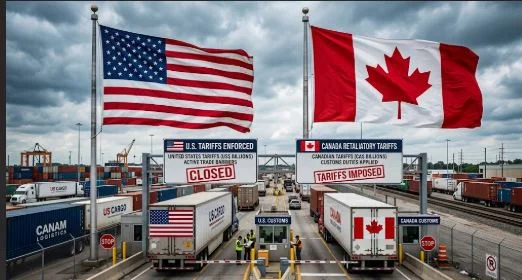
OTTAWA (Web News): Canadian premiers have reacted strongly to U.S. President Donald Trump’s decision to impose tariffs of up to 50 per cent on a significant portion of Canadian imports, with most provincial leaders supporting Ottawa’s decision to retaliate against American goods.
However, Alberta Premier Danielle Smith has adopted a more cautious position than many of her provincial counterparts, warning that a prolonged trade war could create serious economic challenges for Alberta’s farmers, businesses and other industries.
Most Premiers Support Ottawa’s Response
Premiers from most Canadian provinces and territories have expressed concern over the latest U.S. trade measures and supported the federal government’s decision to respond with retaliatory tariffs.
They argue that strong action is necessary to protect Canadian industries, workers and businesses from the impact of heavy U.S. tariffs.
Prime Minister Mark Carney has also made it clear that Canada will respond to American trade measures and will take whatever steps are necessary to protect the country’s economic interests.
Carney’s government has announced that new retaliatory tariffs on U.S. goods will take effect on September 8, 2026.
Alberta Premier Takes a Different Approach
Alberta Premier Danielle Smith, however, has taken a somewhat different approach from several other premiers.
Speaking during her regular radio call-in program, Smith expressed concern about the potential economic consequences of a prolonged trade war.
She specifically highlighted concerns affecting Alberta farmers, furniture manufacturers and beekeepers, warning that the consequences of the trade dispute could extend beyond major corporations and affect smaller businesses and agricultural producers.
Smith’s comments reflect Alberta’s strong economic ties with the United States and the importance of cross-border trade to several sectors of the provincial economy.
Concerns for Alberta Farmers
Agriculture and exports play a major role in Alberta’s economy. Many Canadian agricultural producers depend on access to the U.S. market, making them particularly vulnerable to higher tariffs and disruptions in cross-border trade.
If Canadian products become more expensive in the United States because of tariffs, exporters could face reduced demand and greater difficulty competing with American producers.
Smith has therefore urged both countries to avoid allowing the dispute to escalate further.
She has argued that negotiations would provide a better path forward than continuing to increase tariffs and counter-tariffs.
Call to Resume Negotiations
The Alberta premier has called on Canadian and American negotiators to return to the negotiating table and work toward resolving their trade differences.
Smith has warned that prolonged tariff measures could hurt businesses and consumers in both countries.
Her position is that Canada and the United States have deeply interconnected economies, meaning that a prolonged trade conflict could ultimately create costs on both sides of the border.
The call for renewed negotiations comes after the United States imposed tariffs of up to 50 per cent on Canadian products, while Canada announced retaliatory tariffs covering approximately C$27.6 billion worth of U.S. goods.
The Canadian measures are scheduled to take effect on September 8.
Ottawa Announces Retaliatory Tariffs
Canada’s federal government has targeted a range of American products as part of its response.
The measures include tariffs affecting products such as steel, aluminum, furniture, clothing, seafood, cheese and other American goods.
Ottawa says the objective is to respond to U.S. trade pressure while protecting Canadian businesses and industries from the economic impact of American tariffs.
The federal government has also announced approximately C$7.5 billion in support measures for businesses and workers affected by the trade dispute.
The package includes financial assistance for businesses as well as support for workers who could face employment disruptions because of the escalating trade conflict.
Political Differences Become More Visible
The trade dispute has also highlighted some differences among Canadian provincial governments over how Ottawa should respond to Washington.
While most premiers have supported the federal government’s retaliatory approach, Alberta’s government has placed greater emphasis on the potential economic consequences of an extended trade war and the need to restore negotiations.
The difference does not necessarily represent a complete disagreement with Ottawa’s objectives, but it highlights the varying economic interests of Canada’s provinces.
Alberta’s economy has particularly strong connections with the U.S. market, especially in agriculture, energy and other export-oriented sectors.
Alberta’s Economic Interests
Alberta’s cautious position is closely linked to the province’s economic relationship with the United States.
Thousands of Canadian businesses depend on cross-border trade, while American companies also rely on Canadian products, resources and supply chains.
Any prolonged disruption could increase costs, reduce investment and create uncertainty for businesses planning future operations.
For Alberta’s agricultural sector, the situation could be especially challenging if American tariffs make Canadian products less competitive.
Smith’s call for negotiations therefore reflects concerns that an extended trade war could have consequences far beyond the immediate tariff dispute.
Risk of Further Escalation
The latest developments indicate that the Canada-U.S. trade dispute could enter another difficult phase.
If negotiations are not resumed, additional tariffs and retaliatory measures could be introduced by either side.
Businesses could also face disruptions to supply chains, while consumers could eventually see higher prices for certain imported products.
The economic consequences could extend across manufacturing, agriculture, transportation, retail and other industries that depend on cross-border commerce.
What Happens Next?
The coming weeks will be important for both Canada and the United States.
Ottawa is preparing to implement its retaliatory tariffs on September 8, while provincial leaders are assessing how the trade measures could affect their local economies.
Most Canadian premiers appear prepared to support the federal government’s efforts to protect Canadian economic interests, but Alberta is emphasizing the importance of limiting the damage caused by a prolonged confrontation.
For Premier Danielle Smith, the priority is to ensure that Alberta’s farmers, businesses and workers are protected while encouraging both countries to return to negotiations.
The dispute could ultimately determine the future direction of one of the world’s most important bilateral trading relationships.
For now, Canada and the United States remain locked in a growing trade confrontation, with both sides facing pressure to protect domestic industries while avoiding economic damage caused by an extended tariff war.
The next major question is whether negotiations can resume before the latest retaliatory measures take effect or whether the dispute will continue to escalate.