The True Post (Web News) — U.S. President Donald Trump has signed an executive order directing the name of Lake Ontario to be changed to “Lake America” for official federal use in the United States, adding a new and highly symbolic dimension to the growing political and trade tensions between Washington and Ottawa.
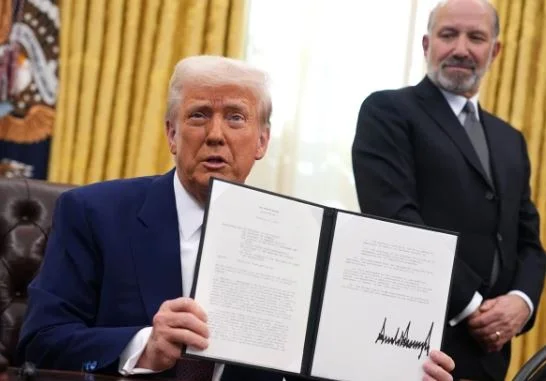
Trump announced the decision Thursday while speaking to reporters in the Oval Office. A map displayed behind the president also showed the lake under the name “Lake America.”
Trump Defends the Name Change
Trump said the decision to rename the lake was something he had been considering for some time.
The president linked the move to his broader criticism of Canada and its relationship with the United States, arguing that Canadian officials have not treated the U.S. fairly.
The executive order directs the U.S. government to use the new name in federal records and official geographic naming systems. However, the order does not require Canada, international organizations or private companies to adopt the new name.
Lake Ontario Will Remain Lake Ontario in Canada
The name change has been rejected by Canadian officials, who have made it clear that Canada will continue to call the body of water Lake Ontario.
Prime Minister Mark Carney emphasized the historical significance of the name and said Canadians would continue using the traditional name.
More than half of Lake Ontario’s surface area is in Canada, while the remainder is located within the United States near New York State.
Mark Carney Rejects the New Name
Carney responded to the announcement by stressing that the lake’s name predates both Canada and the United States as modern nations.
The Canadian prime minister said Canadians know the lake as Lake Ontario and will continue to use that name.
His response reflects Ottawa’s broader position that the name change is a matter for the United States’ federal government and does not alter Canada’s own geographic naming conventions.
New York Governor Says State Will Not Use the Name
The decision also drew a quick response from New York Governor Kathy Hochul.
Hochul said New York would not adopt Trump’s proposed name for the lake.
Lake Ontario borders New York State on the American side, making the issue particularly relevant to state and local authorities as well as the federal government.
Vermont Governor Phil Scott also criticized the move, describing it as disappointing and unnecessary.
Trade Talks Between Canada and U.S. Have Broken Down
The announcement comes at a particularly tense moment in Canada-U.S. relations.
Trade negotiations between the two countries collapsed last week after several days of intensive discussions. Both governments have blamed the other side for the failure to reach an agreement.
Canada has accused U.S. negotiators of making demands that Ottawa considered unacceptable, while American officials have argued that Canada chose not to accept a possible agreement.
The breakdown has added to tensions already created by tariffs imposed by the Trump administration and Canada’s retaliatory trade measures.
Canada Announces Retaliatory Tariffs
Canada has responded to U.S. tariffs with its own targeted measures against American products.
Ottawa has announced tariffs covering more than 700 U.S.-made products, with the measures affecting goods across several sectors.
The Canadian government has also announced a C$7.5 billion support package aimed at helping workers and businesses affected by the trade conflict.
Trump Has Previously Renamed the Gulf of Mexico
The Lake Ontario decision follows Trump’s earlier effort to change the name of the Gulf of Mexico to the Gulf of America for U.S. federal use.
That move also generated international debate over geographic names and whether the United States could impose its preferred terminology beyond its own federal institutions.
The latest order concerning Lake Ontario similarly applies to U.S. federal usage rather than automatically changing the name internationally.
Trump Hints at Possible Ocean Name Changes
Trump also suggested that he could consider renaming major oceans.
Speaking to reporters, he indicated that after changing the names of a gulf and a lake, the Atlantic or Pacific Ocean could potentially become the subject of another naming effort.
The comments have added to the controversy surrounding his administration’s approach to geographic names.
Indigenous Leaders Condemn the Decision
The proposed name change has also drawn criticism from Indigenous representatives.
Wendat Nation Grand Chief Pierre Picard condemned the decision, arguing that the traditional name has historical and cultural significance.
The name Ontario has Indigenous origins, adding another layer to the debate over whether governments should change long-established geographic names for political reasons.
Map Services May Not Follow the U.S. Order
The executive order does not automatically force private mapping companies and international organizations to adopt the new name.
MapQuest, for example, has said it will continue using Lake Ontario rather than changing the name to Lake America.
The response highlights the difference between the U.S. federal government’s official terminology and the names used by private companies, other countries and international institutions.
A New Symbol of Canada-U.S. Tensions
Lake Ontario is one of North America’s five Great Lakes and is shared by Canada and the United States.
The lake has major geographical, economic and cultural importance, particularly for Ontario and New York.
The decision to rename it comes as the two countries remain locked in a broader dispute over tariffs, trade negotiations and economic relations.
For Canada, the lake remains Lake Ontario. For the U.S. federal government, Trump’s order directs agencies to use Lake America.
The dispute over the name is therefore unlikely to change the lake’s physical or international status, but it has become another visible symbol of the increasingly strained relationship between the two neighbouring countries.