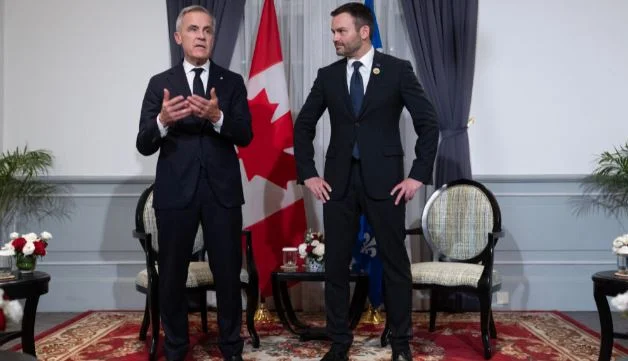
Canadian Prime Minister Mark Carney and Quebec Premier Paul St-Pierre Plamondon have held their first in-person meeting on the sidelines of the Francophonie Summit in Cambodia, discussing key political issues despite weeks of tensions between the federal government and Quebec’s provincial leadership.
The meeting lasted approximately 45 minutes and took place in a friendly atmosphere, raising hopes of improving strained relations between Ottawa and Quebec.
Speaking to reporters afterward, Quebec’s separatist premier described the discussion as pleasant and interesting. He said both leaders shared a sense of humour and enjoyed a relaxed conversation.
The meeting had initially been scheduled for 30 minutes but continued for approximately 45 minutes.
Oxford University Hockey Team Provides a Friendly Start
Before the meeting, the two leaders exchanged light-hearted remarks in front of media cameras, recalling their previous involvement with the Oxford University hockey team.
Both Carney and St-Pierre Plamondon were members of the university’s hockey team during their time at Oxford in the United Kingdom.
Carney jokingly asked the Quebec premier whether he was doing well before laughing and adding that he was not doing well. The remark prompted laughter from both leaders and helped create a relaxed atmosphere ahead of their discussions.
Leaders Agree to Cooperate Despite Political Differences
Following the meeting, Carney said the two governments shared several priorities, particularly addressing homelessness and the financial pressures facing ordinary Canadians due to rising living costs.
St-Pierre Plamondon also thanked Carney for supporting Quebec’s proposal to invite economic ministers from member countries of the Organisation internationale de la Francophonie to Quebec City in 2027.
The Quebec premier said he was willing to cooperate with Carney whenever doing so served the interests of Quebec residents.
The two leaders also exchanged personal phone numbers during the meeting, signalling their willingness to maintain direct communication.
Immigration, Healthcare and US Trade Negotiations Remain Disputed
Despite the positive atmosphere, significant disagreements remain between the federal government and Quebec.
The Quebec government is demanding increased federal financial assistance for healthcare, reduced immigration levels and full compensation for the costs associated with accommodating asylum seekers.
Quebec also wants a more active role in trade negotiations with the United States.
However, Carney maintains that negotiations with Washington must remain under federal government authority, arguing that Canada needs a single representative to speak on behalf of the country.
These disagreements continue to create political friction between Ottawa and Quebec City.
How Tensions Between Ottawa and Quebec Escalated
Relations between the two leaders had become increasingly strained before their meeting in Cambodia.
St-Pierre Plamondon had refused to attend a Canada-European Union summit because he believed he had not been given an opportunity to address guests at the event.
At the time, he made it clear that he would not participate simply for the sake of attending a formal gathering.
Carney subsequently proposed a meeting, but the Quebec premier insisted that it should take place in Quebec City. Carney, citing scheduling commitments, suggested Montreal or Ottawa instead.
Tensions escalated further when St-Pierre Plamondon sent letters to 59 American politicians seeking to ensure that Quebec’s position was represented in the trade dispute between Canada and the United States.
Carney responded by emphasizing that only the federal government had the authority to negotiate with Washington on Canada’s behalf.
In response, the Quebec premier declared that Carney was not his boss, further highlighting the disagreement over political authority and Quebec’s role in international relations.
European Leaders Describe Quebec Independence as an Internal Matter
During the Francophonie Summit, St-Pierre Plamondon also held separate meetings with four political leaders from Europe and Africa.
When Luxembourg’s Deputy Prime Minister Xavier Bettel was asked whether his country would recognize Quebec as an independent state, he avoided commenting directly on the possibility.
Bettel said Canada’s internal political affairs were a matter for Canadians and that he did not wish to interfere.
He also referred to his communications with Canada’s Foreign Affairs Minister Anita Anand.
His comments reflected the cautious approach of international leaders toward Quebec’s independence debate.
Federal and Quebec Disagreements Remain Unresolved
The meeting between Mark Carney and Paul St-Pierre Plamondon carries considerable political significance because relations between Quebec’s separatist leadership and Canada’s federal government can influence national politics, immigration policy, financial arrangements and trade relations with the United States.
The decision by both leaders to establish direct communication represents an effort to keep political dialogue open despite their disagreements.
However, major differences over healthcare funding, immigration levels and authority in international trade negotiations remain unresolved.
For now, the meeting is best viewed as an important step toward restoring communication between Ottawa and Quebec City rather than a resolution of their underlying political disputes.
Whether this improved dialogue leads to practical agreements will depend on how both governments handle their competing priorities in the coming months.