

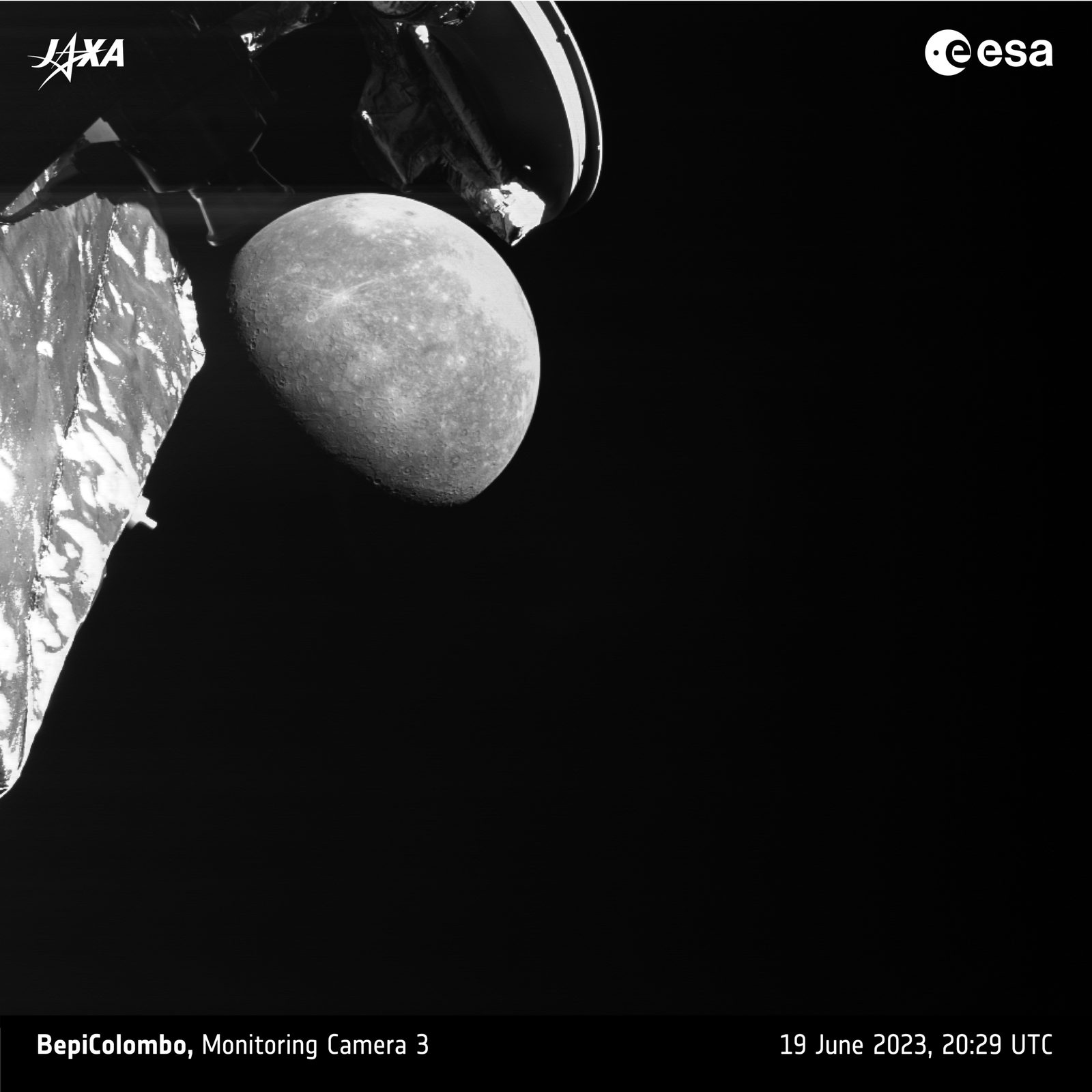
After eight years in space, the European and Japanese BepiColombo mission has finally arrived at Mercury. The spacecraft fired its thrusters on Saturday, 21 November, and was captured by the weak gravity of the smallest planet in the Solar System, ending one of the longest journeys ever flown to another world.
The European Space Agency confirmed the success hours later, after flight controllers in Darmstadt, Germany, pored over telemetry beamed back from about 152 million kilometres away. BepiColombo is only the second mission ever to orbit Mercury, after NASA’s Messenger, and the first spacecraft to visit the planet in more than a decade.
Eight years on the road
BepiColombo launched on 20 October 2018 from Kourou in French Guiana aboard an Ariane 5 rocket. To reach Mercury it flew one flyby of Earth, two of Venus and six of Mercury itself, using each planet’s gravity to slow down and bend its path towards the Sun. The mission cost about 2 billion dollars, or 1.7 billion euros, and is a joint project of the European Space Agency and the Japan Aerospace Exploration Agency.
The spacecraft approached Mercury on its night side and entered an initial elliptical orbit measuring 590 by 11,640 kilometres. Four thrusters on the Mercury Planetary Orbiter fired to slow the stack enough for the planet to capture it.
Two orbiters, one mission
BepiColombo is really two spacecraft flying together. The European Mercury Planetary Orbiter will study the planet’s surface, while Japan’s Mio orbiter will study its magnetic field and how it interacts with the solar wind. The two will separate on 9 and 10 December, making BepiColombo the first mission ever to fly two spacecraft around Mercury at the same time.
The Mercury Planetary Orbiter will then make more burns over the coming months to reach its final science orbit by March 2027. Science operations for both spacecraft are set to begin in April 2027.
What scientists hope to learn
Mercury is barely bigger than the Moon, yet it holds a dense iron core and a global magnetic field, two features scientists still cannot fully explain. Its surface is scarred by impact craters, volcanic plains and mountain ridges rising as high as 4.5 kilometres.
From their separate orbits, the two spacecraft will map the planet’s surface, probe its interior and measure its thin exosphere, building a complete picture of a world shaped by its closeness to the Sun. The mission is named after Italian mathematician Giuseppe Colombo, who worked out how to use gravity assists to reach Mercury in the first place.
For a mission that has waited eight years to begin its real work, the science phase is now only months away.
