
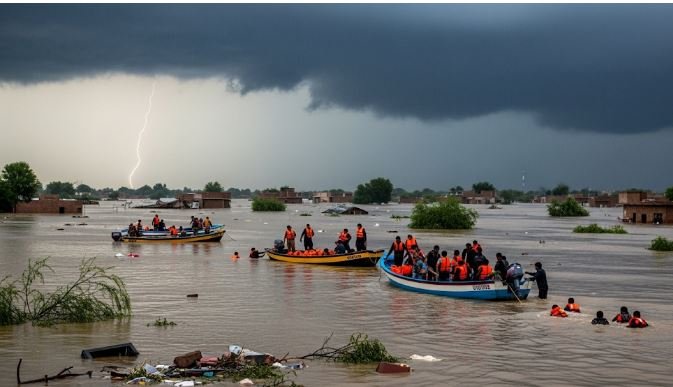
The True Post (Web News)Unprecedented monsoon floods have wreaked havoc across Pakistan’s Punjab province, displacing millions of residents and placing several major districts, including Multan and Kasur, at severe risk. The disaster, which has been described by officials as one of the worst in recent years, has also extended its reach into neighboring Balochistan, further compounding the humanitarian crisis.
According to local authorities, weeks of relentless rainfall have caused rivers and canals to overflow, submerging vast stretches of farmland, washing away homes, and destroying critical infrastructure. Multan, known as the “City of Saints,” is facing one of the gravest threats as water levels in the Chenab River continue to rise. Emergency workers have been deployed to strengthen embankments, but residents fear that the protective barriers may not hold if rainfall persists.
In Kasur, the situation has grown equally dire. Overflowing rivers and flash floods have inundated villages, forcing thousands of families to flee to higher ground. Relief agencies warn that if immediate protective measures are not taken, the historic district could see widespread destruction of property and agricultural land, which would have long-lasting economic repercussions.
Provincial disaster management authorities report that millions of people have been displaced across Punjab, many of them taking shelter in temporary camps set up by the government and aid organizations. Access to clean water, food, and medical assistance remains limited in many flood-hit areas, raising concerns of potential outbreaks of waterborne diseases.
The devastation has not remained confined to Punjab alone. Neighboring Balochistan, already grappling with fragile infrastructure and recurring natural disasters, has also come under the grip of flooding. Several districts have reported washed-out roads, collapsed bridges, and isolated communities cut off from rescue operations. Local officials warn that without immediate federal assistance, relief and recovery efforts in Balochistan could face severe delays.
Humanitarian organizations have sounded the alarm over the magnitude of the crisis. They highlight that the displacement of such a large population not only creates urgent shelter and food requirements but also raises long-term challenges, including loss of livelihoods, destruction of farmland, and damage to schools and health facilities.
Experts link the increasing intensity of seasonal floods in Pakistan to climate change, pointing out that rising global temperatures have amplified extreme weather patterns. Pakistan, despite contributing minimally to global carbon emissions, remains one of the most vulnerable countries to climate-induced disasters.
In response to the disaster, the provincial government in Punjab has declared an emergency in the hardest-hit districts. Rescue teams, including military personnel, have been mobilized to carry out evacuations, distribute food supplies, and provide medical relief. Boats and helicopters are being used to reach stranded populations in areas where road access has been completely severed.
Prime Ministerial aides have urged international donors to step in, noting that the sheer scale of displacement requires resources beyond what the provincial and federal governments can immediately provide. Officials have also emphasized the urgent need for long-term investments in flood-management systems, early warning networks, and climate-resilient infrastructure to prevent future catastrophes of this scale.
For now, however, millions of displaced families remain in desperate need of shelter and assistance. With water levels showing no signs of receding in many parts of Punjab and Balochistan, the humanitarian crisis is expected to worsen in the coming weeks, unless rapid and coordinated relief efforts are implemented.