Muhammad Amanullah — September 7, 2026
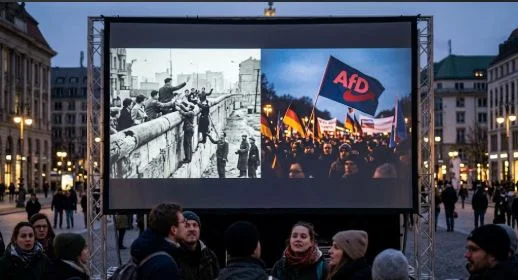
Sixty-five years after the construction of the Berlin Wall, Germany is once again facing deep political and social divisions, with the growing influence of the far-right Alternative for Germany (AfD) party in the country’s former eastern states raising fresh questions about national unity and the future of democracy.
The political landscape has revived memories of Germany’s Cold War division, even though today’s divisions are political and ideological rather than geographical.
The Morning of August 13, 1961
On August 13, 1961, more than 10,000 police officers and military personnel began constructing the Berlin Wall, a barrier that rapidly divided Berlin and symbolised the broader division of Germany into East and West.
The wall separated streets, neighbourhoods, families and friends, while East Germany followed a communist system and West Germany developed under a democratic political order.
For millions of Germans, the wall became one of the most visible symbols of the Cold War.
A Wall That Stood for 28 Years
The Berlin Wall remained in place for 28 years. At least 140 people died in connection with attempts to cross the wall, including people trying to flee East Germany, passers-by and border guards.
Its fall in 1989 paved the way for German reunification.
Yet, decades after reunification, significant political, economic and social differences between eastern and western Germany have remained.
A Family Left Behind in the East
Hartmut Richter, who witnessed the early days of the Berlin Wall, recalled that his family was trapped in East Germany when construction began.
According to Richter, nobody at the time imagined that the wall would remain standing for nearly three decades.
In 1966, Richter managed to escape from East Germany to West Berlin by swimming across a partially frozen river.
He later helped another 33 people escape from East Germany by hiding them in the boot of his car, putting his own life at considerable risk.
A Renewed Concern for Freedom
Sixty-five years later, Richter views his experiences not simply as memories of the past but as a warning for the future.
He has expressed concern about the future of freedom in Germany, arguing that the country is once again facing a political crossroads where democratic freedoms and social cohesion could come under pressure.
The concerns have gained renewed attention amid the rise of the AfD, particularly in areas of the former East Germany.
AfD’s Historic Rise
The growing popularity of the Alternative for Germany has become one of the most significant developments in Germany’s contemporary political landscape.
Analysts say the party has successfully turned long-standing grievances and feelings of disadvantage in parts of eastern Germany into political support.
The AfD has sought to portray itself as a defender of eastern German identity and the interests of people who believe they have not benefited equally from reunification.
The Impact of Economic Disadvantage
Research into voting patterns has identified economic difficulties, demographic changes and a longstanding sense of collective disadvantage among some of the factors contributing to the AfD’s popularity in eastern Germany.
Support for the party has been particularly strong in some rural areas and regions with ageing populations.
Political observers say that despite German reunification, some residents of eastern states continue to feel politically and economically overlooked compared with their counterparts in western Germany.
The issue is therefore not simply about current politics but also about how people in the former East perceive the legacy of reunification.
A Major Test in Saxony-Anhalt
Elections in Saxony-Anhalt, a former East German state, have been regarded as an important political test for the AfD.
Ahead of the election, opinion polls showed strong support for the party, raising concerns that it could potentially move closer to forming a far-right government at the state level.
At the national level, the AfD has also recorded growing support and has been ranked among Germany’s most popular political parties in opinion surveys.
Such developments have increased debate over whether Germany’s political mainstream can contain the rise of the far right through democratic competition.
Hard-Line Position on Immigration
The AfD’s political programme places strong emphasis on nationalist social policies and tougher measures on immigration.
The party has also backed proposals that critics regard as conflicting with European Union principles and policies, including suggestions involving separate schools for children of migrants.
The party promotes what it describes as traditional family values and has opposed the promotion of modern and non-traditional lifestyles.
Its immigration policies have made the party a particularly controversial force in German politics.
Calls for Deportations
Some AfD politicians and policy proposals have supported large-scale deportations and tougher measures against people with non-German backgrounds.
The party has also advocated what it describes as a “patriotic cultural policy” and has called for restrictions on public funding for projects it considers inconsistent with national interests.
Critics argue that some of these positions risk deepening social divisions, while AfD supporters maintain that the party is responding to concerns over immigration, national identity and public security.
The Shadow of Germany’s Nazi Past
Germany’s Nazi past continues to have a profound influence on its political culture.
As a result, the growing strength of far-right political movements is viewed with particular sensitivity.
Björn Höcke, the AfD’s leader in Thuringia, has faced fines from German courts on two occasions over the use of a banned slogan associated with the Nazi era.
In another legal ruling, a German court found that describing Höcke as a fascist was not, in the circumstances of that case, defamatory.
The controversies surrounding Höcke have further intensified debate over the AfD’s relationship with Germany’s far-right history.
Could Germany Face a New Form of Division?
Political analyst Justus Bender has described the situation as a bitter irony: Germany spent decades working to reunite the country after its division into East and West, yet a political force has emerged that critics accuse of deepening divisions within German society.
The current divisions are fundamentally different from those created by the Berlin Wall. There is no physical barrier separating Germans today, but disagreements over immigration, national identity, economic inequality and the direction of democracy have created increasingly sharp political fault lines.
Sixty-five years after the construction of the Berlin Wall, the central question for Germany is whether the country is moving from its historic geographical division towards a new period of political and ideological fragmentation — or whether its democratic institutions will prove strong enough to manage the growing disagreements while preserving national cohesion.