Muhammad Amanullah | August 13, 2026
The True Post (News Desk) — Crude oil prices fell by more than $1 in global markets, as investors focused on expectations of weaker global oil demand and the potential economic impact of the ongoing war and tensions in the Middle East.
Market uncertainty has prompted investors to adopt a cautious approach, while analysts warn that a potential slowdown in global economic activity could weigh on oil demand. At the same time, the ongoing conflict involving the United States, Israel and Iran has raised fresh concerns about global energy supplies.
Brent Crude Prices Decline
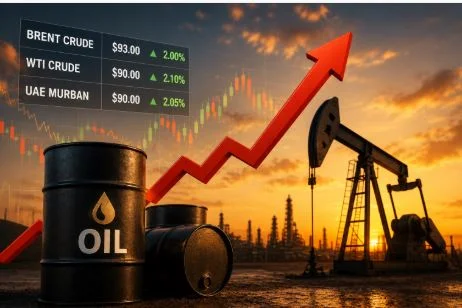
According to Reuters, the global benchmark Brent crude price fell $1.29, or 1.5%, to $87.69 per barrel.
Brent crude is considered a key benchmark for global oil pricing, meaning changes in its price can have an impact on energy markets around the world.
U.S. Oil Also Falls
The price of U.S. crude oil, known as West Texas Intermediate (WTI), also declined.
WTI fell $1.30, or 1.6%, to $81.97 per barrel.
The simultaneous decline in Brent and WTI suggests that global investors are currently taking a cautious view of future oil demand and the broader economic outlook.
Concerns Over Falling Demand
Analysts say one of the major factors behind the recent decline in oil prices is a weaker outlook for global oil demand.
Various institutions and market analysts have revised their forecasts for global oil demand in 2026.
Concerns about a potential slowdown in the global economy, weaker trade activity and continuing tensions in the Middle East have raised fears that industrial and economic activity could be affected.
If global economic growth slows more than expected, energy consumption in industries, transportation and other sectors could also decline, putting additional pressure on oil demand.
No Major Progress in U.S.-Iran Talks
Meanwhile, there has been no clear breakthrough in negotiations between the United States and Iran.
Major disagreements remain between the two countries, leaving global investors uncertain about the future of energy markets.
Any further escalation in tensions between the United States and Iran could have a direct impact on global energy markets, while progress in negotiations could provide a more positive signal for oil markets.
All Eyes on the Strait of Hormuz
Amid continuing tensions in the Middle East, global oil markets are also closely watching the Strait of Hormuz.
The waterway is one of the world’s most important energy routes, with a significant volume of oil from the Gulf region transported through it to international markets.
Any disruption or significant reduction in shipping through the Strait of Hormuz could affect global oil supplies.
For this reason, investors are closely monitoring developments in the Middle East and preparing for potential volatility in oil prices.
War Creates Market Uncertainty
The ongoing conflict involving the United States, Israel and Iran has created several new risks for the global economy.
If the conflict continues for an extended period, pressure could increase on global trade, shipping, energy transportation and investment.
On one side, the possibility of supply disruptions caused by the conflict is supporting oil prices. On the other, expectations of weaker global demand are putting downward pressure on prices.
This combination has made it difficult for the global oil market to establish a clear direction.
Why Has a Bigger Price Decline Been Limited?
Although concerns about weaker global demand have pushed crude prices lower, tensions in the Middle East have limited the possibility of a much larger decline.
Investors remain concerned that if the conflict expands or oil shipments through the Strait of Hormuz are disrupted, the global market could face a supply shortage.
In such a situation, even weaker demand could be outweighed by a sharp reduction in supply, potentially sending oil prices significantly higher again.
Impact on the Global Economy
Lower oil prices could have some positive effects on the global economy.
If crude oil remains cheaper for an extended period, fuel and energy costs could decline, potentially helping reduce inflationary pressures in some countries.
However, if falling oil prices are primarily the result of a significant weakening in global demand and economic activity, they could also be a warning sign for the global economy.
What Happens Next?
Analysts say several major factors will determine the direction of oil prices in the coming days.
These include:
- Progress in U.S.-Iran negotiations
- The situation surrounding the Middle East conflict
- Oil shipments through the Strait of Hormuz
- Global economic activity
- New oil supply and demand data
If negotiations between the United States and Iran make progress and regional tensions ease, concerns over supply disruptions could decline.
On the other hand, further escalation of the conflict or a major disruption in the Strait of Hormuz could trigger another sharp rise in oil prices.
For now, concerns about weaker demand and the possibility of supply disruptions are pulling the global oil market in opposite directions, making the coming days particularly important for the international energy market.