Muhammad Amanullah
Date: October 14, 2026
The True Post (Web News) —
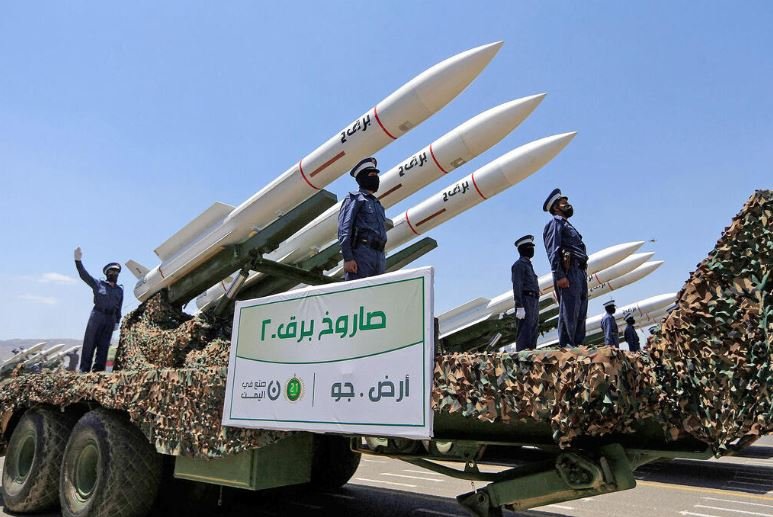
Yemen’s Houthi movement is reportedly attempting to develop an advanced medium-range ballistic missile, raising concerns about the group’s growing military capabilities and the potential implications for security across the Middle East.
According to a report by The Wall Street Journal, Houthi fighters are attempting to build a missile using components obtained from a Chinese supplier.
If the project succeeds, it could expand the group’s missile capabilities and increase security concerns across the region. However, the available information does not establish that the Houthis have completed the proposed missile or demonstrated its operational performance.
Chinese Components
According to The Wall Street Journal, the investigation was examined by Conflict Armament Research, an organisation that documents and investigates weapons supplies and arms used in conflicts.
The organisation’s research reportedly found that the Houthis had obtained various components from a Chinese supplier. These components could potentially be used to develop a missile modelled on Iran’s advanced Kheibar Shekan ballistic missile.
The report discusses the nature of the components and their possible role in missile production. However, the information presented does not confirm that the Houthis have successfully assembled a complete missile based on this design.
The key concern is the group’s reported effort to expand its missile-building capabilities through components sourced from abroad. If successful, the project could represent a significant development in the Houthis’ military capabilities.
At the same time, the acquisition of components does not, by itself, establish that a complete weapon has been produced, tested or deployed.
Potential Missile Range
The report suggests that the proposed Houthi missile could have a range of approximately 1,200 miles, equivalent to about 1,930 kilometres.
A missile with that potential range could reach targets considerably farther away than those accessible to shorter-range systems. However, its actual range would depend on the final design and operational capabilities, neither of which has been independently established in the information presented.
Iran’s Kheibar Shekan is described as a precision-guided ballistic missile. The report draws a comparison between that Iranian system and the missile the Houthis are reportedly attempting to develop.
That comparison should not be interpreted as confirmation that the proposed Houthi missile would have the same range, accuracy or overall performance as the Iranian weapon.
The available reporting does not provide confirmation of a successful test or verified details about the proposed missile’s operational capabilities.
Potential Threat to Saudi Arabia and Israel
According to the report, if the Houthis successfully develop a missile capable of travelling approximately 1,930 kilometres, the entire territory of Saudi Arabia could potentially fall within its range.
Israel could also potentially be within reach of such a system, raising concerns about the possible consequences for an already complex regional security environment.
The Houthi movement has previously drawn international attention for its military activities and missile attacks in the Middle East. The development of a longer-range ballistic missile could prompt renewed questions about the group’s ability to threaten targets beyond Yemen and neighbouring areas.
However, a country being within the potential range of a missile does not mean that an attack will necessarily take place. Any assessment of the threat would depend on the weapon’s verified capabilities, its eventual deployment, the intentions of those controlling it and the wider regional circumstances.
Until the missile’s development and performance are independently confirmed, the potential threat should be distinguished from a demonstrated operational capability.
The Connection With Iran
The Houthi movement is widely described as an Iran-aligned group. The reported comparison between its proposed missile and Iran’s Kheibar Shekan has therefore added another dimension to discussions about military capabilities among Iran and its regional partners.
If the reported project progresses, it could intensify scrutiny of the weapons and technologies available to the Houthis and the extent of their external supply networks.
However, the information described in the report does not fully establish Iran’s direct involvement in this particular missile project.
It is also unclear how much technical assistance the Houthis may have received in developing the proposed system. Further verified information would be needed to establish the extent of any outside involvement.
The distinction is important because the use of a design associated with an Iranian missile does not, on its own, prove that Iran directly designed, supplied or supervised the development of the proposed Houthi weapon.
Chinese Government’s Role Remains Unclear
The report refers to components obtained from a Chinese supplier. However, it does not establish that the Chinese government played an official role in supplying those components.
Information about a private or commercial supplier should not automatically be interpreted as evidence of direct government assistance. Establishing official involvement would require separate supporting evidence.
The available reporting also does not clearly identify the precise stage the Houthis have reached in developing the missile. Nor does it confirm a successful test or operational deployment of the proposed weapon.
These gaps leave important questions unanswered about the project’s progress, the reliability of the estimated range and the extent of any external technical support.
What It Could Mean for Regional Security
The reported effort highlights concerns about the Houthis’ attempts to expand their missile capabilities and their possible use of components sourced through international supply networks.
If the project is completed and the missile performs as estimated, it could have implications for the security calculations of Saudi Arabia, Israel and other countries in the region.
For now, however, the distinction between a reported development programme and a verified operational weapon remains crucial.
The report points to a potential change in the Houthis’ military capabilities, but confirmation of the missile’s completion, performance and deployment would be needed before its practical threat could be assessed with greater certainty.