Muhammad Amanullah | The True Post
JERUSALEM: Israel’s general election has emerged as a crucial test for Prime Minister Benjamin Netanyahu, with a closely contested political battle expected between his governing bloc and opposition forces.
The election could determine whether Netanyahu secures another opportunity to form a government or whether opposition parties can gather sufficient parliamentary support to bring about a change in leadership.
Public opinion polling has indicated a competitive political landscape, making coalition-building and parliamentary arithmetic central to the outcome.
Voting Schedule and Parliamentary Majority
According to the supplied report, polling is scheduled to begin at 7 a.m. and close at 10 p.m. local time in Israel. The corresponding voting hours in Pakistan would be 10 a.m. to 1 a.m. the following day.
Israel’s parliament, known as the Knesset, has 120 seats. A government generally needs the support of at least 61 lawmakers to command a parliamentary majority.
Under Israel’s parliamentary system, winning the largest number of seats does not automatically guarantee the formation of a government. Political parties must secure sufficient support from other lawmakers or coalition partners to establish a governing majority.
Consequently, negotiations between political parties could become decisive if neither major political bloc secures enough support to form a government independently.
Opposition Seeks to Challenge Netanyahu
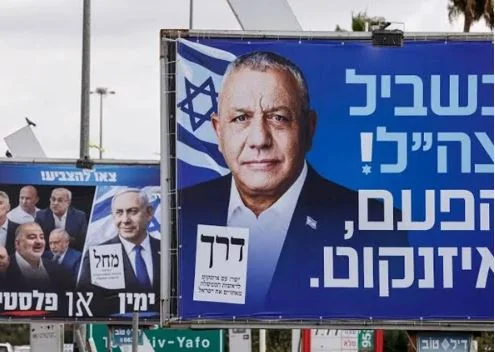
Opposition figures, including former military chief Gadi Eisenkot and former prime minister Naftali Bennett, have featured prominently in discussions about a potential challenge to Netanyahu’s political dominance.
Opposition parties are seeking to attract voters dissatisfied with the current government’s performance and strengthen their parliamentary position.
However, differences between opposition groups could complicate efforts to form a united governing coalition. Their ability to agree on leadership, policy priorities, and coalition arrangements may prove as important as their combined electoral support.
For Netanyahu, the challenge extends beyond winning votes. He must also secure the backing of enough political allies to form a government.
If his political bloc falls short of the required parliamentary majority, negotiations with other parties could become necessary. Opposition groups would face a similar challenge in attempting to assemble an alternative coalition.
War and Security Issues Shape the Political Debate
The October 7, 2023, attacks and the subsequent conflict have significantly influenced Israel’s political environment.
National security, military strategy, and the government’s handling of the conflict remain important subjects of public debate.
Netanyahu’s government has faced criticism over its security and wartime decisions, while his supporters have defended its approach as necessary to protect Israel’s national interests.
The prolonged conflict, economic pressures, and domestic political divisions have added further complexity to the election debate.
The next government will face difficult decisions involving national security, military policy, regional diplomacy, and the management of domestic disagreements.
Iran Policy Remains a Major Concern
Israel’s approach towards Iran is another significant issue in the country’s political debate.
Tensions between Israel and Iran, concerns about regional security, and the possibility of further military escalation could influence the next government’s priorities.
Netanyahu’s political position and the views of parties joining a future coalition may shape how Israel approaches these challenges.
However, the election result alone will not necessarily determine an immediate change in policy. Coalition agreements, security developments, and regional diplomatic considerations will also influence future decisions.
Coalition Negotiations Could Determine the Outcome
Once voting concludes and the results are counted, attention will turn to the number of seats secured by each party and the potential coalitions that could command a parliamentary majority.
Smaller parties may play a decisive role if neither major bloc secures sufficient support on its own.
In such circumstances, negotiations could take considerable time as political groups seek agreement on cabinet positions, policy commitments, and the distribution of government responsibilities.
The outcome could therefore depend not only on the election results but also on the willingness of different parties to cooperate after voting ends.
What the Election Means for Israel and the Middle East
The election has implications extending beyond Israel’s domestic political landscape.
The formation of a new government could influence the country’s security strategy, its approach towards Iran, and its broader position on regional conflicts and diplomacy.
For Netanyahu, the election represents a major test of political support and his ability to maintain or rebuild a governing coalition.
For the opposition, the challenge is to turn electoral support into a viable parliamentary majority.
The final political picture will become clearer once official results are available and the process of forming a government advances.