The True Post(Web News) Flood waters have gradually begun to recede in some areas of the Canadian province of British Columbia (BC).
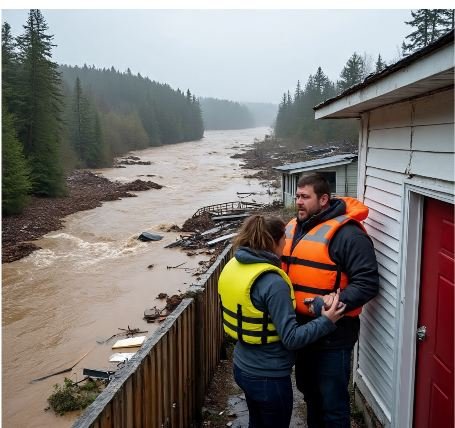
However, officials have warned that the threat remains as the Fraser Valley has already been drenched by heavy rains and more rain is forecast in the coming days. According to the city of Abbotsford, some residential areas saw “clear improvement” on Saturday, but the Nooksack River from Washington State is still flowing north, causing flooding earlier in the week. Several secondary roads are still under water, while the Trans-Canada Highway is completely closed, cutting off the fastest land route between Metro Vancouver and the rest of Canada.
The city government clarified that “there is currently no safe route to eastern B.C. via Abbotsford and Chilliwack,” and also warned that online maps are showing incorrect information about road closures. Emergency Infobee also confirmed that Highway 1 remains closed and drivers are strongly advised not to attempt to cross barriers or take side roads, as many roads are still submerged. “Driving in flood zones poses a serious risk to human life,” according to the agency.
Casualties and accidents
Various accidents have occurred during the flooding caused by the Atmospheric River. According to Abbotsford police, a vehicle overturned in a water-filled ditch on Huntingdon Road on Saturday morning, resulting in the sole occupant of the vehicle not being able to survive. Rescue workers tried to extricate him, but he died at the scene. Parts of the road remain closed while the investigation continues.
Evacuations and emergency measures
So far, about 450 properties have been evacuated across the province due to flooding, the majority of which are located in Abbotsford, while another 1,700 properties are on evacuation alert. According to B.C. Emergency Management Minister Kelly Green, the situation is being monitored continuously.
— Bitter memories of 2021 fresh
For long-time Fraser Valley residents, the scenes are bringing back bitter memories of the devastating floods of 2021. Cindy Brown, a resident of Delier Park, Abbotsford, said that when she returned home on Thursday night, she saw Highway One submerged in water and couldn’t help but say: “Oh my God, it’s all the same again!” She said that this time the situation was not as severe as in 2021, but the speed of the water rise was alarming and she had no idea how long it would take for it to completely subside.
More rain and landslides expected
More rain is expected on Sunday, according to Environment and Climate Change Canada, while another “significant wave” of moisture is likely on Monday and early next week. The department has warned that the risk of landslides has also increased due to excessive soil moisture. Chilliwack Mayor Ken Popov said sensitive areas are being continuously monitored, especially in places where landslides have occurred in the past. He said evacuation notices have been issued in the Marble Hill area due to the risk of debris flows, while an evacuation alert has been issued in a small area near Patterson Road.
The problem is linked to climate change.
According to experts, these floods are part of a larger trend emerging as a result of climate change. Tara Martin, a professor and environmental conservation expert at the University of British Columbia, says that research shows that floods in this region will now occur more frequently and more intensely. According to her, “Climate change is increasing the amount of rainfall and air currents have become more common, which causes water to flow into rivers faster. Areas like the Sumas Prairie are particularly vulnerable.” She said that water has to go somewhere, and in the current conditions it spreads back to the same low-lying areas.
Tara Martin suggested that governments should consider planned relocation of people from areas at high risk of flooding. According to her, the purchase of affected properties could cost about $1 billion, while new dikes and pumping infrastructure could cost more than $2 billion, although there is no guarantee of success.
Agriculture and dairy farms also affected
The floods have also affected businesses across the province, especially the agricultural sector. BC Dairy Board Chairman Casey Perron said that water levels are now stabilizing on affected farms, but cleanup and restoration will take a long time. He said farmers are frustrated that safety infrastructure has not improved significantly since 2021. However, according to him, most livestock remained safe and milk deliveries were continuing with the support of local governments and emergency agencies.
Instructions for the public
The BC River Forecast Centre has issued a high stream flow advisory for all coastal areas of the province. Officials have appealed to the public to stay away from fast-flowing rivers, unstable banks and flooded roads and to get the latest information before traveling, as conditions can change quickly.