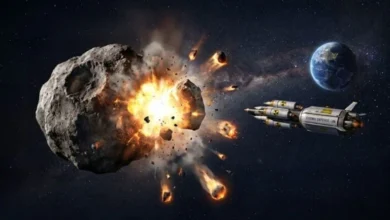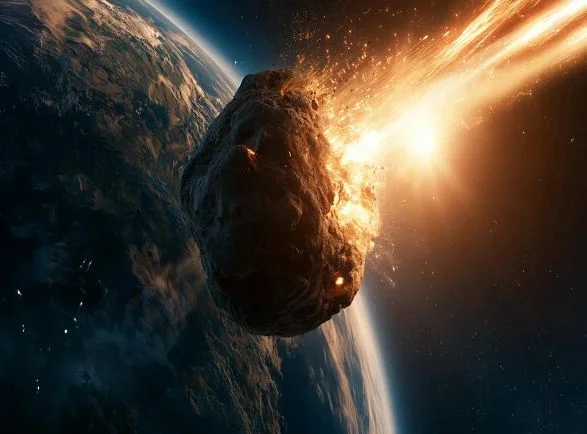
A nuclear explosion could potentially be used to change the course of a dangerous asteroid heading towards Earth, according to new scientific research. However, scientists have found that the effectiveness of this approach may depend heavily on the direction from which the asteroid is exposed to the explosion’s energy.
The findings offer fresh insight into a possible future planetary defence strategy designed to reduce the threat posed by potentially hazardous space objects.
X-Rays Could Alter an Asteroid’s Trajectory
According to the research, powerful X-rays released by a nuclear explosion could rapidly heat an asteroid’s surface, causing material to vaporise and eject into space.
The escaping material could generate a recoil effect, pushing the asteroid and changing its speed and trajectory. If applied under carefully controlled conditions, this process could potentially help move a threatening space object away from a collision course with Earth.
Scientists believe the approach could become part of future efforts to protect the planet from dangerous asteroid impacts.
Direction of Radiation Produces a Fivefold Difference
A study published in the scientific journal Icarus found that exposing the same asteroid to X-ray radiation from different directions can produce significantly different changes in its movement.
During computer simulations, radiation applied from one direction changed the asteroid’s speed by 3.9 millimetres per second. When the radiation was directed from another angle, the change was only 0.8 millimetres per second.
This represents an approximately fivefold difference, highlighting how crucial the direction of energy delivery could be when attempting to deflect an asteroid.
Asteroid Shape Also Plays an Important Role
The research also highlights the importance of an asteroid’s physical structure. Computer simulations often represent asteroids as smooth, spherical objects, but actual asteroids typically have irregular shapes and uneven surfaces.
These physical characteristics can influence how radiation interacts with an asteroid and how much material is ejected from its surface. As a result, the object’s shape could significantly affect the force generated and the resulting change in its trajectory.
Nathan Moore, a physicist at Sandia National Laboratories who led the research, said scientists had already expected the direction of the radiation to matter. However, the scale of the difference observed in the results was surprising.
Potential Implications for Planetary Defence
Researchers say the findings could help scientists develop more effective technologies for defending Earth against potentially hazardous asteroids.
Although the approach remains a subject of scientific investigation, understanding how radiation direction, surface structure and material ejection affect an asteroid’s movement could improve future planetary defence models.
The research highlights the importance of detailed simulations and further studies before such a method could be considered a practical option for protecting Earth from an asteroid impact.