The True Post(Web News) The United States has presented a 28-point peace plan to Ukraine, with a deadline of November 27 for its acceptance.
Not just a proposal, but a major test of global diplomacy, principled politics, and international order. The plan has not only put Ukraine under unprecedented pressure, but has also raised serious questions about the role and priorities of global powers. US President Donald Trump’s plan — developed jointly by Washington and Moscow — effectively reinforces several long-standing Kremlin demands. It includes a provision recognizing some Ukrainian regions as “de facto Russian,” which directly contradicts the UN’s founding principles of state sovereignty and territorial integrity.
Ukrainian President Volodymyr Zelensky has rightly called it one of the “most difficult moments” in his country’s history. The choice before him is either to anger his key partner, the United States, or to pay the price for his national sovereignty — a decision that will likely be felt for generations to come.
Peace at what cost?
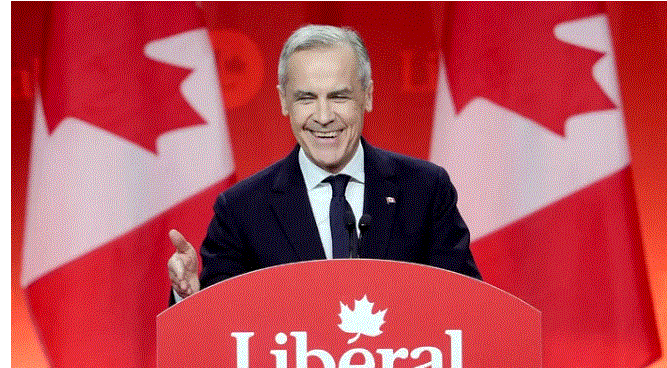
If the condition for peace is to quietly cede parts of a state to another power, then it is not peace, but a decision of force. Canadian Prime Minister Mark Carney and 12 other world leaders have rightly expressed reservations about the plan. They say that borders cannot be changed “by force.” Moreover, the plan’s proposal to limit Ukraine’s military capabilities poses a serious threat to the future — a disarmed Ukraine will always be a weak Ukraine. Principles are often weak in world politics, but the current situation strongly demands that major powers not make international law dependent on their short-term strategies. If today the desire of a powerful country is fulfilled at the expense of Ukraine, tomorrow another country may fall victim to the same pressure. The words of Canadian Foreign Minister Anita Anand are very important in this context. If the world truly believes in the rule of law and state sovereignty as a matter of principle, then Ukraine’s future should be decided by Ukraine alone—and not under pressure or bargaining from any external power.
This time is also a test for the international community. Will it give up on principles by calling this project “peace”? Or will it stand for a world where weak states are not victims of the will of a great power? The path to peace is certainly necessary, but this path must pass through justice and equality. Power politics-based projects cannot bring lasting peace. Ukraine’s issue is not today’s—it is a matter of the global future. The G20 leaders must face this crisis with courage, principle, and impartial thinking—because if principles are broken today, tomorrow’s borders will be even weaker.