Muhammad Amanullah — August 18, 2026
THE TRUE POST (Web News) — Canada has announced a major investment package worth nearly $70 billion for the Churchill Falls and other power projects in Labrador, describing it as the largest clean-energy investment in the history of North America.
$10 Billion in Federal Financing
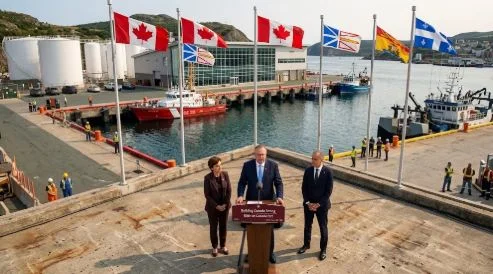
Prime Minister Mark Carney announced the new agreement Monday in St. John’s alongside Newfoundland and Labrador Premier Tony Wakeham and Quebec Premier Christine Fréchette.
The federal government will provide $10 billion in financing to modernize the Churchill Falls generating station and increase its power-generation capacity. The package also includes the Gull Island hydroelectric project, the construction of new transmission lines and a 2,000-megawatt onshore wind-energy project in Labrador. The location and other details of the wind project are still being considered.
Electricity Generation Could Nearly Triple
According to the federal government, the combined value of the projects is approximately $70 billion. Once completed, the projects are expected to nearly triple Churchill Falls’ current electricity-generation capacity.
Prime Minister Carney said the expanded Churchill Falls facilities could produce approximately 14,000 megawatts of renewable energy.
He said this would be more than the total generating capacity of BC Hydro and more than twice the output of Bruce Power, North America’s largest nuclear power facility. Carney said the amount of electricity would be enough to power, heat and cool all the homes in Toronto, Montreal and Vancouver.
Read Also:
23,000 Jobs Expected
The government estimates that approximately 23,000 jobs will be created through the construction and development of the projects.
The investment is expected to increase electricity generation while also supporting infrastructure, transmission and renewable-energy development in Labrador.
The provincial government hopes the new projects will generate additional revenue from natural resources, particularly as Newfoundland and Labrador continues to face significant debt pressures.
Relief for Electricity Consumers
A major part of the agreement involves reducing electricity costs for consumers.
Electricity customers across Newfoundland and Labrador will receive a new 15 percent discount on the first 2,000 kilowatt-hours of electricity used each month.
Premier Tony Wakeham said the measure could save an average household approximately $351 per year.
Major Benefits for Quebec
The new agreement will also provide Quebec with an additional and reliable source of electricity.
Quebec has long been connected to the Churchill River hydroelectric projects, and the latest agreement is intended to take the energy relationship between the two provinces into a new phase.
Under the agreement, Newfoundland and Labrador will receive guaranteed access to 985 megawatts of transmission capacity through Quebec.
This means the province will be able to move that amount of Churchill River electricity through Quebec’s transmission network to other markets.
Potential to Sell Electricity to U.S. States
The new transmission access could also give Newfoundland and Labrador an opportunity to reach U.S. electricity markets in the future.
For example, if Massachusetts or New York requires additional electricity, Newfoundland and Labrador could potentially sell some of its generated power to those markets through Quebec’s transmission system.
According to the provincial government, this represents a major change from the previous agreement because the 2024 memorandum of understanding did not provide Newfoundland and Labrador with a clear guarantee of transmission access.
Criticism of the Old Agreement
The original 1969 Churchill Falls agreement has faced criticism in Newfoundland and Labrador for decades.
There has long been a perception in the province that the agreement was more beneficial to Quebec and that Newfoundland and Labrador did not receive a fair financial return from its natural resources.
Premier Tony Wakeham described the new agreement as a historic achievement for the province, saying local residents will now be able to benefit more from their resources.
He said people in Newfoundland and Labrador will have greater control over how their electricity is used and how much of it can be sold to external markets.
Major Change From the 2024 Agreement
The new interim agreement also represents a significant financial change compared with the 2024 memorandum of understanding.
According to Newfoundland and Labrador Hydro, the net present value of the agreement for the province has increased to $49 billion, compared with the $36 billion estimated under the 2024 agreement.
The current interim agreement will remain in effect until March 31, 2027. However, both sides could agree to change the timeline or sign a final agreement before then.
Political Changes Could Affect the Agreement
The future of the agreement could also be affected by Quebec’s upcoming election.
If the government in Quebec changes, a new administration could take a different position on the agreement.
Despite this possibility, Wakeham described the current agreement as beneficial to all three parties. He said it would provide Newfoundland and Labrador with more electricity, greater financial benefits and increased transmission access.
Special Legislative Session Instead of Referendum
During last year’s election campaign, Tony Wakeham had promised to hold a public referendum on the new Churchill Falls agreement.
However, on Monday he announced that instead of a referendum, a special session of the provincial legislature would be held on September 14.
The session will provide an opportunity for political debate and allow provincial representatives to express their views on the new agreement.
Hope for a New Era
Wakeham said the focus should not be on tearing up old agreements or repeating the past, but on building the future.
The expansion of Churchill Falls, the Gull Island hydroelectric project, new transmission lines and the proposed wind-energy project could play an important role in Canada’s clean-energy future.
If the projects move forward as planned, Newfoundland and Labrador could generate greater revenue from its natural resources, Quebec could gain access to additional electricity, and Canada could significantly increase its renewable-energy capacity.
However, the real test will now be finalizing the agreement, securing political support and turning the billions of dollars in proposed investments into actual projects.