Muhammad Amanullah | August 9, 2026
The activities of two Chinese icebreaking research vessels near the Arctic have raised security concerns in Canada and the United States. Both countries have been monitoring the movements of the Chinese ships for several weeks, while a Royal Canadian Air Force surveillance aircraft has also been tracking their activities from Alaska.
Chinese Ships Operating Near Alaska
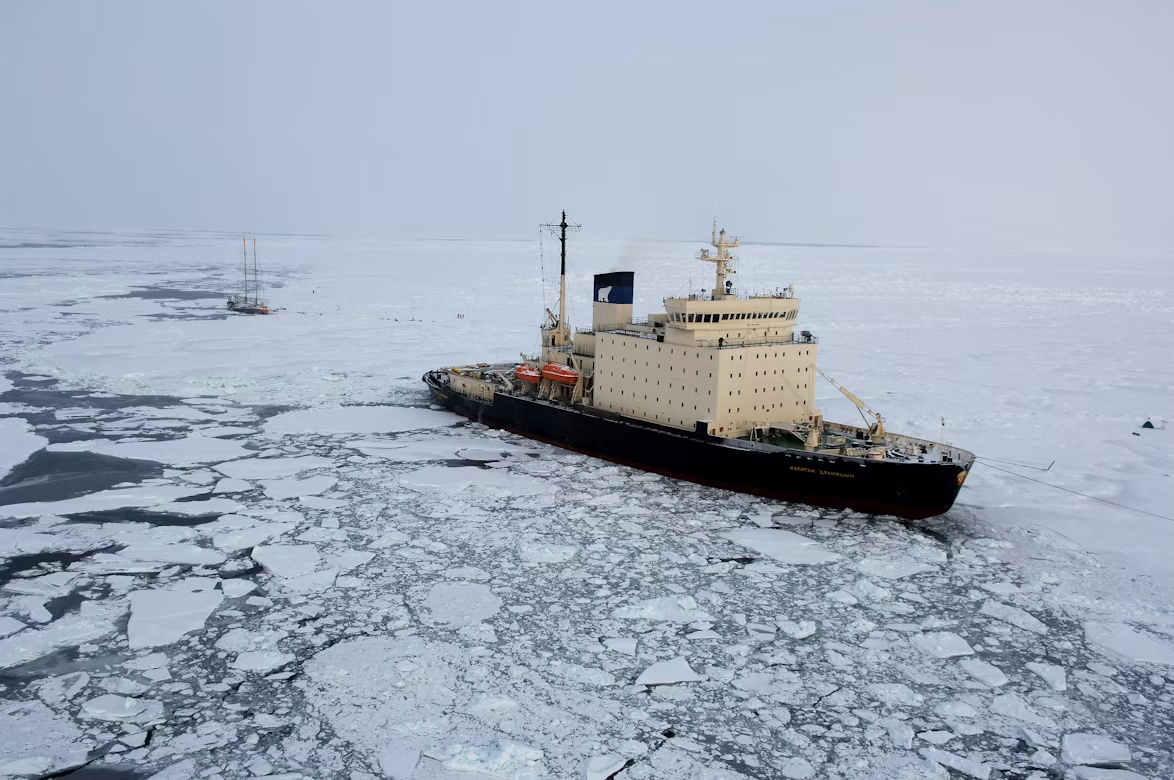
According to the U.S. Coast Guard, the Chinese research vessels Xue Long (Snow Dragon) and Xue Long 2 (Snow Dragon 2) moved northward through the Bering Sea during July, near the U.S. exclusive economic zone.
The continued presence of Chinese research vessels in the Arctic during the summer months has become a growing concern for Western defense and security officials in recent years. Officials say it may not be sufficient to view their activities solely as scientific research, given the advanced capabilities of the vessels.
Canadian Aircraft Monitoring the Ships
According to data compiled by independent maritime researcher and ship tracker Stephen Watkins, a Royal Canadian Air Force CP-140 surveillance aircraft has been based in Alaska since the beginning of July.
Canada’s Department of National Defence has also confirmed that the aircraft worked with U.S. authorities to monitor the activities of both Chinese vessels.
Department of National Defence spokesperson Cheryl Forrest said the Canadian Joint Operations Command is actively monitoring maritime traffic in the Arctic, including the Xue Long and Xue Long 2.
Chinese Vessels Outside Canadian Waters
Canadian officials say both Chinese vessels are currently operating outside Canada’s exclusive economic zone.
An exclusive economic zone gives a coastal country special rights over marine resources and certain activities, but it is not the same as the country’s territorial waters.
Canada says the Chinese ships are not currently inside its direct territorial waters. However, officials believe their movements should be closely monitored as Chinese activity in the Arctic continues to increase.
Scientific Research or Security Activity?
China has repeatedly stated that its icebreakers operate in the Arctic for peaceful scientific research, environmental monitoring and climate studies.
However, Western defense experts have also pointed to the advanced sonar and telemetry buoy capabilities carried by such vessels. According to these experts, the equipment can be used to collect information about the marine environment, underwater geography and the seabed, while potentially also providing information related to submarine activity.
Defense researcher Richard Shimooka said Chinese research vessels are capable of conducting different types of activities, making continuous monitoring of their presence important.
Concerns Over Underwater Infrastructure
Experts say there is no major international network of undersea fiber-optic cables in the Bering Sea, although important regional submarine networks serve Alaska.
Defense experts have raised concerns that Chinese vessels could potentially collect information about underwater systems and maritime routes while conducting marine research.
This is one reason Canada and the United States are paying closer attention to the vessels’ movements.
Rising Tensions in the Arctic
Canada has been focusing on improving surveillance of northern maritime areas and strengthening coordination with its allies since last year.
As part of these efforts, Canadian naval vessels, Arctic-capable ships, aerial surveillance assets and special forces have been involved in various operations.
Canadian officials say growing Russian and Chinese interest in the Arctic means monitoring the region is likely to become even more important in the future.
Canada Plans to Strengthen Arctic Defense
Canada has also begun working on plans to strengthen its Arctic defense capabilities through the acquisition of new naval vessels and advanced submarines.
The government is also considering establishing a modern network of underwater sensors to help detect suspicious activities in northern maritime areas at an early stage.
James Bezan, a member of the Canadian Parliament’s defence committee, has also emphasized the need for additional surveillance resources in the Arctic. He said the growing activities of China and Russia are testing Canada’s ability to monitor the region and respond quickly.
Experts believe the Arctic could become one of the world’s most important regions for security, natural resources and maritime routes in the coming years. As a result, the activities of China, Russia, the United States and Canada in the region are expected to receive increasing international attention.