

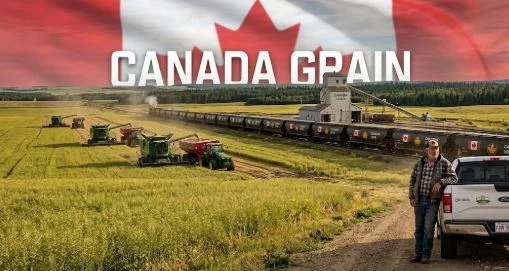
Canada’s agriculture sector is adopting new technologies, but farmers and industry experts say regulatory delays, transportation infrastructure problems and labour shortages are making it harder for the country to compete in the rapidly growing global food market.
Canada exports roughly $100 billion worth of agricultural and food products every year, yet its share of global food trade has been declining as other major agricultural exporters expand at a faster pace.
Farmers Turn to Drone Technology
In Colville, Saskatchewan, farmer Dan Roberts recently watched a demonstration of a large agricultural drone capable of spraying crops across thousands of hectares.
Roberts farms about 4,000 hectares of canola, wheat, barley and pulses. During the demonstration, a DJI T100 drone was used to show how the technology could be applied across large fields.
The drone has a 100-litre tank that can carry agricultural products used for crop protection.
For farmers, the technology could become particularly useful during periods of heavy rainfall when traditional farm machinery cannot safely enter fields.
Drones Could Help During Wet Weather
Roberts said drones could be especially valuable when wet conditions make it difficult to operate heavy equipment without damaging crops or soil.
Pulse crops, for example, can require fungicide applications during periods of high moisture. However, taking heavy machinery into wet fields can cause significant damage.
Drones can fly over the fields and apply treatments without driving through the crops, allowing farmers to protect their harvest while reducing soil compaction and crop damage.
Regulatory Delays Remain a Concern
Although agricultural drones have been available in Canada for some time, farmers previously faced restrictions on using them to spray certain pesticides.
Interest in the technology increased after Health Canada eased restrictions in late June on the use of drones for applying certain pest-control products.
Roberts said countries including the United States, China, Brazil, Japan and Australia have moved ahead of Canada in the adoption of agricultural drone technology.
Canada’s Global Food Trade Share Is Falling
The challenge facing Canadian agriculture extends beyond technology.
Canada remains a major food exporter, but global food trade has been growing faster than Canadian exports.
Evan Fraser, executive director of the Arrell Food Institute at the University of Guelph, said the faster growth of global food trade has resulted in Canada losing part of its share of the international market.
A 2025 analysis by the Royal Bank of Canada found that Canada had fallen from fifth to seventh place among the world’s agricultural exporters, with China and Brazil moving ahead.
The report also warned that Canada could fall further in the global rankings in the coming years.
Since 2000, Canada’s share of global food exports has declined by about 12 per cent. While Canada’s food exports have nearly quadrupled during that period, global food exports have grown roughly five times.
Rail Transportation Is Another Major Challenge
Getting Canadian agricultural products to international markets is another major concern, particularly for farmers in Western Canada.
Much of the agricultural production in the western provinces is destined for export markets, making rail transportation a critical part of the supply chain.
Roberts said farmers in his region often depend on railways to move crops toward Canada’s ports. On average, agricultural products from Western Canada may travel approximately 1,500 kilometres by rail before reaching export terminals.
Disruptions caused by severe weather, mountain routes or problems along the West Coast can quickly create pressure throughout the grain transportation system.
A One-Week Rail Delay Can Create Months of Problems
Even a relatively short disruption can have a significant impact on farmers.
Roberts said that when rail service is delayed for a week, it can take several more weeks for the system to return to normal because Canada’s rail network is often operating close to capacity.
During that period, grain continues accumulating at storage facilities while farmers have limited options for moving large quantities of crops by truck over thousands of kilometres.
The result can be higher transportation costs, reduced storage capacity and delays in getting Canadian products to international customers.
Labour Shortages Add to the Pressure
Industry experts also identify a shortage of skilled workers as another major challenge for Canadian agriculture.
Modern equipment and advanced technologies can improve productivity, but farmers still need trained workers who can operate, maintain and manage increasingly sophisticated agricultural systems.
Agricultural business adviser Evan Schouten said infrastructure problems frequently emerge in discussions with farmers, particularly when crops are ready for market but transportation problems prevent them from reaching buyers.
Canada Needs Broader Agricultural Reforms
Experts say improving Canada’s position in global agricultural markets will require more than simply adopting new technology.
The industry will need faster regulatory approvals, improved transportation infrastructure, stronger rail capacity and solutions to labour shortages.
Greater access to agricultural technology, including drones, could also help farmers improve efficiency and protect crops during difficult weather conditions.
However, technology alone will not solve the country’s export challenges.
Farmers and industry experts say Canada must address the wider problems affecting the agricultural supply chain if it wants to increase production and regain market share.
With the global demand for food continuing to grow, Canada has significant potential to expand its agricultural exports. But achieving that potential will depend on how quickly the country can modernize its regulations, infrastructure and workforce.
