Muhammad Amanullah | August 25, 2026
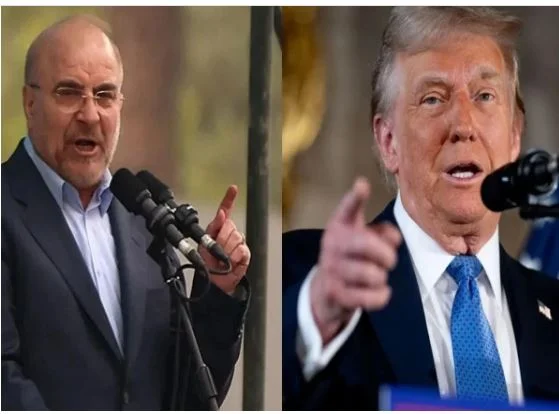
The True Post (Web News) — A growing war of words between U.S. President Donald Trump and Iranian Parliament Speaker Mohammad Bagher Ghalibaf has added another political dimension to the already tense relationship between Iran and the United States.
The sharp and sarcastic responses exchanged by the two leaders show that the dispute is no longer limited to diplomatic, military and economic issues. Public messaging, competing narratives and attempts to shape international opinion have increasingly become another important front in the confrontation.
Trump Takes a Hard Line
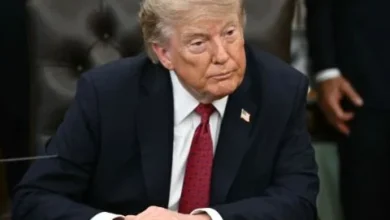
Donald Trump recently commented on Iran’s current situation, saying that the country was heading toward complete destruction. To reinforce his argument, the U.S. president shared a statement attributed to Iranian Parliament Speaker Mohammad Bagher Ghalibaf.
The statement was presented as suggesting that Iran was facing food shortages and that it would be difficult for the country to continue a war through military strength alone if its people were going hungry.
By highlighting the statement, Trump appeared to be attempting to portray Iran as facing growing economic and humanitarian pressure and to argue that a prolonged conflict could further deepen the country’s difficulties.
However, the Iranian Parliament rejected this interpretation, arguing that Ghalibaf’s original comments had been taken out of context.
Ghalibaf Responds With Sarcasm
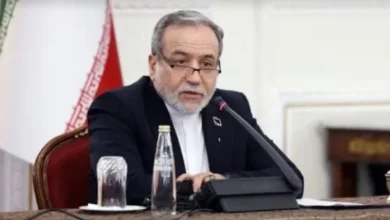
In response to Trump’s remarks, Iranian Parliament Speaker Mohammad Bagher Ghalibaf turned one of the U.S. president’s best-known political slogans into a sarcastic counterattack.
Ghalibaf used the phrase “Make America Hungry Again,” a reference to Trump’s “Make America Great Again” slogan, to draw attention to food insecurity and economic difficulties in the United States.
Ghalibaf claimed that around 47 million people in the United States face food insecurity and suggested that roughly one in eight Americans is affected by the problem.
His response was more than a sarcastic political remark. It was also an attempt to challenge Washington’s narrative by arguing that economic hardship is not limited to Iran and that the United States also faces serious social and economic problems.
Iranian leaders have repeatedly criticized U.S. sanctions, arguing that economic pressure ultimately affects ordinary Iranian citizens. Ghalibaf’s response fits into that broader Iranian argument.
Dispute Over the Context of Ghalibaf’s Remarks
One of the most important aspects of the dispute is the Iranian Parliament’s objection to Trump’s interpretation of Ghalibaf’s earlier comments.
According to Iran’s parliamentary media center, Ghalibaf had discussed Iran-Iraq economic cooperation, efforts to withstand U.S. sanctions and the prospects of confronting economic pressure during a visit to Iraq.
Iranian officials argued that his remarks did not represent an admission that Iran had been militarily defeated or that the country was unable to continue resisting.
Instead, according to the Iranian interpretation, Ghalibaf was arguing that Iran had confronted the United States on the military front and that Washington was now relying increasingly on psychological and economic pressure.
This difference in interpretation has become central to the latest exchange between the two sides.
Why Has the Conflict Become a Battle of Narratives?
The latest statements from Trump and Ghalibaf demonstrate that information and public messaging have become an increasingly important part of the Iran-U.S. confrontation.
Trump has sought to highlight Iran’s economic difficulties and internal pressures in an effort to demonstrate that American pressure is producing serious consequences for Tehran.
Iranian officials, meanwhile, have attempted to highlight economic and social problems inside the United States to challenge Washington’s claims and undermine the moral and political authority of the American position.
Both sides are therefore attempting to draw attention to the weaknesses of the other while presenting their own position as stronger.
The battle is taking place not only through official statements but also through social media, political speeches and public messaging.
Economic Pressure Remains at the Center
Behind the latest verbal confrontation lies a much broader dispute over economic pressure.
Iran has faced extensive U.S. sanctions for years, affecting its economy, trade and access to international financial systems.
Washington has used sanctions and economic pressure as major tools for influencing Tehran’s policies, while Iranian officials describe the measures as a form of economic warfare.
Ghalibaf’s response can be viewed within this wider context. By pointing to economic difficulties in the United States, he attempted to argue that economic hardship is not an issue affecting Iran alone.
The Iranian leadership has repeatedly sought to portray the country as capable of resisting external pressure, while also arguing that sanctions impose costs on ordinary people.
Political Messaging Could Affect Future Talks
The latest exchange between Trump and Ghalibaf does not necessarily indicate an immediate diplomatic breakthrough.
However, it demonstrates how difficult the political environment between Iran and the United States remains.
If diplomatic negotiations resume, increasingly aggressive public statements could influence public opinion and make the negotiating environment more complicated.
On the other hand, if tensions continue to rise, both sides may increasingly use economic sanctions, military pressure and information campaigns alongside traditional diplomatic tools.
The political battle over how the conflict is understood internationally could therefore become almost as important as the underlying military and economic confrontation.
What Happens Next?
The coming period will determine whether the current war of words remains largely political or develops into a broader escalation.
Trump is attempting to portray Iran as facing serious economic and internal challenges, while Ghalibaf is responding by highlighting America’s own economic and social problems.
The exchange demonstrates that the Iran-U.S. confrontation is no longer simply a contest of military strength or economic pressure. It is also a battle over public perception, credibility and political narratives.
As both sides continue to defend their positions, statements from senior officials are likely to remain an important part of the wider conflict. Whether this rhetoric eventually gives way to negotiations or contributes to further escalation will depend on developments in the coming weeks.