Author: Muhammad Aman Ullah
Published: August 28, 2026
THE TRUE POST (Web News) The U.S. Federal Aviation Administration (FAA) is taking steps to fire two air traffic controllers at New York’s LaGuardia Airport who allegedly left work early on the night of a fatal runway collision involving an Air Canada Express aircraft and an airport fire truck.
The development has raised fresh questions about staffing, workplace practices and safety procedures at one of New York’s busiest airports. The March 22, 2026, collision killed both pilots of the Air Canada Express flight and injured dozens of other people.
The National Air Traffic Controllers Association (NATCA), the union representing U.S. air traffic controllers, has confirmed that it is discussing the allegations with FAA leadership.
Two Controllers Allegedly Left Early
According to reports, the two controllers allegedly left LaGuardia’s control tower approximately one hour before the end of their scheduled shifts on the night of the crash.
Their departure reportedly left two other controllers working in the tower without the additional coverage that had been available earlier in the shift.
The FAA is reportedly treating the alleged early departure as a serious time-and-attendance issue. The agency has not publicly confirmed details of the individual personnel cases, but it has said that employees will be held accountable for conduct that could affect the safety and efficiency of the U.S. National Airspace System. (Reuters)
Air Traffic Controllers’ Union Responds
The National Air Traffic Controllers Association said it is actively discussing the allegations with FAA officials.
The union has not publicly confirmed whether the two controllers violated specific workplace rules or whether their early departure contributed directly to the crash.
The FAA has also not said that the controllers’ absence caused the accident. The National Transportation Safety Board (NTSB) continues to investigate the crash, and its final cause has not yet been determined. (ABC News)
How the LaGuardia Crash Happened
The fatal collision occurred shortly before midnight on March 22, 2026.
Air Canada Express Flight 8646, operated by Jazz Aviation, was arriving at LaGuardia Airport from Montréal-Trudeau International Airport in Quebec.
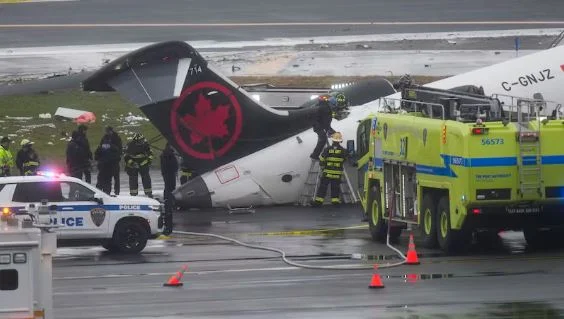
The aircraft was a Mitsubishi Heavy Industries CRJ-900 regional jet. According to the NTSB, the aircraft was landing on Runway 4 when it collided with Rescue 35, an Oshkosh Striker 1500 airport rescue and firefighting vehicle.
The aircraft was carrying 72 passengers and two flight attendants. Two people were also inside the airport fire truck.
The collision caused substantial damage to the aircraft and resulted in the deaths of the captain and first officer. The NTSB reported that 39 people were transported to local hospitals, including six who suffered serious injuries. (NTSB)
Both Air Canada Express Pilots Were Killed
The two pilots killed in the crash were Captain Antoine Forest and First Officer Mackenzie Gunther.
Both pilots were working for Jazz Aviation, the regional airline operating the Air Canada Express service.
Their deaths shocked the Canadian aviation community and prompted renewed scrutiny of safety procedures at LaGuardia Airport.
Last-Minute Warning Before the Collision
Investigators have been examining the communications between the control tower, the aircraft and the airport emergency vehicle.
According to preliminary findings reported after the crash, the Air Canada Express aircraft had been cleared to land less than two minutes before the fire truck was cleared to cross the active runway.
The situation quickly became dangerous as the aircraft approached the runway while the emergency vehicle was still moving across it.
The controller eventually issued repeated instructions for the fire truck to stop, but the collision could not be prevented.
Questions About Staffing
The allegations involving the two controllers have added another issue to the investigation.
Reports indicate that the two controllers who allegedly left early had been providing additional coverage. Their departure left two controllers in the tower, with one reportedly handling two positions while the other was dealing with a separate emergency.
The incident has therefore renewed concerns about staffing levels and workload at U.S. air traffic control facilities, particularly during periods of heavy traffic and operational disruptions. (ABC News)
NTSB Investigation Remains Ongoing
The NTSB is leading the investigation into the LaGuardia collision.
The agency’s preliminary report identified several factors surrounding the accident, but it has not yet determined a final probable cause.
The NTSB has emphasized that its preliminary information is subject to change as investigators continue examining evidence, communications, procedures and other circumstances surrounding the crash. (NTSB)
The final investigation is expected to take considerably longer and will determine whether staffing, communication problems, airport procedures or other factors played a role in the collision.
Fire Truck Tracking Also Under Scrutiny
Investigators also examined the technology available for tracking airport vehicles.
The emergency vehicle involved in the collision did not have a transponder that could have provided additional position information to aircraft and air traffic controllers.
Following the crash, authorities have been looking at ways to improve the tracking and identification of airport emergency vehicles to reduce the risk of similar runway incidents in the future.
FAA Promises Accountability
The FAA has said that safety remains a top priority and that employees will be held accountable when their conduct violates rules or puts additional pressure on other workers.
Transportation Secretary Sean Duffy also emphasized that the overwhelming majority of air traffic controllers perform their duties responsibly, while misconduct that affects the airspace system will not be tolerated. (ABC News)
The reported action against the two LaGuardia controllers is part of a wider effort by the FAA to address alleged timecard and attendance violations among air traffic control personnel.
No Final Link Established Between Early Departure and Crash
Despite the seriousness of the allegations, officials have not established that the two controllers’ early departure directly caused the LaGuardia collision.
The NTSB investigation remains active, and a final determination will be required before responsibility for the accident can be fully assessed.
The latest development does, however, put renewed attention on staffing and working conditions inside the LaGuardia control tower on the night of the tragedy.
Safety Concerns Continue
The LaGuardia collision remains one of the most serious aviation accidents involving an Air Canada Express flight in recent years.
While investigators continue working to establish exactly what happened, the case highlights the importance of adequate staffing, clear communication between controllers and airport vehicles, reliable runway safety systems and strict adherence to scheduled duties.
The FAA’s move to take disciplinary action against two controllers adds a new dimension to the investigation, but it remains unclear whether their alleged early departure had any direct connection to the fatal collision.
The final NTSB findings will be crucial in determining the causes of the accident and identifying any safety changes needed to prevent a similar tragedy in the future.