Muhammad Amanullah
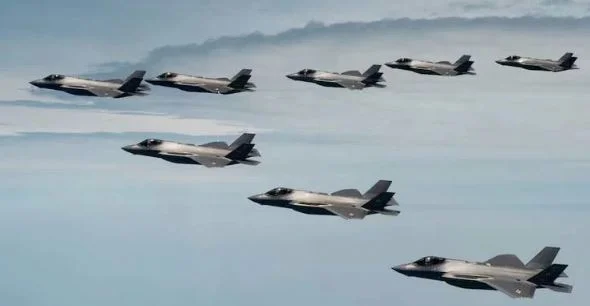
Date: September 18, 2026 The True Post (Web News) — The US decision to approve the possible sale of 48 advanced F-35 stealth fighter jets to Saudi Arabia is more than a defence agreement. It represents a significant development in the changing geopolitical landscape of the Middle East.
The package, valued at approximately $24.3 billion, includes the advanced aircraft along with engines, communications systems, training facilities, spare parts and other support equipment. However, the sale has not yet been finalized, as it still has to go through the US Congress review process.
Saudi Arabia’s Major Defence Ambition
Saudi Arabia has long expressed interest in acquiring F-35 fighter jets. At the beginning of 2025, Riyadh reportedly made a direct request to US President Donald Trump for the aircraft.
The US State Department’s approval now represents a significant step towards turning that request into a potential agreement.
The F-35 is not simply a conventional fighter aircraft. It is a fifth-generation combat system equipped with stealth technology, advanced sensors and sophisticated information systems. For Saudi Arabia, therefore, the importance of the proposed deal extends well beyond acquiring 48 aircraft.
Iran Factor Also Important
It is difficult to view the decision separately from the current regional tensions. Rising tensions between Iran and the United States in the Gulf have highlighted defence concerns for Saudi Arabia and other Arab states in the region.
Against this backdrop, Riyadh’s pursuit of some of the most advanced Western military technology can be seen as part of its broader defence strategy.
The US State Department has also linked the proposed sale to strengthening Saudi Arabia’s defence capabilities and enhancing security cooperation in the Gulf.
A Key Question for Israel
One of the most important aspects of the proposed F-35 deal concerns Israel’s military advantage in the region.
Israel is currently the only country in the Middle East operating F-35 fighter jets. If Saudi Arabia eventually receives the aircraft, the number of countries in the region possessing advanced air-combat technology would increase.
Under US law, Washington must also take into consideration the need to preserve Israel’s qualitative military edge in the region.
The US State Department has said that the proposed sale would not alter the regional military balance. However, the issue remains a subject of discussion between the United States and Israel.
China Is Another Major Concern
China represents another sensitive aspect of the proposed agreement.
US officials and some lawmakers have raised concerns that Saudi Arabia’s expanding defence ties with China could create questions over the protection of sensitive technology associated with the F-35.
Reports related to US intelligence assessments have also highlighted concerns surrounding the protection of sensitive military technology.
Also Read:
Saudi Arabia Faces Fresh Houthi Missile and Drone Attacks as Regional Tensions Rise
The issue is particularly significant because the F-35’s capabilities are not limited to speed or weapons-carrying capacity. Much of its military value lies in its highly sophisticated sensors, software and information systems.
$24.3 Billion in Economic and Strategic Interests
For the United States, the agreement would also represent a major defence export.
The package involving 48 aircraft, 49 engines and other support equipment has a total estimated value of $24.3 billion.
The proposed deal could therefore provide Washington with a major commercial agreement for its defence industry while further strengthening security ties with Riyadh.
Final Decision Has Not Yet Been Made
It is important to note that approval by the US State Department does not mean Saudi Arabia will receive the aircraft immediately.
The proposed sale still has to undergo review by the US Congress, where political and security objections could be raised.
For lawmakers, issues including Israel’s military advantage, the protection of sensitive technology and Saudi Arabia’s defence relationships will remain important considerations.
The current approval is therefore a major step in a longer process, rather than the final stage of the agreement.
A New Alignment in the Middle East?
Overall, the proposed F-35 deal reflects Saudi Arabia’s efforts to modernize its air-defence capabilities, deepen its defence relationship with the United States and respond to changing security priorities in the region.
If the agreement is ultimately completed, Saudi Arabia could become the second country in the Middle East after Israel to operate F-35 fighter jets.
That possibility makes the proposed deal more significant than an ordinary arms agreement. Its potential implications could extend beyond Saudi Arabia’s defence policy to the broader relationships among the United States, Israel, Iran and China in the Middle East.