Muhammad Amanullah
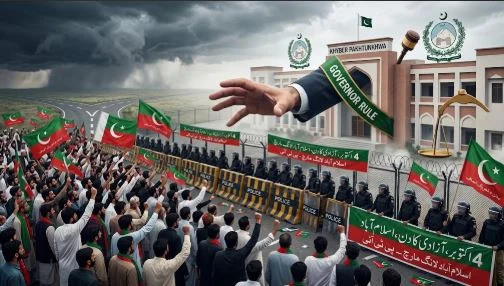
Date: September 29, 2026 The True Post (Web News) —Political tensions in Khyber Pakhtunkhwa are rising once again as Pakistan Tehreek-e-Insaf (PTI) prepares for its announced long march towards Islamabad on October 4. Meanwhile, reports have emerged that the federal government is considering different options for potential political changes in the province.
The possibility of Governor’s Rule, an emergency declaration and a no-confidence motion against the provincial government have become subjects of political discussion. Against this backdrop, October 4 could become an important stage in the ongoing political confrontation between the federal and provincial governments, rather than simply another protest.
Why Is October 4 Important?
PTI’s long march is taking place amid already serious disagreements between the federal government and the Khyber Pakhtunkhwa government. PTI describes the march as a way to increase public pressure in support of its political demands, while the federal government views the situation through the lens of law and order.
The central questions are how much public support PTI can mobilise on October 4 and how the federal government will respond.
If the protest remains limited and peaceful, the situation could move towards negotiations despite the political pressure. However, if confrontations occur, the existing political divide could widen further.
What Options Does the Federal Government Have?
Several political and constitutional options concerning Khyber Pakhtunkhwa have been discussed at the federal level. A no-confidence motion against the provincial government is among the most discussed political possibilities, while measures such as Governor’s Rule or an emergency declaration would be considerably more sensitive.
In the event of a no-confidence motion, the provincial assembly would become the main arena of political contest. The chief minister would need to demonstrate majority support in the assembly to remain in office.
Consequently, the support of assembly members could become particularly important in the coming days.
The Issue of Governor’s Rule
Discussion about Governor’s Rule has introduced another dimension to the political debate in Khyber Pakhtunkhwa. However, constitutional requirements and prevailing political circumstances would be central to any such move.
Political disagreement or an opposition protest alone cannot automatically serve as the sole basis for imposing Governor’s Rule. If the federal government considers this option, it would also need to establish the relevant constitutional and political justification.
For now, discussion of Governor’s Rule appears to remain part of the broader debate over political pressure and possible scenarios rather than a confirmed decision.
PTI’s Response
PTI has made it clear that any attempt to weaken the Khyber Pakhtunkhwa government through political pressure would be met with a show of public support.
Chief Minister Sohail Afridi has also adopted a firm political position towards the federal government.
October 4 is significant for PTI because the party could present a successful march as a demonstration of its political strength. Conversely, if turnout is limited or the protest fails to generate the intended impact, the nature of the political pressure on the government could change.
The No-Confidence Motion Scenario
If a no-confidence motion proceeds, the political contest would shift from the streets to the provincial assembly.
In that setting, numerical strength rather than public rallies or political slogans would determine the outcome.
If the provincial government succeeds in keeping its members united, an attempt to remove it through a no-confidence motion could fail. However, if a substantial number of assembly members withdraw their support or side with the opposition, the government could face serious difficulties.
This is why the political positions of members of the Khyber Pakhtunkhwa Assembly are likely to assume particular importance in the coming days.
Negotiations or Confrontation?
Despite the escalating tensions, the possibility of negotiations has not been completely ruled out. Political crises can ultimately leave room for dialogue as a way to resolve disagreements.
If the federal and provincial governments move towards direct negotiations, the October 4 protest could become a source of political pressure that eventually leads to talks.
However, if the situation deteriorates because of protests, arrests, road closures or an untoward incident, hard-line positions on both sides could become more entrenched.
The Critical Phase Ahead
Two major developments are emerging simultaneously in Khyber Pakhtunkhwa: PTI’s October 4 long march and uncertainty surrounding the future of the provincial government.
The federal government has the political option of pursuing a no-confidence motion, while discussion about Governor’s Rule and emergency measures continues separately.
The next few days are therefore important for the province’s political landscape. The size of the October 4 march, the government’s response, the numerical balance in the provincial assembly and the willingness of both sides to negotiate will shape the direction of the political crisis.
For now, the central feature of the situation is that the dispute in Khyber Pakhtunkhwa is no longer confined to the provincial government alone. It has become part of a broader political confrontation between the federal and provincial governments.