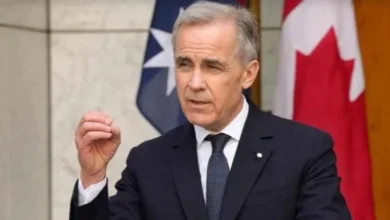
Muhammad Amanullah
Date: October 1, 2026 The True Post (Web News) —The verbal dispute between US President Donald Trump and Canada has intensified, with Trump sharply criticising Canadian leadership during an event at the White House marking Hispanic Heritage Month, describing it as “very bad.”
Trump said the US government had previously been run in a “foolish manner” because former American presidents had allowed automakers to move assembly plants outside the country, including to Canada.
Automotive Industry
The US president said previous administrations had allowed other countries to manufacture vehicles and sell them in the United States. He claimed his administration would no longer allow this to continue and was changing the policy through higher import tariffs.
Trump accused Canada of benefiting from the United States for many years. He said he loved the Canadian people but claimed Canadian leaders had taken advantage of what he described as weak American leadership and had begun to consider themselves powerful.
Trump said Canada was now being “taught a lesson.”
Name of the Lake
As part of his broader policy approach towards Canada, Trump also referred to an initiative to rename Lake Ontario in the United States as “Lake America.”
He said changing the name of the Gulf of Mexico to the “Gulf of America” had been an even more interesting move. Pointing to people attending the event, Trump remarked that some of them might not like the initiative.
Import Restrictions
Trump’s latest remarks came a day after the United States imposed import restrictions on several Canadian products. The affected goods include molasses, motorcycles, dairy products, alcoholic beverages and other items.
Restrictions on Canadian beer, wine and other alcoholic products are being viewed as potentially damaging for Canada because the country exported approximately $1.2 billion worth of such products to the United States last year.
US Trade Representative Jamieson Greer said Washington was unhappy with Canadian restrictions on alcohol sales and the limited opportunities available to American companies to compete in provincial government procurement.
US Response
According to Greer, the United States had given Canada considerable room to manoeuvre, but a point was eventually reached when Washington decided it would no longer tolerate the situation. American restrictions were subsequently imposed in response to Canadian measures.
Trump’s trade adviser Peter Navarro also sharply criticised Canada. He described Prime Minister Mark Carney and other Canadian leaders as extremely arrogant, alleging that individuals associated with Canadian interests were attempting to influence American government officials in Washington.
Carney’s Response
Prime Minister Mark Carney declined to comment directly on Navarro’s harsh remarks. However, he said a mutually beneficial trade agreement between the United States and Canada could still be possible in the future.
Carney emphasised that Canada remained willing to negotiate in good faith. Greer also said the door remained open to a possible agreement, although he indicated that the US administration was satisfied with the current situation.
Trade Reality
Questions have also been raised about the US administration’s claim that Canada has unfairly benefited from the United States for many years.
Trade figures indicate that the United States has a relatively limited trade deficit with Canada, much of which is attributed to American purchases of oil from Alberta.
Some refineries in the American Midwest depend heavily on Canadian oil supplies. Meanwhile, the United States consistently maintains a trade surplus with Canada in the services sector.
Agricultural Trade
Trump also raised concerns about what he described as high Canadian tariffs affecting American farmers. However, according to available global trade figures, approximately 96.7 per cent of US agricultural products enter Canada without import duties.
Figures from the US Department of Agriculture indicate that around half of Canada’s agricultural imports come from the United States.
High tariffs on Canadian dairy products apply when imports exceed specified quotas. According to the American dairy industry, US exports have not come close to reaching those established limits.
The trade dispute between Trump and Canada has therefore expanded beyond tariffs alone. Political rhetoric, import restrictions and negotiations over a possible future trade agreement are now also shaping the relationship between the two countries.