Muhammad Amanullah
Date: October 6, 2026 The True Post (Web News) —Canada’s economy is currently going through a period in which U.S. trade policy, global tensions, energy prices and business uncertainty have increased pressure on economic activity.
According to the latest economic data, the country’s services sector contracted for the fourth consecutive month, raising further questions about the direction of business activity in the coming months.
Services Sector
In September, Canada’s services business activity index stood at 48.3. A reading below 50 indicates a decline in business activity. Although a slight improvement was recorded compared with August, remaining below 50 for the fourth consecutive month indicates that businesses continue to adopt a cautious approach.
Impact of the Trade War
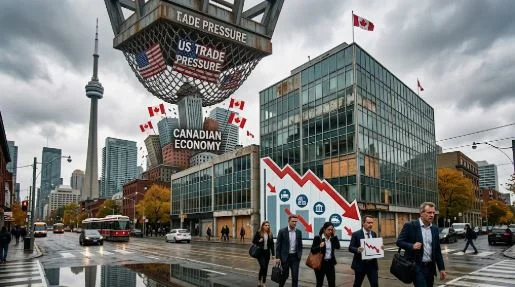
Trade tensions between Canada and the United States have become one of the major causes of the current economic pressure. U.S. tariffs and Canada’s measures in response have complicated costs, exports and future planning for businesses.
The United States is among the most important trading markets for Canadian businesses. As a result, trade barriers between the two countries do not remain limited to imports and exports; they can also affect investment, production, employment and consumer confidence.
Economic Activity
Overall economic activity in Canada has also experienced fluctuations in recent months. Real gross domestic product did not record significant growth in July. Activity increased in construction and some other sectors, but weakness in manufacturing, mining, oil and gas, retail and wholesale trade affected the overall situation.
This situation indicates that Canada’s economy is facing several different pressures at the same time.
The Energy Factor
Rising energy prices globally have created a complex situation for Canada. On the one hand, higher energy prices create an opportunity for the country’s energy exporters to increase revenues. On the other hand, expensive fuel increases costs for domestic consumers and businesses. This can have a direct impact on the prices of transportation, food and other goods.
Read Also: Canada’s Real Test Begins as Trade War with U.S. Changes the Direction of the Economy
The Interest Rate Question
Despite the slowdown in the economy, the interest-rate decision is not easy for the central bank. If inflationary pressures remain, there may be limited room for an immediate interest-rate cut, while weak economic activity calls for easier financial conditions for businesses and consumers.
Because of this contradiction, upcoming economic data will be extremely important for the central bank’s monetary policy.
Employment and Business
One important aspect of the economic slowdown is employment. If business activity remains weak for an extended period, the pace of new job creation could be affected, while companies may also limit investment.
The challenge for Canada is to maintain investment and production despite trade uncertainty.
The Road Ahead
Under the current circumstances, reducing Canada’s trade dependence on the United States is becoming an important economic strategy. Access to new global markets, diversification of energy exports, major infrastructure projects and increased domestic production capacity could provide the economy with a stronger foundation over the long term.
However, this process will take time rather than producing immediate results. In the meantime, Canada will have to manage pressure from inflation and energy prices while also supporting weak business activity.
Analysis
Overall, it would not be sufficient to describe Canada’s current economic situation simply as a temporary slowdown. Changes in U.S. trade policy, global tensions and energy prices are factors that could have a long-term impact on the country’s economic direction.
The decisions taken by the government, businesses and the central bank in the coming months will determine the extent to which Canada can turn these pressures into opportunities.