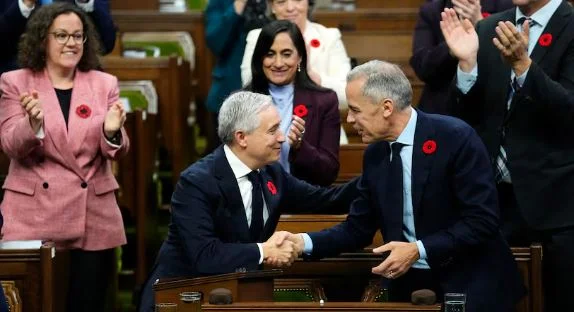
Prime Minister Mark Carney’s government has unveiled an ambitious plan to transform Canada’s economic structure through its second federal budget, outlining a new strategy aimed at reducing the country’s exposure to global economic pressures, particularly its dependence on the United States.
The 2026 budget proposes billions of dollars in investments across business, clean energy, critical minerals, forestry, housing, and infrastructure. The government’s broader objective is to build a stronger, more independent, and investment-friendly Canadian economy.
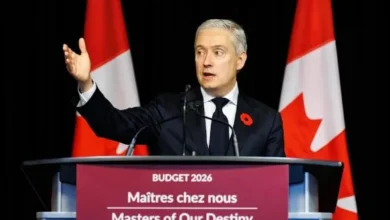
Titled “Masters of Our Destiny,” the budget draws inspiration from the historic Quebec political slogan “Maîtres chez nous,” which became popular during the province’s Quiet Revolution in the 1960s. That period marked a significant transformation in Quebec, characterized by rapid modernization, reforms, and major economic and social changes.
Finance Minister François-Philippe Champagne said while presenting the budget that current global conditions require Canada to adopt an ambitious economic strategy that allows the country to take greater control of its own future.
Preparing to Replace Canada’s Traditional Economic Model
A central feature of the Carney government’s economic strategy is the transformation of Canada’s traditional development model.
Rather than relying primarily on government spending and conventional economic activity, the government is placing greater emphasis on private-sector investment, industrial development, productivity, and major national projects.
One of the budget’s largest financial incentives is the proposed Productivity Mega Deduction, which would provide businesses with tax advantages on new investments.
The initiative is expected to cost approximately $36 billion over the next five years, representing nearly one-quarter of the budget’s new spending commitments.
The government’s objective is to encourage companies to invest in new machinery, advanced technology, industrial projects, and equipment that can improve productivity and expand production capacity.
The budget also proposes new capital gains tax relief for business owners to encourage entrepreneurship, business creation, and expansion.
Billions of Dollars for Clean Energy and Critical Minerals
Clean electricity and energy development have been placed at the centre of Canada’s long-term economic strategy.
Approximately $9 billion has been allocated to accelerate the development and implementation of clean electricity projects.
More than $2 billion is also planned for modernizing Canada’s forestry industry, while approximately $1.7 billion is earmarked for the exploration, development, and expansion of critical minerals production.
The budget additionally includes investments in nuclear energy and electric vehicle charging infrastructure.
Through these initiatives, the government hopes to meet future energy requirements, support industrial development, and strengthen Canada’s position in emerging global markets.
Major Infrastructure Projects Announced for Northern Canada
The federal government has also included significant infrastructure initiatives aimed at developing Canada’s northern regions.
Under the proposed plan, the federal government will take responsibility for fully funding and overseeing the construction of the Mackenzie Valley Highway project in the Northwest Territories.
Support will also be provided for two hydroelectric projects in Yukon.
In addition, the government plans to move forward with proposals to transfer certain operations at major Canadian airports to the private sector.
Another important initiative involves establishing a new sovereign national wealth fund, with plans to provide Canadian citizens with opportunities to participate in its investments.
Measures to Address Inflation and the Housing Crisis
Alongside its long-term economic ambitions, the government has included measures to address immediate financial challenges facing Canadian households.
Proposals to increase the Groceries and Essentials Benefit and the Workers Benefit are intended to support low-income families struggling with inflation and rising everyday expenses.
The two measures are expected to cost a combined $6.7 billion, while the temporary suspension of the federal fuel excise tax is projected to cost an additional $2.9 billion.
Housing affordability and homelessness are also major priorities in the budget.
The government has set a target of ending homelessness over the next decade, with $11.2 billion allocated over the next five years to support this objective.
The plan includes affordable housing construction, the use of federal land for residential developments, and improvements to housing-related infrastructure.
$26 Billion Package for Indigenous Communities
The federal budget proposes $26 billion in funding over the next five years to improve housing, infrastructure, and social services in Indigenous communities across Canada.
The investment is intended to support residential developments, essential infrastructure, and improvements to community facilities.
The initiative represents a major financial commitment towards addressing longstanding infrastructure and housing challenges faced by Indigenous populations.
Concerns Over National Debt and Interest Payments
Despite the government’s ambitious development plans, questions remain about Canada’s fiscal position and the long-term cost of borrowing.
Higher oil prices in international markets have improved government revenues, helping reduce the previous fiscal year’s budget deficit compared with earlier projections.
According to the government’s latest estimates, Canada’s overall debt-to-GDP ratio is expected to stabilize at approximately 40 per cent, around three percentage points lower than the previous year’s government projection.
However, the federal budget deficit is projected to reach $53.4 billion by 2029, while interest payments on federal debt are expected to rise to $78.4 billion during the same year.
Conservative finance critic Michael Chong criticized the budget, arguing that the government had failed to present a credible fiscal strategy for reducing debt and balancing the budget.
He warned that increasing debt levels and interest payments could place additional pressure on federal finances in the coming years.
A Defining Moment for Canada’s Economic Future
Prime Minister Mark Carney’s second federal budget represents more than an annual spending plan. It is an attempt to establish a new direction for Canada’s economy through investment, energy development, critical minerals, industrial production, and major infrastructure projects.
The government hopes that these initiatives will strengthen Canada’s long-term economic foundations, reduce dependence on external markets, and create new opportunities for businesses and workers.
However, the success of this strategy will ultimately depend on whether billions of dollars in proposed investments translate into real industrial growth, new employment opportunities, and improvements in Canadians’ quality of life.
At the same time, rising debt levels, interest payments, and the ongoing housing crisis will remain significant challenges for the Carney government as it attempts to reshape the country’s economic future.