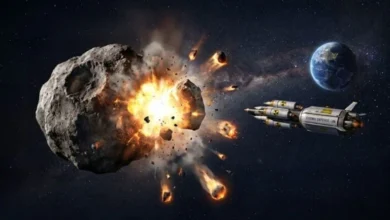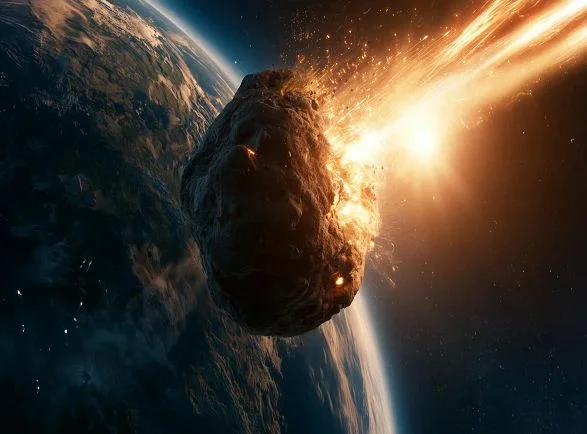
Using a nuclear explosion to divert dangerous asteroids heading towards Earth could become a possible planetary defence strategy, according to new scientific research.
The study suggests that powerful X-rays released during a nuclear detonation could alter an asteroid’s trajectory by heating its surface and forcing material to escape. However, researchers have found that the effectiveness of this method depends significantly on the direction from which the asteroid is exposed to the radiation.
X-Rays Could Change an Asteroid’s Trajectory
According to the research, intense X-rays produced by a nuclear explosion can rapidly heat an asteroid’s surface, causing material to vaporise and eject from it.
The resulting force could push the asteroid, changing its speed and potentially altering its path through space.
Scientists believe this approach could eventually contribute to strategies designed to protect Earth from potentially hazardous space objects.
Radiation Direction Can Produce a Fivefold Difference
The study, published in the scientific journal Icarus, found that exposing the same asteroid to X-rays from different directions can produce significantly different changes in its velocity.
During computer simulations, radiation applied from one direction changed the asteroid’s speed by 3.9 millimetres per second. When the radiation came from another direction, the change was only 0.8 millimetres per second.
This represents an approximately fivefold difference, highlighting how strongly the direction of radiation can influence the effectiveness of a nuclear-based asteroid deflection method.
Irregular Asteroid Shapes Also Matter
The researchers also highlighted the importance of an asteroid’s physical shape and surface characteristics.
Computer simulations often represent asteroids as smooth, spherical objects. In reality, however, many asteroids have uneven surfaces and irregular shapes.
These physical features can affect how radiation interacts with an asteroid and how the resulting forces influence its movement.
Scientists Highlight Unexpected Results
The research was led by physicist Nathan Moore of Sandia National Laboratories.
Moore said scientists had already expected the direction of radiation to play an important role in asteroid deflection. However, the scale of the difference observed in the results was surprising.
Researchers believe these findings could help improve future planetary defence technologies and support further space research aimed at protecting Earth from potential asteroid impacts.
Although the technique remains a subject of scientific investigation, the study provides important insight into how nuclear-generated X-rays might one day be used to change the course of hazardous asteroids.