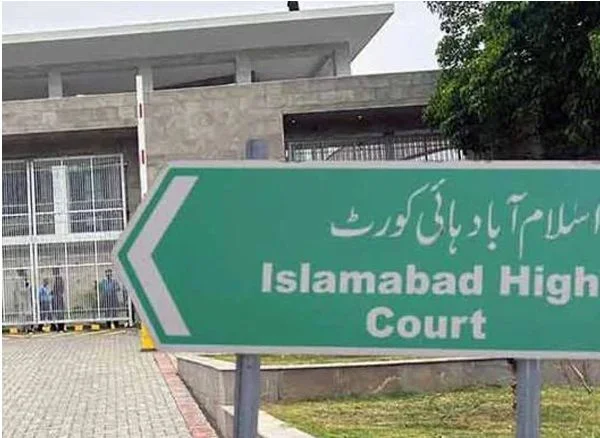
The Islamabad High Court has reserved its verdict on the maintainability of a petition seeking to halt the 2026 local government elections in the federal capital.
The court also reserved its decision on a separate application seeking suspension of the election schedule, while expressing serious concern over alleged discrepancies in declared election expenses.
During the hearing, the court observed that spending millions of rupees on an election and subsequently declaring expenses of only Rs. 100,000 was an alarming situation.
Justice Umer Majeed Malik questioned what the court could do if someone spent millions on an election, emphasizing the seriousness of the apparent discrepancy.
The judge heard a petition filed by Chaudhry Amjad Ali. During the proceedings, the petitioner’s lawyer, Adil Aziz Qazi, argued that several legal and administrative irregularities had affected the process of conducting local government elections in Islamabad.
He also raised concerns regarding constituency delimitations, the election schedule and legal complications arising from the proposed Local Government Ordinance.
Dispute Over Islamabad Local Government Elections and Constituency Delimitations
The petitioner’s lawyer informed the court that new constituencies were delimited in Islamabad in 2024, following which an election schedule was announced.
However, the introduction of a new Local Government Election Ordinance in 2026 created further complications and uncertainty surrounding the electoral process.
According to the lawyer, the new ordinance resulted in the withdrawal of the previously announced election schedule and the cancellation of the earlier delimitation arrangements.
He explained that the Islamabad Local Government Act provides for a single Metropolitan Corporation, whereas the new ordinance proposed the establishment of three Metropolitan Corporations.
The lawyer further argued that after the ordinance ceased to have legal effect, a new election schedule was announced without formally restoring the previous constituency boundaries.
He said this had raised serious questions about the legal validity of the ongoing election process.
Court Questions Legal Authority Behind New Delimitations
Justice Umer Majeed Malik asked the petitioner’s lawyer whether the new Local Government Election Ordinance had become law.
Adil Aziz Qazi responded that the ordinance had not yet become an Act of Parliament. He said it had been approved by the cabinet and subsequently forwarded to Parliament.
The court questioned under which legal authority or order the new delimitations had been carried out, particularly given the changing legal status of the ordinance and the issue surrounding the previous constituency boundaries.
Justice Malik observed that if the earlier delimitations were intended to be restored, a formal order could have been issued or objections could have been invited from the relevant parties.
Claim That Some Electoral Wards Have Only Two Residents
During the hearing, the petitioner’s lawyer also highlighted alleged irregularities in the constituency boundaries being used for the elections.
He claimed that certain union councils and wards had been structured in a way that made it difficult to fulfil the basic legal requirements for conducting elections.
According to the lawyer, Ward No. 2 of one union council had only two individuals, whereas at least three people were required to complete nomination papers: the candidate, proposer and seconder.
The court asked whether the proposer and seconder were legally required to belong to the same ward or whether they could be registered voters from anywhere within the union council.
The lawyer maintained that both the proposer and seconder had to belong to the same ward.
Justice Malik questioned how elections could be conducted in a ward containing only two individuals if three people were required for the nomination process.
The judge also directed the lawyer to present the relevant legal provision establishing that the proposer and seconder must belong to the same ward.
However, the lawyer said he would submit the relevant legal provision before the court at a later stage.
Objections Over Election Schedule and Availability of Voter Lists
The petitioner’s lawyer also argued that voter lists had not been provided to the relevant individuals by the time the election schedule was announced.
As a result, he said, many residents did not know which wards their votes had been registered in.
He claimed that the lack of access to voter lists contributed to a low number of candidates submitting nomination papers.
The deadline for filing nomination papers was subsequently extended to the 8th of the month.
The lawyer argued that the entire electoral process had been rushed and that local government elections were being conducted without fulfilling the necessary legal requirements.
At this stage, Justice Umer Majeed Malik asked whether the petitioner’s position was that the entire election process was being conducted hastily and in violation of the law.
Court Raises Serious Concerns Over Millions in Election Spending
The petitioner’s lawyer requested that the court immediately halt the local government election process and suspend the announced election schedule.
He also referred to a previous order issued by the same court that had suspended the electoral process.
The lawyer warned that if the election schedule was not suspended immediately and the court subsequently ordered the process to stop, candidates could already have spent millions of rupees, potentially causing them substantial financial losses.
In response, Justice Umer Majeed Malik made significant observations about election expenditure.
The judge questioned what the court could do if an individual spent millions of rupees on an election.
He described the situation as extremely alarming, particularly if millions had allegedly been spent while the declared election expenditure was shown as only Rs. 100,000.
The remarks highlighted the court’s concerns about transparency and the accuracy of declared election expenses.
Islamabad High Court Reserves Verdict on Local Government Elections Petition
After hearing the arguments presented by the petitioner’s lawyer, the Islamabad High Court reserved its decision on whether the petition seeking to stop the local government elections in the federal capital was maintainable.
The court also reserved its ruling on the separate application seeking suspension of the election schedule.
The forthcoming decision will determine whether the petition challenging the Islamabad local government elections can proceed before the court and whether the ongoing election schedule should be suspended.
The case raises several important questions concerning constituency delimitations, compliance with electoral laws, access to voter lists and transparency in election spending.
The court’s decision is expected to be significant for the future of the 2026 local government elections in Islamabad.