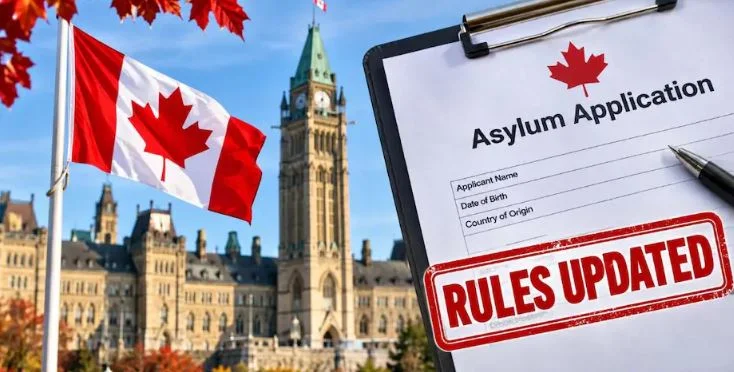
Canada’s federal government has introduced significant changes to its refugee protection system, imposing stricter requirements on individuals seeking asylum in the country. The new measures establish clearer deadlines for submitting applications, providing supporting documents and meeting legal eligibility requirements.
The government says the reforms are designed to reduce delays in processing refugee claims, ease pressure on the immigration system and ensure that people genuinely in need of protection receive timely assistance.
Effective November 3, 2026, the new rules introduce a unified online application system for individuals seeking asylum from within Canada or at designated border entry points.
Under the revised process, applicants must submit complete applications and provide all required information within specified deadlines.
According to federal government figures cited in the report, asylum claims between January and August 2026 declined by 52 per cent compared with the same period in 2025. The number was also 68 per cent lower than during the corresponding period in 2024.
New Restrictions on Asylum Applications Filed After One Year
One of the most significant changes concerns individuals who delay applying for refugee protection after arriving in Canada.
Under the new rules, asylum claims may be deemed ineligible if applicants first entered Canada after June 24, 2020, and submit their initial asylum applications more than one year after their first arrival.
A separate restriction applies to individuals entering Canada from the United States through irregular border crossings.
If such individuals wait 14 days or longer after entering Canada before making an asylum claim, their applications may also be considered ineligible under the revised regulations.
However, certain exemptions remain in place, including provisions for unaccompanied minors and individuals who meet specific circumstances under the applicable rules.
Applicants Given 60 Days to Complete Online Applications
The revised system gives asylum seekers 60 calendar days to submit their complete online applications.
In certain circumstances, applicants may receive one additional extension of 30 days.
Failure to provide the required documents and information within the prescribed timeframe could result in proceedings to declare an application abandoned.
This makes it particularly important for applicants to prepare their legal documents, supporting evidence and personal information before submitting their claims.
The government has also revised the initial screening process to ensure that security, identity and other legal requirements are examined at an earlier stage.
Work Permits May Be Available to Asylum Applicants
The new reforms also introduce an important provision for eligible asylum seekers.
Applicants whose claims are found eligible for referral to the Immigration and Refugee Board of Canada (IRB), and who meet the other applicable requirements, may receive work permits before their cases are formally referred for a hearing.
The measure is intended to allow eligible individuals to find employment and support themselves while waiting for decisions on their refugee claims.
Access to employment could help reduce financial hardship among asylum seekers who otherwise face extended waiting periods during the immigration process.
Growing Backlog Puts Pressure on Canada’s Refugee System
Canada’s asylum system has been facing increasing pressure due to a growing backlog of unresolved refugee claims.
According to government figures cited in the report, the number of refugee cases awaiting decisions at the Immigration and Refugee Board stood at approximately 70,000 at the end of 2022.
By the end of 2025, that figure had increased to nearly 300,000.
The growing backlog has become a major challenge for Canada’s immigration authorities, prompting the federal government to introduce legislative and administrative reforms aimed at improving application processing, hearings and decision-making.
Balancing Humanitarian Protection With Border Management
The new immigration measures are expected to have wider implications for Canada’s refugee system, border management and settlement programmes.
The government faces the challenge of reducing unnecessary claims and lengthy legal delays while ensuring that people facing genuine threats and persecution are not denied access to international protection.
The effectiveness of the new digital application system, stricter deadlines and early screening procedures will become clearer over the coming months.
The key question remains whether these changes will significantly reduce the growing backlog while ensuring that genuine refugees continue to receive fair and timely consideration of their applications.