Muhammad Amanullah | August 24, 2026
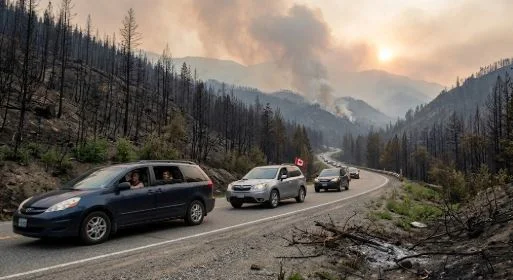
British Columbia’s wildfire crisis is intensifying as the Pearl Lake wildfire continues to spread, prompting authorities to expand evacuation orders and alerts for additional properties and communities.
The wildfire, which has become one of the largest active fires in the province, has already burned a vast area and destroyed more than 120 structures. Officials are warning residents that changing weather conditions could make the situation even more dangerous.
Evacuation Orders Expanded
The Squamish-Lillooet Regional District expanded its evacuation order on Saturday for areas south of the Pearl Lake wildfire.
The latest order includes several properties near Highway 99 in the Marble Canyon area.
The Thompson-Nicola Regional District also expanded its evacuation order west of the Highway 97 junction along Highway 99.
Together, the expanded orders now cover approximately 200 properties.
Authorities are urging residents in affected areas to leave immediately when ordered and to follow instructions from emergency officials.
First Nation Communities Also Affected
Ts’kw’aylaxw First Nation has issued evacuation orders affecting several of its reserves as the wildfire continues to threaten surrounding areas.
Emergency authorities have also expanded evacuation alerts in the affected regions, allowing residents to prepare for a possible evacuation if fire conditions deteriorate.
Officials say residents should remain prepared because wildfire behaviour can change rapidly, particularly when strong winds and dry thunderstorms develop.
Pearl Lake Fire Has Burned More Than 1,600 Square Kilometres
According to the British Columbia Wildfire Service, the Pearl Lake wildfire has burned more than 1,647 square kilometres.
More than 120 structures have been destroyed, with much of the damage reported around Clinton and surrounding communities.
Officials say fire activity remains particularly significant along the western and southern edges of the wildfire.
These areas remain a major concern because changes in wind direction could cause the fire to move quickly toward additional communities and properties.
Some Residents Allowed to Return
While evacuation orders remain in effect in several areas, some residents who were previously forced to leave have now been allowed to return home.
Some residents of Clinton have returned, although evacuation orders remain in place for a number of properties in the western part of the community.
Some residents in Summerland have also begun returning home. However, authorities continue to advise residents to follow water-use precautions in affected areas.
Severe Thunderstorms Create Additional Risk
Wildfires are not the only threat facing British Columbia.
Environment and Climate Change Canada has issued a severe thunderstorm watch covering large parts of the province’s Interior, the Cariboo region and Metro Vancouver.
A severe thunderstorm warning has also been issued for parts of Vancouver Island.
Officials are warning residents to take shelter immediately if severe weather approaches.
Dry Lightning Could Trigger More Fires
The British Columbia Wildfire Service says changing weather conditions could bring dry lightning and strong winds to parts of the southern and central Interior.
Wind speeds could reach approximately 80 kilometres per hour during some storms.
Such conditions could rapidly intensify existing wildfires and make firefighting operations more difficult.
Dry lightning also creates the possibility of new wildfires starting in areas that are already extremely dry.
New Fire Reported Near Kamloops
A new wildfire was reported Saturday in the Jacko Lake area south of Kamloops after lightning struck the region.
By Saturday evening, the fire had grown to approximately 44 hectares.
Fire officials classified the blaze as “being held,” meaning crews did not expect the fire to spread beyond its current boundaries at that time.
Nineteen firefighters, along with aerial resources, were deployed to fight the blaze.
Firefighters Continue Containment Efforts
British Columbia Wildfire Service crews reported progress in their efforts to contain the fires on Saturday.
Firefighters continued strengthening control lines and monitoring areas where fire activity remained elevated.
Kamloops Fire Rescue crews also remained at the scene overnight to monitor the situation and respond if conditions changed.
More Than 150 Wildfires Active Across the Province
By Saturday evening, more than 150 wildfires were active across British Columbia.
Approximately 60 of those fires were considered out of control, highlighting the scale of the challenge facing provincial firefighting crews.
Firefighters and aircraft are being deployed across multiple regions as crews attempt to contain existing fires while responding to new blazes caused by lightning.
Provincial State of Emergency Extended
The British Columbia government extended the province’s wildfire-related state of emergency on Friday.
The extension is currently scheduled to remain in effect until at least August 29.
Officials say continued monitoring is necessary because wildfire conditions can change quickly as weather patterns shift.
Authorities are urging residents to take evacuation orders, evacuation alerts and weather warnings seriously.
With strong winds and dry lightning possible, firefighters remain concerned that existing fires could suddenly become more aggressive or that new fires could develop in previously unaffected areas.