The True Post (Web News) Federal Finance Minister Muhammad Aurangzeb has presented a federal budget of Rs 17,573 billion for the next fiscal year in Parliament, in which there is a deficit of Rs 6,501 billion, Rs 8,207 billion will be spent on interest payments, Rs 2,550 billion has been allocated for defense, and the budget has increased the salaries of government employees by 10 percent and pensions by 7 percent.
The budget session of the National Assembly was called for 5 pm, but the session began about half an hour late. Prime Minister Shehbaz Sharif was also present in the house.
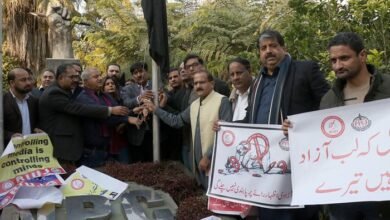
During the National Assembly budget session, the opposition leader demanded permission to speak, but when permission was not granted, he started protesting. The opposition protested by making noise in the house, banging desks and shouting slogans. Opposition members tore up copies of the agenda. Opposition members continued to protest and make noise until the end of the session. PML-N members surrounded the Prime Minister.
Federal Finance Minister Muhammad Aurangzeb, while addressing the budget session, said that it is a great honor for me to present the budget for the fiscal year 2025-26 before this esteemed house. This is the second budget of this coalition government.
He said that I deeply thank the leadership of the political parties in the coalition government led by Prime Minister Shehbaz Sharif, especially Mian Muhammad Nawaz Sharif, Bilawal Bhutto Zardari, Khalid Maqbool Siddiqui, Chaudhry Shujaat Hussain, Abdul Aleem Khan and Khalid Hussain Magsi for their guidance.
The Federal Finance Minister said that our forces showed extraordinary courage and gave a befitting reply to the enemy. Our nation becomes a lead-lined wall to deal with any challenge. We have to work for economic development with the same spirit and have stabilized the country’s economy through tireless work.
Muhammad Aurangzeb said that I pay tribute to the military and political leadership. The nation showed solidarity against Indian aggression. The great success sent a message that the Pakistani nation is united. Now our focus is on economic stability. The government has taken tough decisions for economic improvement. International economic institutions are acknowledging our economic improvement.
He said that there has been a significant improvement in the Business Confidence Index, Fitch has upgraded Pakistan’s rating, inflation has decreased significantly, we have to stabilize our economy and ensure the welfare of the people, we have achieved many successes, and a surplus current account is expected this year.
The Finance Minister said that we are optimistic that the volume of remittances will reach $38 billion. The government had to take tough decisions, the people also made many sacrifices, the government under the leadership of the Prime Minister has achieved many important successes, reforms were initiated in the FBR under the guidance of the Prime Minister, substantial investment is being made in the development of human resources, no mini-budget has been introduced nor has any additional tax been imposed.
Muhammad Aurangzeb said that the country is on the path of sustainable development, the current account is likely to have a surplus of $1.5 billion this year, the FBR collected revenues of $78.4 billion this year, the system of electricity distribution companies has been entrusted to professional boards, and political interference has been eliminated from the boards.
He said that last year, many things were done to improve the economy. Inflation came down to 4.7 percent. Two years ago, inflation had reached 29.2 percent. The value of the rupee is stable. Remittances have reached $31.2 billion. In the current fiscal year, the volume of remittances will reach $37 to $38 billion. Foreign exchange reserves will reach $14 billion this fiscal year.
The Finance Minister said that tough decisions had to be made for economic improvement. The tax gap was estimated at Rs 5.5 trillion. This situation was unacceptable. Digital production tracking is being launched for cement, fertilizer, beverages and textiles. An artificial intelligence-based system is being introduced for sales and income tax.
Muhammad Aurangzeb said that revenues from the sugar sector increased by 47 percent, 390,000 non-filers were identified, fake refund claims worth Rs 9.8 billion were blocked, and from July 1, the 800-column return will be formatted in a simple format, requiring 7 basic pieces of information.
He said that agreements with IPPs will save Rs 3,000 billion, the losses of electricity distribution companies have been reduced by Rs 140 billion, the price of electricity has been reduced by more than 31 percent, agreements with IPPs have been reviewed, and the review of agreements will save Rs 3,000 billion.
Copper and gold mines are important assets
The Federal Finance Minister said that the copper and gold mines located in Reko Diq are an important asset of our future, and we are focused on making these assets useful. The feasibility study of the project was completed in January 2025, and the expected mining period of the project is 37 years.
Muhammad Aurangzeb said that the project will generate an additional cash flow of $75 billion to the country, and that 41,500 jobs will be created through construction work under the project. The government is committed to creating a favorable business environment and increasing exports.
He said that all sectors of the economy will benefit from the reforms. According to the World Bank, after the implementation of the reforms, average tariffs will become the lowest in the region, and the volume of debts has decreased.
The Finance Minister said that tariffs are being made appropriate so that economic growth can be accelerated by increasing exports. On the instructions of the Prime Minister, reforms are being made part of the National Tariff Policy. Additional customs duties are being eliminated in four years and regulatory duties in five years.
Muhammad Aurangzeb said that the customs duty slab will range from 5 to 15 percent, and improving financial management has reduced the volume of debt relative to the economy.
He said that agreements with IPPs will save Rs 3,000 billion, and in 9 months, the losses of electricity distribution companies will be reduced by Rs 140 billion, and these losses will be completely eliminated in 5 years.
The Finance Minister said that tariff reforms are being made part of the National Tariff Policy 2025-2030, additional customs duties will be eliminated in 4 years, regulatory duties will be eliminated in 5 years, the debt-to-GDP ratio has decreased from 74 to 70 percent, and the preparation of the first Panda Bond has been completed.
Privatization of PIA and Roosevelt Hotel
Muhammad Aurangzeb said that non-profit government institutions are a burden of 800 billion on the treasury. The privatization of PIA and Roosevelt Hotel will be completed in the next fiscal year. 45 companies and institutions are being privatized, merged or closed.
He said that two years ago, our debt-to-GDP ratio was 74 percent, which has now come down to below 70 percent. The private sector must come forward for the country’s development. Reforms have been made in the pension scheme to correct the pension scheme and reduce the burden on the treasury.
The Finance Minister said that Pakistan is the country most affected by climate change, environmental protection is essential for our survival, and tackling climate change is a top priority.
End of tax exemption for FATA, PATA
Muhammad Aurangzeb said that tax exemptions for FATA and PATA have been abolished, sales tax will be implemented in a phased manner on goods manufactured in FATA and PATA, and it is proposed to impose tax at a rate of 10% in the next fiscal year.
He said that IT exports reached $3.1 billion in the first ten months of the year, and plans are underway to increase IT exports to $25 billion in the next five years. Pakistan’s services in digital governance and cybersecurity have been recognized globally.
The Finance Minister said that the Prime Minister has paid special attention to the promotion of SMEs, a steering committee has been formed for the promotion of SMEs, SMEDA has prepared a business plan, overseas Pakistanis sent remittances worth $31.2 billion in the first 10 months of the fiscal year, and the volume of remittances increased by $10 billion in the last two years.
Budget 2025-26
The federal government has presented a federal budget for the upcoming fiscal year 2025-26, with a total deficit of Rs 6,501 billion, worth Rs 17,573 billion, to Parliament for approval.
The budget proposes a 10% increase in the salaries of government employees and a 7% increase in pensions. It also proposes a significant reduction in income tax rates across all income slabs for the salaried class.
It is proposed to provide a 30 percent disparity allowance to employees in grades one to sixteen, while it is proposed to reduce the income tax rate from five percent to one percent for salaried employees with an annual income of six hundred thousand to twelve hundred thousand rupees.
It has been proposed to reduce the tax amount for employees earning a salary of Rs. 1.2 million from Rs. 30,000 to Rs. 6,000.
It has been proposed to reduce the income tax rate from 15 percent to 11 percent for employees earning up to Rs. 2.2 million. It has been proposed to reduce the income tax rate from 25 percent to 23 percent for those earning up to Rs. 3.2 million.
The total expenditure for the next fiscal year is estimated to be Rs 17,573 billion, the total gross revenue target is proposed to be Rs 19,298 billion and the net revenue target is proposed to be Rs 11,072 billion, while the FBR tax collection target is proposed to be Rs 14,131 billion, the non-tax revenue target is proposed to be Rs 5,147 billion, and the target of obtaining Rs 87 billion from the privatization of institutions in the next fiscal year has been proposed.
The Finance Minister said that 2550 billion has been allocated for defense.
The budget deficit of Rs6,501 billion proposed for the next fiscal year is estimated to be 5 percent of GDP, while Rs2,550 billion is proposed to be allocated for defense.
Rs 16,286 billion has been allocated for current expenditure, Rs 8,207 billion for interest payments on loans, Rs 1,055 billion for pension payments, Rs 1,928 billion for grants and transfers to provinces, Rs 1,186 billion for subsidies, and Rs 289 billion for emergency and contingency expenses in the event of natural and sudden disasters.
Rs 1,287 billion has been allocated for overall development and net lending, out of which Rs 1,000 billion has been allocated for the federal PSDP and Rs 287 billion for net lending.
The economic growth rate (GDP) target for the next fiscal year 2025-26 has been set at 4.2 percent, while the inflation target has been set at 7.5 percent. The export target has been set at $35.3 billion, while the import target has been set at $65.2 billion, and the remittance target has been set at $39.4 billion.
The current account deficit for the next fiscal year has been allocated at $2.1 billion. The export target for the next fiscal year has been set at $35.3 billion, while the import target has been set at $65.2 billion.
The budget proposes to set the FBR’s tax collection target at more than Rs14,131 billion, the economic growth rate target at 4.2 percent, while the budget proposes to set the size of the Federal Development Budget (PSDP) at Rs1,000 billion.
According to the targets set under the Annual Development Plan for the upcoming fiscal year 2025-26, the current account deficit for the fiscal year 2025-26 is estimated to be negative 0.5 percent of GDP. The current account deficit for the upcoming fiscal year has been allocated $2.1 billion.
The export target for the next fiscal year has been set at $35.3 billion, while the import target has been set at $65.2 billion. In the next fiscal year, the export target in the services sector has been set at $9.6 billion, while the import target in the services sector has been allocated at $14 billion.
In addition, the target for remittances for the next fiscal year has been set at $39.4 billion, the target for exports of goods and services for the next fiscal year has been set at $44.9 billion, while the target for imports of goods and services has been set at $79.2 billion.
It is proposed to set the annual average inflation target at 7.5 percent and the economic growth rate target at 4.2 percent for the next fiscal year, while proposals have been made to set the economic growth rate target at 4.2 percent, the annual average inflation target at 7.5 percent, and the agricultural sector target at 4.5 percent for the next fiscal year.
Similarly, proposals for the new fiscal year include a target of 4.3 percent for the industrial sector, 4 percent for the services sector, a target of 14.7 percent for total investment, 13 percent for fixed investment, a target of 3.2 percent for public including general government investment, and a target of 9.8 percent for private investment.
Proposals have been made to set the national savings target for the next fiscal year at 14.3 percent, the target for major crops at 6.7 percent, the target for other crops at 3.5 percent, cotton ginning at 7 percent, livestock at 4.2 percent, forestry at 3.5 percent, and fishing at 3 percent.