Muhammad Amanullah | August 10, 2026
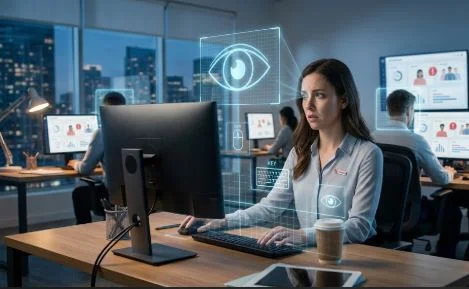
The growing use of digital surveillance software to monitor employees at major Canadian companies is raising concerns among workers, who say constant tracking of their computer screens, browsers, chats and meeting applications is increasing stress, anxiety and job insecurity.
A growing number of companies are using workplace monitoring tools to measure productivity. These systems can record how much time employees spend on different applications and how long they remain active on their computers.
Workers, however, argue that such measurements can place too much emphasis on screen activity rather than the quality and complexity of the work being performed.
TD Bank Introduces New Monitoring System
TD Bank told employees in its financial crimes and risk management teams in June that their screen activity would be monitored.
Reports indicate that the bank plans to use WorkiQ, software capable of tracking time spent across browsers, internal chat systems and meeting applications.
Employees in other parts of the bank have also expressed concerns about productivity-monitoring tools, saying the growing use of surveillance technology is contributing to pressure and anxiety in the workplace.
An employee working for TD in Edmonton, who spoke on condition of anonymity, said workers are concerned that the new system could create additional pressure over how they perform their jobs.
Concerns Over Stress and Job Security
The employee said her department has already been using ControliQ, another product developed by British technology company ActiveOps, the company behind WorkiQ.
According to the employee, ControliQ measures the amount of time workers spend on different tasks but does not record detailed activity such as every keystroke or mouse movement.
She said productivity figures generated by the system have been used for almost two years during meetings to compare employees, creating additional pressure for some workers.
Workers argue that many important tasks cannot be accurately measured through screen activity alone.
Reading documents, analyzing information, reviewing complex cases and thinking through difficult problems may involve little visible computer activity despite requiring significant time and expertise.
Could Monitoring Affect Bonuses and Promotions?
Employees are also concerned that low productivity scores could eventually affect their annual performance evaluations, bonuses or salary increases.
The TD employee said workers fear that being classified as less productive could initially result in verbal or written warnings and could eventually affect their employment records or even put their jobs at risk.
The broader concern, she said, is that a significant portion of an employee’s work cannot be measured simply by how long they appear to be active on a computer.
Microsoft Teams Status Under Scrutiny
The employee also said some managers monitor employees’ Microsoft Teams status, including whether they appear “Active” or “Away.”
Workers argue that such indicators do not provide a complete picture of actual performance.
Nevertheless, the constant visibility of these digital indicators can create the feeling that employees are being watched throughout the working day.
Meta Also Halted Employee Tracking Program
Concerns over workplace surveillance are not limited to Canada.
Technology company Meta also halted a program in June that tracked employees’ keystrokes and mouse movements.
The program prompted privacy concerns among employees, with around 1,600 workers reportedly signing a petition opposing the monitoring system.
The decision highlighted a wider debate within the technology industry over how far employers should go when using digital tools to measure productivity.
Bell Employees Raise Similar Concerns
Employees at Canadian telecommunications company Bell have also raised concerns about workplace screen monitoring.
A long-serving Bell employee in Toronto said the company began using Verint software during the COVID-19 pandemic, when many employees were working from home.
The system uses measures such as screen time and mouse activity to assess workplace indicators including “occupancy” and “effectiveness.”
Workers Fear Disciplinary Action
According to the Bell employee, workers who fail to meet required effectiveness targets can initially face verbal warnings followed by increasingly serious disciplinary measures, potentially leading to termination.
She said constant monitoring has had a significant negative effect on her mental well-being.
The employee described the experience as particularly distressing for workers with decades of experience who nevertheless feel as though someone is constantly watching their every move.
Companies Defend Productivity Tools
TD Bank spokesperson Mike Ramos did not directly respond to questions about the specific software or the concerns raised by employees.
He said, however, that like many organizations, TD uses workflow tools in certain areas to understand how work is being performed and identify ways to make processes more efficient.
ActiveOps has similarly defended its technology.
The company says its tools are designed to provide organizations with information that can help them better plan workloads and allocate resources.
The company is now promoting WorkiQ under the term “Application Mining.”
However, ActiveOps had previously described WorkiQ on its website more explicitly as employee monitoring software, language that was later changed.
Privacy and Employee Rights at the Centre of Debate
The growing use of workplace surveillance technology is intensifying debate in Canada over employee privacy, workplace rights, trust and well-being.
Workers acknowledge that technology can help companies understand workloads and improve business processes. Their concern is that when monitoring systems are used as a tool for constant surveillance or punishment, they can create fear rather than trust.
The central question is becoming increasingly difficult for employers, workers and policymakers:
How far should companies be allowed to go in monitoring employees’ digital activity in the name of productivity, and what limits should be established to protect workplace privacy and employee well-being?
As digital monitoring becomes more common, the debate is likely to expand beyond productivity and efficiency to broader questions about privacy, workplace culture and the future relationship between employers and employees.