

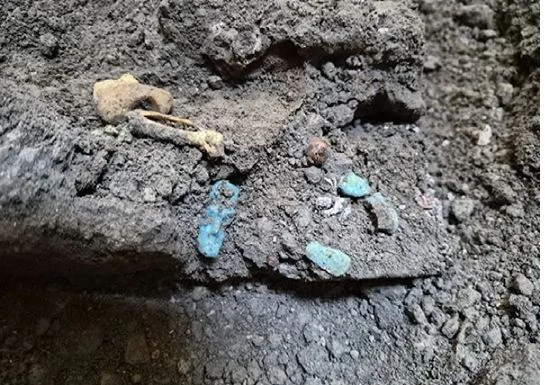
Archaeologists working in the ancient Italian city of Pompeii have uncovered a rare perfume bottle believed to be around 2,000 years old, along with several other historical artefacts offering a glimpse into everyday Roman life.
The objects were discovered inside an ancient cupboard in the rear section of a house. The collection includes children’s necklaces, 38 bronze coins, lead weights and decorative items.
According to researchers, the discovery could provide valuable insights into domestic routines, personal belongings and the way people lived in Roman society nearly two millennia ago.
Perfume Bottle, 38 Bronze Coins and Children’s Necklaces Discovered
The ancient cupboard contained several objects believed to have been used by the household’s residents.
The discoveries include:
- A rare perfume bottle dating back approximately 2,000 years.
- Necklaces associated with children.
- 38 bronze coins.
- Lead weights used for measuring.
- Various decorative objects.
Archaeologists say finding these items together in one cupboard offers an opportunity to study how Roman households stored their belongings and organised everyday life.
The children’s necklaces and personal decorative objects are particularly significant because they may provide further clues about the private lives of the people who lived in the house.
Who Owned the Cupboard in Pompeii’s Regio IX?
The cupboard was discovered in the rear section of a house in Regio IX, one of the archaeological districts of Pompeii.
The property has been tentatively associated with an individual named Cornelius Maximus. However, inscriptions found on the cupboard have deteriorated over time, making it impossible to establish its ownership with certainty.
Researchers have also used archaeological traces and surviving marks to reconstruct the cupboard’s original appearance and structure.
The work is helping experts understand not only the interior arrangement of the ancient house but also how household objects were stored during the Roman period.
Mount Vesuvius Eruption Buried Pompeii in 79 AD
Pompeii is among the world’s most famous archaeological sites. In 79 AD, the city was buried under volcanic ash and other material following the catastrophic eruption of Mount Vesuvius.
The volcanic deposits covered homes, streets, shops and countless everyday objects, preserving them for centuries.
This disaster turned Pompeii into an extraordinary historical record of Roman civilisation. Archaeologists have since recovered evidence revealing how people lived, ate, worked, dressed and interacted with one another.
The preservation of ordinary household objects has made the ancient city especially valuable for understanding daily life nearly 2,000 years ago.
Renovation Work Was Underway Before the Eruption
Researchers believe the house where the cupboard was found was undergoing repairs and renovation before Mount Vesuvius erupted.
This assessment is based on the building’s architectural features and traces found on its walls and ceilings.
The ceiling’s decorative work appeared to be unfinished, with only basic plastering in place. Researchers also identified a window that seemed to have been added during a later stage of construction.
These details suggest that renovation and decorative work were still in progress when the volcanic eruption suddenly brought normal life in Pompeii to an end.
Archaeologists Reconstruct the Original Cupboard
Using surviving marks, remains and architectural evidence, researchers have worked to reconstruct the cupboard’s original design.
The reconstruction is helping them understand how the piece of furniture was built and how its contents may have been arranged and stored.
Discoveries of this kind are particularly important because they provide evidence of the interiors and domestic environments of ancient Roman homes.
The fact that the perfume bottle, children’s necklaces, coins and other objects were found together makes the discovery especially valuable for studying personal belongings and household life in Roman society.
Around Two-Thirds of Pompeii Has Been Excavated
Archaeological excavations over several centuries have uncovered approximately two-thirds of Pompeii, while research and excavation continue in the remaining areas.
Each new discovery reveals another aspect of ancient Roman civilisation.
Researchers say the latest collection of artefacts demonstrates how ordinary household objects can help uncover details of the past that might otherwise have remained unknown.
The 2,000-year-old perfume bottle, together with the children’s necklaces, coins and other objects, opens further opportunities to investigate personal decoration, childhood, household practices and everyday life in the ancient Roman world.
