Muhammad Aman Ullah
Published: August 3, 2026
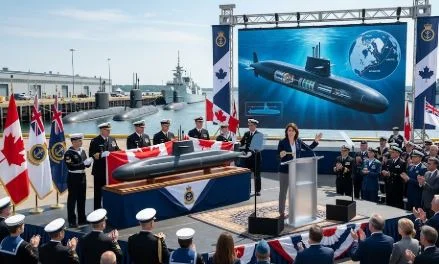
Calgary: Canada has announced a multi-billion-dollar submarine modernization program aimed at strengthening the country’s naval capabilities and protecting its maritime interests in an increasingly complex global security environment.
Prime Minister Mark Carney said the future submarine fleet will play a critical role in defending Canada’s coastlines, safeguarding national waters, and enhancing maritime security across the Atlantic, Pacific, and Arctic oceans.
Germany Selected as Preferred Bidder
Canada has chosen Germany’s ThyssenKrupp Marine Systems (TKMS) as the preferred bidder to build its next generation of diesel-electric submarines.
The new fleet will replace the Royal Canadian Navy’s aging Victoria-class submarines and significantly improve Canada’s underwater operational capabilities.
Protecting Three Oceans
Retired Vice-Admiral Darren Hawco said Canada’s unique geography requires a capable submarine force because the country is responsible for security across the Atlantic Ocean, Pacific Ocean, and Arctic Ocean.
He noted that the submarines would not be limited to domestic operations and could also participate in international missions in strategically important regions such as the Taiwan Strait, South China Sea, Mediterranean Sea, and Baltic Sea.
Safeguarding Undersea Infrastructure
One of the fleet’s key missions will be protecting critical underwater infrastructure.
Experts note that nearly 90 percent of global telecommunications traffic travels through undersea fibre-optic cables rather than satellites.
Former Royal Canadian Navy commander Mark Norman said recent geopolitical conflicts, including the early stages of the war in Ukraine, highlighted the vulnerability of underwater infrastructure and reinforced the need for enhanced maritime surveillance.
Growing Strategic Importance of the Arctic
The Arctic remains one of Canada’s highest defence priorities.
According to Hawco, Canada’s seabed claims overlap with those of Russia in parts of the Arctic Ocean, making the region increasingly important from both security and resource perspectives.
He pointed to the Lomonosov Ridge, an underwater geological feature believed to contain valuable natural resources that several Arctic nations claim as part of their extended continental shelves.
Protecting Future Mineral Resources
Experts say the ocean floor contains significant deposits of rare and valuable minerals that could become increasingly important for future technologies.
Canada plans to strengthen monitoring of its offshore resources through a combination of advanced submarines, underwater sensors, and autonomous unmanned systems.
Intelligence and Surveillance Missions
The future submarines will also perform intelligence gathering and covert surveillance missions.
Military analysts say they will be capable of tracking hostile ships, submarines, and other strategic targets while remaining difficult to detect.
Although underwater drones are expected to play a larger role in future naval operations, experts believe conventional submarines will remain indispensable because of their ability to operate silently over long periods.
The Advantage of Stealth
One of the greatest strengths of modern submarines is their ability to remain virtually undetectable beneath the ocean’s surface.
Mark Norman said the uncertainty created by an unseen submarine presents a significant strategic challenge for any potential adversary, making stealth one of the most valuable assets in naval warfare.
Why Canada Chose the German Design
Canada selected the Type 212CD submarine offered by Germany over South Korea’s larger KSS-III design.
Officials say the decision reflected a balance of military capability, economic considerations, and strategic partnerships.
The Type 212CD will be capable of deploying torpedoes and cruise missiles while providing advanced surveillance and deterrence capabilities without serving as a strategic nuclear platform.
Delivery Expected by 2034
The first submarines are expected to enter service around 2034, with the program projected to cost several billion dollars.
The initiative underscores Canada’s long-term commitment to strengthening Arctic sovereignty, protecting critical maritime infrastructure, and expanding its role in international security operations.