Muhammad Amanullah | August 13, 2026
The True Post (News Desk) — Trade negotiations between Canada and the United States have once again reached an apparent deadlock, with only days remaining before President Donald Trump’s latest tariff deadline.
Sources familiar with the negotiations say the two countries have not yet reached a point where they can agree on a final trade deal. Canadian officials are also reportedly dissatisfied with the latest proposal put forward by the United States.
According to sources, Washington presented Canada with a new proposal on Tuesday that included offers to reduce tariffs on certain sectors. However, the proposed reductions remain below the level of relief Canada is seeking.
Sources in both countries familiar with the talks said negotiations are continuing, but significant differences remain on several key issues.
50% Tariff Deadline Looms
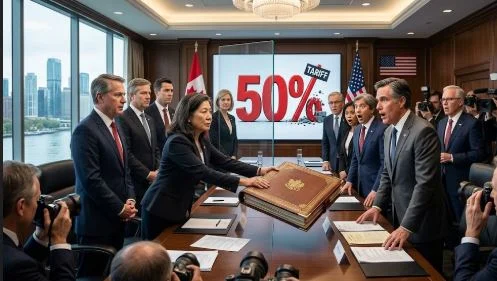
U.S. President Donald Trump has announced plans to impose a 50% tariff on hundreds of Canadian goods starting August 19.
The new tariff would come on top of existing sector-specific tariffs already imposed on various Canadian products.
With the deadline approaching, negotiators from both countries have been holding intensive discussions for several weeks in an effort to reach an agreement that could prevent the new tariffs from taking effect.
Canada has also warned U.S. officials that if the 50% tariffs are imposed on August 19, public and political support in Canada for continuing negotiations with Washington could decline further.
New U.S. Demands
According to sources, the U.S. government is seeking an agreement that would provide the United States with preferential access to Canada’s critical mineral resources.
The proposed agreement could also include energy and security-related issues, while Washington is seeking action from Canada on several other trade concerns.
Canada, meanwhile, wants the United States to significantly reduce additional tariffs imposed on key sectors, including steel, aluminum, lumber and automobiles.
LeBlanc in Washington
Canadian Trade Minister Dominic LeBlanc has met with U.S. Trade Representative Jamieson Greer three times in Washington over the past three weeks.
LeBlanc and Canada’s chief trade negotiator, Jénica Charette, were also seen leaving Greer’s office on Tuesday, but neither responded to questions from reporters.
LeBlanc later said on social media that negotiations were continuing and that he would remain at the negotiating table with Charette.
His office confirmed by Wednesday evening that both the trade minister and chief negotiator remained in Washington.
Canada Seeks Significant Tariff Relief
Canada is seeking to prevent the new 50% tariffs while also securing reductions in existing U.S. sector-specific tariffs.
The Canadian government is particularly seeking relief on tariffs affecting steel, aluminum, lumber and automobiles.
Canada also wants the current negotiations to help establish a path toward future talks on the renewal of the Canada-United States-Mexico Agreement (CUSMA).
The Trump administration rejected extending the agreement beyond 2036 last month, increasing the importance of the current negotiations for Canada.
Daily Negotiations Until August 19
Sources say the two countries have agreed to continue negotiations at various levels every day until the August 19 deadline.
The goal is to maximize the possibility of reaching a compromise and develop a trade package that could be presented to President Trump.
Negotiators are working to establish a potential agreement as quickly as possible so that it can be presented to the Trump administration.
Pressure Mounts on Canada
The latest U.S. proposal has placed Canada in a difficult position.
On one hand, the Canadian government is trying to avoid potentially damaging U.S. tariffs. On the other, it must determine how far it can go in meeting Washington’s demands without compromising Canadian interests.
Sources say Canadian officials consider the latest U.S. offer insufficient because the proposed tariff reductions in some sectors are below the level Canada is seeking.
Ottawa is emphasizing that if Canada is expected to make progress on U.S. demands, it must receive clear and significant tariff relief in return.
Alcohol Dispute Remains an Issue
The U.S. government has also raised Canadian measures against certain American products as part of the broader trade dispute.
One of the issues involves the removal of American alcohol from shelves at provincially operated liquor stores in Canada. Washington has viewed the move as part of Canada’s response to U.S. trade policies.
Canadian officials appear willing to compromise on some of these demands.
According to industry sources, Canada is considering measures such as removing restrictions on American alcohol sales in exchange for tariff relief from Washington.
Opposition Pressure
The Canadian federal government is also facing pressure from the opposition during the trade negotiations.
Conservative Party Leader Pierre Poilievre has written to Prime Minister Mark Carney urging the government to take a tougher position in negotiations with the United States and avoid compromising Canadian interests.
Poilievre said Canadians deserve an agreement that includes zero tariffs on softwood lumber, the removal of sectoral tariffs on steel and aluminum, and a tariff-free arrangement for automobiles.
He has also called for Canada to receive a full exemption from “Buy American” requirements in infrastructure projects.
A Decisive Week for Canada-U.S. Trade
Canada-U.S. negotiations have now entered a decisive stage.
With the August 19 deadline approaching, both governments have very little time to resolve their remaining differences.
If the two sides fail to reach an agreement, hundreds of Canadian goods could face the threatened 50% tariff, potentially worsening already strained trade relations between Canada and the United States.
However, the decision to continue daily negotiations and the continued presence of Canadian officials in Washington suggest that both countries remain committed to pursuing a possible trade compromise until the final hours.