Muhammad Amanullah | August 21, 2026
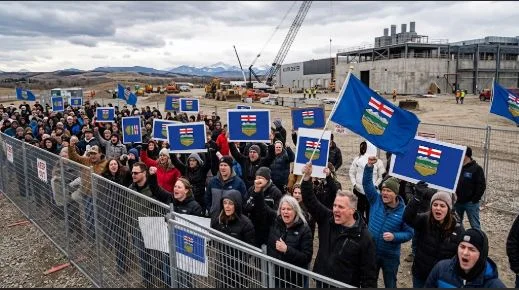
The True Post (Web News) — Plans to develop large artificial intelligence data centres in Alberta are becoming an increasingly difficult political issue for the provincial government, with Technology and Innovation Minister Nate Glubish facing strong criticism, difficult questions and angry reactions from residents at a town hall meeting in Sturgeon County.
The second public town hall on Alberta’s AI data centre strategy was held Thursday in Redwater, north of Edmonton, in the region where technology giant Meta is planning a major data centre project. Some attendees used profanity while addressing the minister, while others repeatedly interrupted his remarks with protests. (Global News)
Meta’s $13 Billion Data Centre Project
A major source of public concern is Meta’s planned data centre in Sturgeon County.
Meta announced in July that it plans to build a 1-gigawatt data centre representing an investment of more than C$13 billion. The project is expected to create more than 3,000 construction jobs at peak construction and support more than 300 permanent jobs once operational. (Meta Data Centers)
The project is also connected to a planned C$4.6 billion natural-gas-fired power facility intended to provide electricity for the data centre. The Greenlight Electricity Centre is expected to have approximately 932 megawatts of generation capacity and is currently scheduled to begin operating in the second half of 2030. (CityNews Calgary)
While the Alberta government views the investment as an important opportunity for technology, investment and employment, some local residents are concerned about the potential impact on water, electricity, land and other infrastructure.
Growing Distrust of the Government
Government transparency and regulation were among the major issues raised during the town hall.
Some residents questioned whether the provincial government would be able to properly regulate projects of this size and protect local communities from their environmental and economic impacts.
Opponents have also raised concerns about whether the government has adequately addressed questions surrounding water consumption, electricity demand and the long-term consequences of large AI facilities. (Global News)
The 30-Year-Old Zoning Argument
In response to questions about the Meta project, Minister Nate Glubish pointed to the existing zoning of the area.
The proposed data centre is located in an industrial area that has been zoned for this type of development for decades. Alberta’s government has argued that the project is therefore being developed in an area that was already designated for large-scale industrial activity.
However, some residents argued that the existence of industrial zoning does not automatically resolve questions about the environmental, economic and social consequences of a project of this scale.
Debate Over Local Jobs
Employment was another major issue during the meeting.
Residents questioned how many meaningful jobs the project would actually provide to people living in the surrounding communities.
The government’s position is that the project will create both direct and indirect economic benefits. Meta itself says approximately 3,000 construction workers are expected at peak construction, while the completed facility is expected to support more than 300 jobs. (Meta Data Centers)
The government has argued that these jobs and broader economic activity represent an important opportunity for Alberta.
Concerns Over Water and Electricity
Water and electricity consumption have emerged as two of the most important concerns surrounding AI data centres in Alberta.
Large AI facilities require substantial computing infrastructure and continuous power for servers and cooling systems. Residents therefore want clearer information about how these facilities will affect local resources and infrastructure.
Meta, however, says its Sturgeon Data Centre will use a closed-loop liquid-cooling system with dry cooling, meaning its cooling system is not expected to use operational water from surrounding sources. The company projects annual operational water use to be less than that of a typical golf course or a 50-acre canola farm in the region. (Meta Data Centers)
Meta also says it plans to add enough clean energy to Alberta’s grid to match 100 per cent of the electricity used by the Sturgeon Data Centre and will fund new generation and grid infrastructure associated with the project. (Meta Data Centers)
Government’s Reputation Also Under Pressure
The town hall also became a broader discussion about trust in Alberta’s United Conservative government.
Some attendees raised concerns about previous provincial decisions and questioned whether the government could be trusted to protect residents’ interests when approving major developments.
Glubish acknowledged the frustration and said he would work to ensure that AI data centre development takes place responsibly.
The minister has also argued that Alberta needs to establish itself as a major destination for AI investment rather than allowing those investments to move to other jurisdictions.
Second Consecutive Town Hall Faces Strong Opposition
The Redwater meeting was not the first event where Glubish faced significant opposition.
One day earlier, at a town hall in Lacombe, the minister faced jeers, boos, interruptions and challenging questions from residents concerned about the province’s plans for AI data centres. (constructconnect.com)
The repeated protests demonstrate that the issue has expanded beyond technology and investment.
For many residents, AI data centres are now connected to questions about water, electricity, environmental protection, land use, employment, government transparency and public trust.
Alberta Government Defends AI Investment
The provincial government maintains that artificial intelligence is rapidly transforming the global economy and that Alberta needs to take advantage of the investment and employment opportunities associated with the sector.
The province has been developing a strategy for large AI data centres while holding public meetings to explain its policies and hear concerns from residents. Another town hall involving Premier Danielle Smith and Glubish is scheduled to take place virtually on August 27, while another in-person meeting is planned for Grande Prairie in September. (DataCentre.ca)
Meta has meanwhile described its Sturgeon County project as one of the largest private-sector investments in Canadian history. The company says it will also invest approximately C$60 million in local infrastructure improvements, including roads and water infrastructure. (Meta Data Centers)
A Growing Political Challenge for Alberta
The controversy surrounding AI data centres is likely to remain a major issue in Alberta as more large-scale projects are proposed.
The government sees the developments as an opportunity to attract billions of dollars in investment, create jobs and position Alberta as a leading destination for artificial intelligence infrastructure.
Local opponents, however, want stronger guarantees regarding environmental protection, electricity costs, water resources, land use and the long-term responsibilities of companies operating these facilities.
The intense reaction at two consecutive town halls shows that the Alberta government’s AI strategy has become a significant public and political debate. How effectively the province responds to residents’ concerns could determine whether future AI data centre projects receive broader public support.