Muhammad Amanullah | August 24, 2026
The True Post (Web News) — A community in Quebec is taking a new approach to helping people living with dementia remain active and connected to society, as local businesses, municipal employees and emergency service workers receive specialized training to better understand the challenges faced by people with dementia and other neurological conditions.
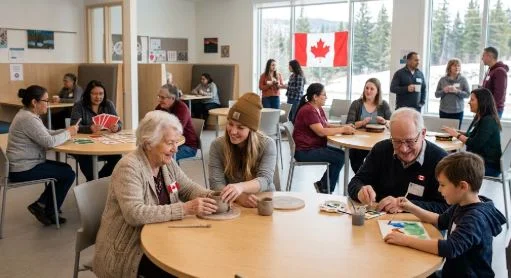
The initiative is being launched in Brome Lake, a town located about 100 kilometres east of Montreal. Organizers are working to develop a dementia-friendly community where people living with dementia can continue to participate in everyday activities with greater independence, dignity and confidence.
The project focuses on practical changes that could make public spaces and services easier to use, including libraries, gas stations, supermarkets and restaurants.
Brome Lake Begins Dementia-Friendly Community Project
The pilot project is being led with the involvement of the Alzheimer Society of Brome-Missisquoi and Haute-Yamaska, which has received federal financial support for the initiative.
The organization is working with local businesses, municipal employees and emergency personnel to provide training on dementia and the difficulties that people living with the condition may encounter in everyday situations.
The objective is to make community services more accessible while also helping residents better understand how to communicate with and assist people living with dementia.
Organizers believe that creating a dementia-friendly environment can help prevent people from becoming socially isolated after receiving a diagnosis.
Focus on the Person, Not the Diagnosis
One of the main goals of the initiative is to change how communities view people living with dementia.
Frances Proto, one of the people involved in the project, said the aim is to ensure that a dementia diagnosis does not lead individuals to withdraw from their communities or abandon activities they previously enjoyed.
Veronique Breuillette, coordinator of psychosocial services and training at the local Alzheimer Society, said society needs to change the way it thinks about dementia.
A person may have Alzheimer’s disease or another form of dementia, but the condition is only one part of that person’s life. Individuals continue to have their own personalities, values, experiences, interests and personal histories.
The project therefore aims to encourage businesses and community organizations to see the person first rather than focusing exclusively on the disease.
Everyday Activities Can Become Difficult
Dementia can affect memory, communication, decision-making and a person’s ability to navigate unfamiliar situations.
For some people, tasks that once appeared simple can become increasingly difficult.
Pauline Quinlan said her 84-year-old husband, Patrick, is living with dementia. Although he remains physically capable, he sometimes requires additional assistance with everyday activities.
Quinlan said even ordering food at a restaurant can occasionally become challenging.
The experience highlights why small changes in public services can make a significant difference for people living with dementia.
Navigating Public Places
According to Breuillette, people with Alzheimer’s disease or other forms of dementia can experience difficulty finding their way around unfamiliar environments.
For example, a person visiting a café or shop may have trouble finding a washroom or identifying the exit.
Restaurants can also present challenges when menus contain too many choices or complicated descriptions.
Organizers say simple language, clear signs and pictures could make it easier for customers living with dementia to understand their surroundings and make decisions independently.
Such measures could allow people to continue visiting restaurants, stores and other public places without requiring constant assistance from family members or caregivers.
Training for Local Businesses
Training is a major component of the Brome Lake initiative.
Local businesses and service providers will be taught how to recognize some of the difficulties associated with dementia and how to respond appropriately.
Instead of interpreting unusual or confused behaviour as disruptive, employees will be encouraged to consider whether the person may be experiencing difficulty understanding their surroundings or communicating what they need.
The training is intended to give employees practical tools to provide assistance while respecting the person’s independence and dignity.
Businesses Joining the Initiative
Some local businesses have already expressed support for the project.
Local resident Jennifer Brodeur said she supports the initiative because she would want to be treated as an active and respected member of society if she were ever diagnosed with dementia herself.
The organizers believe this type of community involvement is essential because people living with dementia frequently interact with businesses and public services as part of their normal daily routines.
Creating a more supportive environment could make it easier for them to continue those activities.
Dementia Diagnosis Does Not Mean Social Isolation
A dementia diagnosis can be difficult for individuals and their families, and in some cases it can lead to social isolation.
Some people may hesitate to tell friends, neighbours or members of the community about their diagnosis because they fear being treated differently.
Advocates say this can create a cycle in which people gradually withdraw from social activities even when they remain capable of participating.
Breuillette stressed that a dementia diagnosis should not mean that a person has to stop taking part in community life.
With appropriate support, understanding and accessible environments, people living with dementia can continue to participate in many everyday activities.
Canada’s Aging Population Adds to the Challenge
The Brome Lake initiative comes as Canada faces a growing need for dementia-related services and support.
The country’s aging population means that the number of Canadians living with dementia is expected to increase in the coming years.
According to the Alzheimer Society of Canada, hundreds of thousands of Canadians are currently living with dementia, and that number is projected to reach about one million by 2030.
The growing number of people affected by dementia is increasing pressure on families, caregivers, health services and communities to develop more effective forms of support.
Other Canadian Communities Taking Action
Brome Lake is not the only Canadian community working to develop dementia-friendly environments.
Other communities, including Calgary and Waterloo in Ontario, have also introduced initiatives aimed at improving the experiences of people living with dementia.
These programs can involve public education, staff training, improved signage, accessible community spaces and stronger connections between people living with dementia and local organizations.
The organizers of the Brome Lake pilot project hope that its experience can eventually provide a model for other communities across Quebec.
Building a More Inclusive Community
For families caring for someone with dementia, having a community that understands the condition can make everyday life considerably easier.
Pauline Quinlan said a community where people understand dementia and are prepared to offer appropriate assistance could become increasingly important as Canada’s population ages.
The goal is not to create a separate world for people living with dementia, but to make existing communities easier for them to navigate and enjoy.
The Brome Lake project reflects a broader shift toward supporting people with dementia in their own communities rather than viewing the diagnosis as a reason for social withdrawal.
If the pilot project succeeds, organizers hope its approach can be expanded to other parts of Quebec and potentially serve as an example for communities elsewhere in Canada.
For people living with dementia and their families, the message behind the initiative is straightforward: a diagnosis does not end a person’s participation in society. With understanding, practical support and accessible public spaces, people can continue to live active, connected and dignified lives within their communities.