Toronto — Muhammad Amanullah | September 16, 2026
Former Canadian prime minister and longtime Conservative Party leader Stephen Harper has backed the federal government’s decision to step away from trade negotiations with the United States, saying Canada had no clear alternative under the current circumstances.
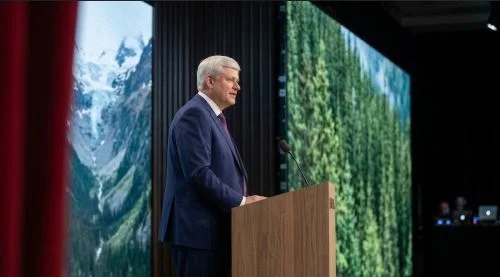
Speaking at the first Canada Investment Summit in Toronto, Harper said the government’s decision was difficult but necessary. He argued that Canada must reduce its economic dependence on the United States while strengthening its sovereignty and industrial capacity.
Harper Calls for Reduced Dependence on the US
Harper said the changing nature of Canada-US relations was personally disappointing to him. He has previously described himself as perhaps the most pro-American prime minister in Canadian history, but said current circumstances had forced Ottawa to reconsider its economic strategy.
According to Harper, the current US administration does not view the deep economic integration between Canada and the United States as fully compatible with the two countries maintaining separate sovereignty.
He said Canada therefore needs to reduce its dependence on the United States and make its economy more competitive domestically, better connected to the rest of the world and more economically independent.
Harper warned that if Canada fails to take steps to maintain and strengthen its industrial capacity, US policies could have significant effects on the Canadian economy.
Investment Summit Sets Ambitious Expectations
Harper made his remarks during the closing session of the Canada Investment Summit hosted by Prime Minister Mark Carney.
The summit brought together business leaders, foreign investors, current and former politicians and other prominent participants from across the country.
The event was aimed at supporting efforts to attract approximately $1 trillion in investment to Canada over the next five years, with a focus on major projects, energy, infrastructure and other key sectors.
Harper praised the summit and described it as an important initiative. With a smile, he joked that it was such a good idea that he wished he had thought of it himself.
Energy Seen as a Major Canadian Advantage
The former prime minister also highlighted Canada’s natural resources as a major economic advantage.
He said Canada needs to move more quickly toward becoming an energy superpower, arguing that the sector is critical to the country’s prosperity and long-term economic future.
Harper said Canada previously had an opportunity to establish a stronger position in global energy markets, but argued that policies adopted by governments after 2015 prevented the country from fully taking advantage of that potential.
Rather than dwelling on the past, however, he said Canada should focus on the opportunities currently available.
He also praised the Carney government’s efforts to accelerate approval processes for major projects, including projects related to Alberta’s oil sands.
Investors Need Greater Regulatory Certainty
Harper also urged the government to take practical steps beyond holding investment summits.
He said Canada has regulatory barriers and restrictions that do not exist to the same extent in other countries, making reforms to approval and permitting processes necessary.
Investors, he said, need clear and reliable timelines and a predictable policy environment when deciding whether to proceed with major projects.
Harper warned that if Canada does not remove these barriers, the United States will continue to be the largest buyer of Canadian products, while Washington will have less urgency to meet its needs from Canada than Ottawa may have in accessing the US market.
Harper and Carney Have Had Differences in the Past
Harper’s positive comments about some of the Carney government’s policies are notable because the two have previously disagreed over political and economic issues.
Last year, Harper criticized some of Carney’s claims regarding his role in Canada’s economic situation during the 2008 global financial crisis. At the time, Carney was governor of the Bank of Canada, while Harper was prime minister and Jim Flaherty was finance minister.
During the 2025 federal election campaign, Harper also openly supported Conservative leader Pierre Poilievre against Carney.
In recent months, however, Harper has placed greater emphasis on reducing Canada’s economic dependence on the United States and strengthening national unity.
Changing Circumstances Shape Harper’s Position
In February, Harper also said Canada should consider imposing tariffs on US products, warning that unilateral trade restrictions could seriously damage Canada’s manufacturing sector.
Following the current impasse in trade negotiations with Washington, the Carney government has taken retaliatory measures, while Harper has argued that Canada needs to diversify its economy and expand its relationships with markets beyond the United States.
Harper said strong relations with the United States have always been important to Canada, but the current circumstances also provide an opportunity for the country to make greater use of its economic capacity, natural resources and international relationships.