Muhammad Amanullah
Date: October 13, 2026
The True Post (Web News) —
The campaign surrounding Alberta’s possible separation from Canada has entered its final phase, with political leaders stepping up speeches, public rallies and door-to-door outreach. Advance voting is scheduled to begin on Tuesday, ahead of the official polling day on Monday, October 19.
Alberta voters will be asked to respond to 10 questions. The most closely watched is whether the province should remain part of Canada or move towards a second and final referendum on separation.
Political Leaders Campaign for Canadian Unity
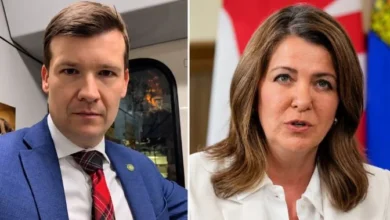
Former Alberta United Conservative Party premier Jason Kenney and former Alberta New Democratic Party premier Rachel Notley, who were political rivals during their time in office, are scheduled to speak at an event in Edmonton on Tuesday. Both support keeping Alberta within Canada.
On Friday, federal Conservative Party leader Pierre Poilievre and Alberta Premier Danielle Smith are expected to address an audience in Calgary. Both have expressed support for Alberta remaining part of Canada.
The pro-Canada organisation Forever Canadian plans to hold gatherings in Calgary on Thursday and Edmonton on Friday. Separate events supporting separation and Canadian unity are also planned in Edmonton over the weekend. The separatist group Let Alberta Decide has announced a rally for Saturday, while the Alberta Federation of Labour plans to hold a pro-Canada rally on Sunday.
Door-to-Door Campaigning and Efforts to Mobilise Voters
Federal Conservative MP Dane Lloyd has been campaigning for Alberta to remain in Canada by visiting households and attending public events. He says voter participation will be crucial and that direct engagement with residents has no substitute.
Prime Minister Mark Carney and members of his Liberal cabinet have not yet announced their upcoming schedules related to the referendum. However, they have visited Alberta several times in recent months. During those visits, announcements included efforts to advance a proposed new oil pipeline from Alberta to the Pacific coast, as well as billions of dollars in ongoing defence spending.
The Alberta NDP opposition says it is running an extensive campaign to keep the province within the Canadian federation. According to the party, more than 15,000 volunteers are involved, contacting voters door to door and by telephone to encourage them to cast their ballots.
NDP leader Naheed Nenshi has criticised Smith, saying his party is trying to fill what he describes as a political vacuum left by the premier and her allies.
Nenshi Accuses Smith of Falling Short on Her Promise
Nenshi says Smith promised to actively campaign for Canadian unity but has not fully delivered on that commitment. Last week, he also criticised members of Smith’s cabinet for travelling abroad instead of focusing on efforts to mobilise voters.
Nenshi argued that ministers should be knocking on doors, speaking directly with residents and encouraging them to participate in the vote. He said the conduct of some government members appeared more consistent with the separatist position.
Smith has rejected the criticism, saying she has expressed support for Alberta remaining in Canada in speeches and at public gatherings. Her government has also launched a $4 million advertising campaign promoting the message that Alberta can be a strong and autonomous province within a united Canada.
Speaking on a podcast last week, Smith said she also attends events where separatist supporters are present. She said she tries to explain that Alberta can protect its interests while remaining in Canada and that the country can work more effectively.
Ten Questions Cover Separation and Constitutional Powers
The separation question appears last on the referendum ballot, as question number 10. The first nine questions concern immigration and constitutional matters.
Smith wants voters to support the first nine proposals, which she believes would strengthen her government’s position in negotiations with the federal government.
The immigration questions ask whether Alberta should have greater control over the selection of people coming to the province to work. Other proposals concern imposing additional restrictions—and potentially fees—on certain newcomers seeking access to health care and education services.
The constitutional questions ask voters whether Alberta should negotiate with other provinces to limit federal government powers and pursue the abolition of the Senate.
Smith’s United Conservative Party did not promise a separation referendum during the 2023 provincial election campaign. However, she argues that dissatisfaction with the federal system grew among some Albertans during former Liberal prime minister Justin Trudeau’s time in office. According to Smith, substantial numbers of signatures were subsequently collected both in support of remaining in Canada and in favour of separation, making a referendum necessary to address the issue.
Smith Faces Criticism From Both Sides
Smith has faced criticism from separatists as well as supporters of Canadian unity.
Some separatist supporters consider her proposed approach too limited because, in their view, it would open the door to further planning rather than deliver immediate separation.
Critics who support Canadian unity argue that Smith is contributing to uncertainty about the country’s future while simultaneously presenting herself as a defender of national unity.
Opinion polls conducted before and after the referendum announcement have continued to indicate support for Alberta remaining in Canada. Critics, including Nenshi, argue that the referendum was intended less to settle the country’s future than to satisfy hard-line separatists within Smith’s own political base.
Recent political developments have also created challenges for the premier’s party. Polls have suggested declining support for the United Conservative Party and rising popularity for the NDP. The next provincial election is expected in approximately a year.
Last month, Smith’s party also lost a Calgary byelection in a constituency long regarded as a stronghold for the United Conservatives.
Questions have also been raised about the presence of separatist supporters within Smith’s party. The premier maintains that the party can formally support Canadian unity while allowing its members to hold differing views.
When Will the Results Be Announced?
According to Alberta election officials, counting for the separation question will begin first on referendum night. The result is expected to become available in the early hours of the following morning.
Smith has said that a simple majority on the separation question would be treated as decisive.
However, the results of the other nine questions may leave several issues unresolved, particularly the precise nature of proposed immigration rules and the groups of people to whom they would apply.
Smith’s government says it plans to determine its next steps during the autumn if the proposals receive public support. Last week, reporters asked the premier how the government would decide how much authority the results gave it to proceed.
Smith said the government would consider both voter turnout and the results. She indicated that a clearer direction on the next steps could be provided on October 20.