The True Post (Web News)
Muhammad Aman Ullah
Published: September 9, 2026
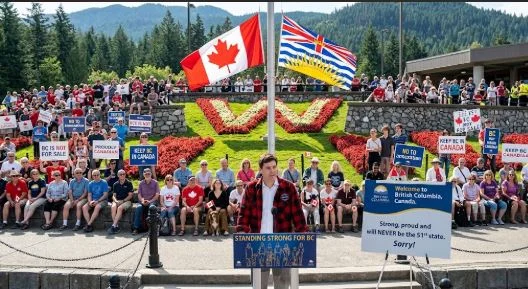
British Columbia Unveils New Border Welcome Signs
British Columbia Premier David Eby has unveiled new welcome signs at border crossings along the Canada-U.S. border carrying a direct message for American visitors: British Columbia is a strong and sovereign part of Canada and will never become the 51st U.S. state.
Eby revealed the new signs during a news conference on Tuesday.
The signs feature a message welcoming visitors to British Columbia while emphasizing the province’s identity within Canada: “Welcome to British Columbia, Canada — strong, confident and never the 51st state. Sorry!”
Response to Trump’s 51st State Comments
Eby’s move comes amid continued attention over U.S. President Donald Trump’s repeated comments about Canada potentially becoming the 51st U.S. state, as well as ongoing trade tensions between the two countries.
The B.C. premier said the new signs are more than a simple welcome message. They are also intended to communicate a clear position on Canadian sovereignty, national identity and the province’s place within Canada.
Remembering September 11
During the news conference, Eby also referred to the September 11, 2001 terrorist attacks in the United States.
He recalled that after the attacks disrupted air travel, thousands of stranded passengers ended up at Vancouver International Airport. Canadians opened their homes to people from their southern neighbour during the difficult period.
According to Eby, approximately 8,500 passengers were affected by the disruption, and Canadians did not hesitate to help American travellers.
Canada Helped in Difficult Times
Eby said that 25 years later, relations between the two countries are again facing a difficult period.
Despite criticism from the United States, what he described as unfair tariffs and statements questioning Canada’s independence and sovereignty, Eby said Canadians would not forget their tradition of hospitality and humanitarian support.
He said that if American citizens once again face serious difficulties in the future, Canadians would be willing to help their neighbours again.
Kindness Should Not Be Mistaken for Weakness
The B.C. premier emphasized that Canada’s willingness to help its neighbours should not be interpreted as weakness.
He said compassion and kindness are among Canada’s greatest strengths, but that does not mean the country will compromise its interests or sovereignty.
According to Eby, Canada can stand with its neighbours during difficult circumstances while also taking a firm position to protect its national interests.
Canadian Retaliatory Tariffs Take Effect
Eby’s comments came as Canada’s retaliatory tariffs against the United States took effect on Tuesday.
The federal government has imposed additional tariffs on a range of American products in response to U.S. trade measures.
The ongoing tariff dispute has increased economic and political tensions between the two countries while also prompting provinces to introduce or maintain their own responses.
B.C. to Maintain Measures Against U.S. Trade Actions
Eby said British Columbia would maintain some of its measures in response to U.S. trade actions.
The province will also continue its policy of keeping American alcoholic beverages off the shelves of provincial stores.
Restrictions on American Alcohol Remain
Eby said keeping American alcohol products off store shelves is part of British Columbia’s response to what he described as an unfair trade war initiated by the Trump administration.
He said the province would continue taking measures within its jurisdiction to protect Canadian businesses and consumers.
More Measures Under Consideration
The B.C. premier said his provincial government remains in close contact with the federal government.
Officials are examining additional potential measures that could help protect Canadian residents and businesses from the economic effects of the trade dispute.
No Compromise on Sovereignty
Eby’s remarks make clear that British Columbia wants to take a firm position not only on the ongoing trade dispute with the United States but also on questions surrounding Canadian sovereignty and national identity.
The new signs at border crossings are part of that broader public message.
By welcoming American visitors while explicitly rejecting the idea of British Columbia or Canada becoming part of the United States, the province is emphasizing that Canada’s independence, identity and sovereignty are not open to compromise.