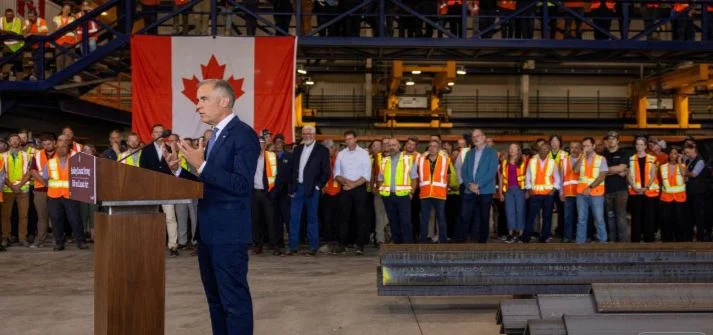
Canada is facing a challenging economic period as the government grapples with several pressures at once, including trade tensions with the United States, the need to protect domestic industries, sluggish economic growth, rising federal deficits and the challenge of making housing more affordable.
Prime Minister Mark Carney’s government faces a difficult balancing act: supporting industries affected by US tariffs without allowing the cost of that assistance to place additional strain on federal finances.
According to an October 20, 2026, report by the Parliamentary Budget Officer (PBO), Canada’s real gross domestic product (GDP) is projected to grow by 0.9 per cent in 2026 and 1.5 per cent in 2027. The report identifies trade conditions with the United States and uncertainty surrounding tariffs as important factors weighing on economic growth.
Why Trade Tensions With the US Threaten Canadian Industries
Canada and the United States maintain deeply interconnected trading relationships. Many Canadian products are sold in American markets, while manufacturing and supply chains in both countries depend on cross-border trade.
When Washington threatens higher tariffs on Canadian goods or trade negotiations stall, the consequences extend beyond exporters. Businesses may need to reconsider production costs, investment plans, employment levels and future orders.
Industries such as steel and automotive manufacturing are particularly exposed to uncertainty, which can discourage investment and complicate long-term planning.
Against this backdrop, Carney and Ontario Premier Doug Ford have announced a joint package worth approximately C$9 billion. The measures include support for the steel industry to access new markets and diversify production, assistance to modernize automotive manufacturing for electric vehicle production, and funding for road infrastructure in the Ring of Fire region.
These initiatives suggest that governments are seeking not only to limit immediate economic damage but also to restructure parts of the industrial economy and diversify export markets.
However, government assistance cannot eliminate every risk. If US tariffs remain in place for an extended period, Canadian products could continue to face competitive disadvantages, weaker business profitability and reduced investment. On the other hand, timely investment in industrial modernization could help Canada reduce its dependence on a single trading partner over the longer term.
C$9 Billion Industrial Package: Short-Term Relief or Long-Term Investment?
One of the package’s objectives is to help affected companies adapt their operations to changing trade conditions.
For the steel industry, gaining access to new markets and diversifying production are important because changes in one country’s trade policy can influence business decisions throughout an entire sector.
Investment in modern machinery and production lines for electric vehicles could also help Canada’s automotive industry prepare for future market demand. However, the benefits may not materialize immediately. Developing new technologies, expanding industrial capacity and establishing alternative markets all take time.
The government must therefore pursue two objectives simultaneously: protecting existing jobs and industrial capacity while laying the foundations for a more competitive economy.
If the funding is used effectively, it could help businesses adapt to changing conditions. But if trade tensions persist and the desired industrial transformation fails to materialize, economic pressures could remain despite substantial public spending.
Federal Budget and the Growing Burden of Debt
Another major challenge is the federal government’s fiscal position.
According to the Parliamentary Budget Officer’s October projections, Canada’s federal deficit is expected to reach C$63.3 billion in the 2026–27 fiscal year. The deficit could rise to C$67.8 billion by 2030–31.
The report estimates that cumulative deficits over the next five years will total C$333.3 billion.
These figures highlight the pressure on the government to maintain fiscal discipline while funding economic development and protecting industries affected by trade disruptions.
A budget deficit does not automatically mean government investment has failed. Spending on infrastructure, technology, energy and productive capacity can generate long-term economic benefits if projects strengthen productivity and create sustainable growth.
However, achieving those benefits requires effective project delivery, measurable economic outcomes and a debt trajectory that remains manageable over time.
The federal budget scheduled for November 5 will therefore be an important test for the Carney government. It will need to demonstrate how industrial assistance, infrastructure investment and economic development plans can be reconciled with the government’s fiscal objectives.
Housing Affordability and the Purchasing Power of Ordinary Canadians
Economic policy affects more than major corporations and government balance sheets. For ordinary Canadians, the central concerns are employment opportunities, wages, rent, the ability to purchase a home and the rising cost of everyday necessities.
In October, the Bank of Canada emphasized that Canada still has considerable work to do to make housing affordable.
According to the central bank, addressing the problem requires more than changes to interest rates. Increasing housing supply, improving planning processes and infrastructure, and avoiding policies that further stimulate demand when supply remains inadequate are also important.
This is significant because lower interest rates can make borrowing more affordable, but housing prices and rents may remain under pressure if the number of available homes fails to keep pace with demand.
Conversely, a sharp decline in home prices could affect the wealth and financial security of existing homeowners.
Resolving the housing crisis will therefore require a combination of policies rather than reliance on any single measure.
Canada Faces a Difficult Economic Balancing Act
Canada’s economic outlook reflects the interaction of several challenges: uncertainty over US trade policy, modest growth projections, pressure on federal finances and persistent housing affordability problems.
The government’s response will require careful decisions about where public money is spent, which industries receive support and how investment can generate lasting economic benefits.
Supporting businesses affected by tariffs may help protect jobs in the short term, while industrial modernization and market diversification could strengthen the economy over time. However, the effectiveness of these measures will depend on implementation, business investment and developments in international trade.
At the same time, Canadians will judge economic policy by its impact on their daily lives, including employment prospects, housing costs and purchasing power.
The challenge for Carney’s government is to protect the economy against external shocks without creating unsustainable fiscal pressures, while ensuring that economic growth translates into tangible improvements for households across the country.