Author: Muhammad Amanullah
Date: August 21, 2026
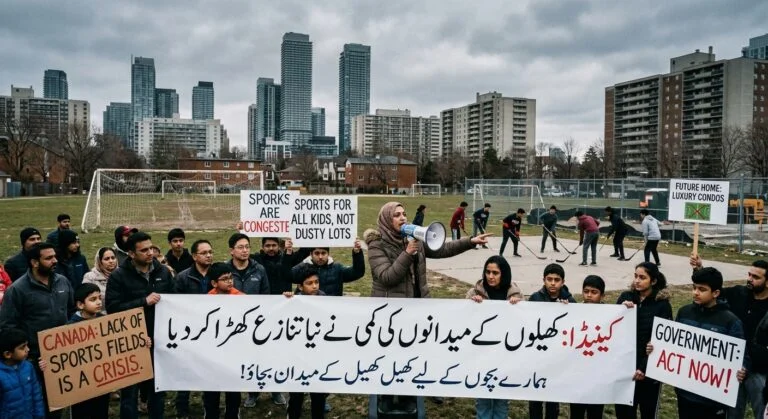
The True Post (Web News) — The growing competition between tennis and pickleball players in Canada may appear to be a disagreement between two sports communities, but urban planning and sports policy experts say the underlying issue is a serious shortage of public sports facilities and recreational spaces.
In several Canadian communities, tennis and pickleball players are increasingly competing for limited court space, creating disputes at the local level.
Experts say the long-term solution is not to give preference to one sport over another, but to significantly expand Canada’s overall recreational infrastructure. More courts, parks, sports fields, swimming pools and community recreation facilities could reduce tensions caused by competition for limited public resources.
Dispute Over Converting Tennis Courts for Pickleball
The growing popularity of pickleball has led several communities to use or convert existing tennis courts for the sport.
While the move provides pickleball players with additional space, it can reduce the number of courts available to tennis players.
In one Canadian community, two public tennis courts were converted into six pickleball courts, prompting local tennis players to oppose the decision. Some players called for the courts to be restored to their original purpose.
In another case on Mayne Island in British Columbia, a dispute between pickleball and tennis players over the use of public courts became serious enough to reach court proceedings.
Such disputes demonstrate how limited recreational infrastructure can increase competition between different sports communities.
The Problem Goes Beyond Tennis and Pickleball
Experts say the shortage of recreational facilities should not be viewed simply as a conflict between tennis and pickleball.
Urban communities are also facing pressure on hockey facilities, swimming pools, parks, sports centres and other public recreational spaces.
University of Toronto urban planning expert Matti Siemiatycki has highlighted the limited availability of space for different sports and recreational activities. According to the analysis presented in the source material, the conflicts between tennis and pickleball are part of a broader challenge involving urban planning and the allocation of public spaces.
Interest in Both Sports Increased After the Pandemic
Experts say public interest in outdoor recreational activities increased during and after the COVID-19 pandemic.
Tennis attracted new players after the pandemic, while pickleball experienced particularly rapid growth in popularity.
Pickleball is played on a smaller court and has different facility requirements from tennis. However, in communities without enough dedicated pickleball courts, players often turn to existing tennis courts.
This has contributed to competition between players from both sports for limited public court space.
New Housing Developments Need Recreational Facilities
Sports policy experts say future residential developments should not focus only on the number of homes and buildings being constructed.
Parks, sports fields, community centres and recreational facilities should also be incorporated into new developments.
University of Toronto sports policy expert Peter Donnelly has pointed to Canada’s historical approach to large-scale residential development, when parks, recreational areas and community centres were often developed alongside new housing.
Experts say greater attention should once again be given to recreational infrastructure as communities expand.
Reduced Development Funding Could Affect Parks
Urban planning experts have also raised concerns about changes to development-related fees and costs introduced in some areas as governments attempt to address Canada’s housing crisis.
The goal of reducing certain fees is to speed up construction and ease pressure on housing costs.
However, experts say these changes can also reduce the funds available to municipalities for building parks and recreational facilities, particularly in rapidly growing communities.
In Ontario, changes introduced in 2022 placed limits on certain community benefit fees. According to experts, such limits can affect the financial capacity of municipalities, especially in areas experiencing rapid population growth.
Private Facilities Alone Cannot Solve the Problem
Experts also emphasize that the responsibility for expanding recreational facilities cannot be placed entirely on the private sector.
If sports facilities are provided exclusively on a commercial basis, the cost of using them may become unaffordable for some residents.
Public courts and sports fields are important because people from different income groups can use them at relatively low cost.
For that reason, experts argue that public recreational infrastructure should be treated as an important component of urban planning alongside housing, roads and other essential services.
Dedicated Pickleball Courts Could Reduce Tensions
Pickleball players argue that the sport has different requirements from tennis and that dedicated courts are better suited to its growing popularity.
If municipalities build enough dedicated pickleball courts, pressure on existing tennis courts could decrease.
At the same time, maintaining an adequate number of dedicated tennis courts would ensure that tennis players also have sufficient opportunities to play.
Rather than the growth of one sport coming at the expense of another, investment in dedicated facilities could allow both sports to expand.
More Courts and Better Planning Are the Real Solutions
The growing tension between tennis and pickleball highlights a broader issue: recreational infrastructure needs to grow alongside Canada’s population and increasing interest in sports.
Converting existing courts from one sport to another may provide a temporary solution, but it can create new complaints and conflicts in the long term.
Experts say a better approach would be for governments, municipalities and the development sector to work together to identify future recreational needs and allocate additional space for sports facilities.
New residential developments could include parks, courts and recreation centres from the beginning, while sufficient funding should be secured for public facilities.
Ultimately, putting tennis and pickleball players against each other is unlikely to solve the underlying problem. Providing adequate facilities for both sports would be a more sustainable approach.
If Canada increases the availability of public courts and recreational spaces, competition for existing facilities could decrease while opportunities for participation increase.
The same strategy could benefit not only tennis and pickleball players but also Canadians involved in a wide range of sports and recreational activities.