Muhammad Amanullah
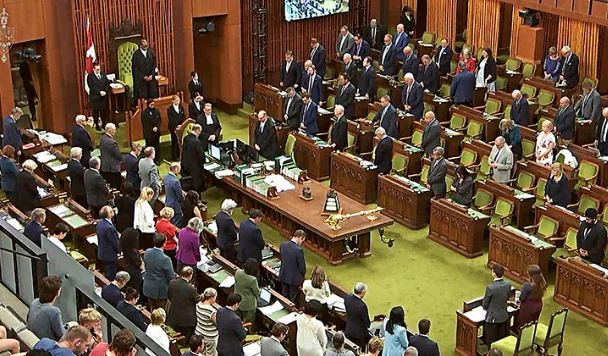
September 21, 2026 The True Post (Web News) —Canada’s Parliament is returning to work Monday after a three-month summer break, with the trade war with the United States, Prime Minister Mark Carney’s push for closer ties with the European Union and the cost of living expected to dominate the fall sitting.
The House of Commons is reconvening at a time when the government is placing greater emphasis on economic diversification, Canadian sovereignty and new international partnerships. At the same time, affordability and the state of the domestic economy are expected to remain important areas of political debate. (Yahoo Finance)
Political science professor Daniel Béland of McGill University said there is strong public support for Carney’s international approach, but cautioned that affordability could provide the opposition with an opportunity to challenge the government. (Yahoo Finance)
Government Promises to Address Cost of Living
Carney told Liberal MPs on Friday that his government would remain focused on lowering costs for Canadians while defending the country’s sovereignty.
The prime minister has also described the new parliamentary session as a crucial one, saying his government intends to introduce legislation that could have consequences for Canada for decades.
The government is therefore entering the fall sitting with both international relations and domestic economic issues high on its agenda.
Closer Relations With the European Union
Carney’s recent European tour has placed Canada-EU relations at the centre of the government’s foreign-policy agenda.
European Commission President Ursula von der Leyen recently floated the possibility of making Canada the European Union’s first “associate member.” The proposed status does not currently exist within the EU, and its exact structure and legal framework remain to be negotiated. Any formal agreement would require approval from the EU’s member states. (AP News)
Carney has welcomed the idea of significantly closer cooperation with Europe while making clear that Canada is not seeking full EU membership.
The proposed relationship could involve greater cooperation in areas such as energy, critical minerals, artificial intelligence, digital trade, defence and security.
Canada has already joined the EU’s SAFE defence procurement programme, becoming the first non-European country to participate in the initiative. (The Washington Post)
Carney has also said that any eventual enhanced partnership with the European Union would be debated in the Canadian Parliament and put to a vote.
Tensions With the United States
The Canada-US trade relationship remains another major issue facing the government as MPs return to Ottawa.
Trade negotiations between Ottawa and Washington were suspended in August after the Canadian government objected to certain US demands.
The dispute comes as both countries continue to deal with tariffs and broader uncertainty over the future of their economic relationship.
The government has increasingly emphasized the need for Canada to diversify its trade relationships and reduce its vulnerability to developments in the US market.
Trump Warns Over Canada-EU Relationship
US President Donald Trump has also reacted strongly to the possibility of closer Canada-EU ties.
Trump said last week that if Canada became the European Union’s first associate member, he could regard the move as a “hostile act.” He also warned of possible consequences for trade. (Reuters)
Carney, however, has maintained that Canada will make its own decisions about its international partnerships.
The Canadian government has described closer cooperation with Europe as an effort to strengthen economic and strategic resilience rather than as an attempt to create a bloc against the United States. (Reuters)
Major Legislation Expected in Parliament
The fall sitting is also expected to feature significant economic legislation.
The government is preparing the Building Canada Strong Act, legislation intended to streamline the review and approval process for major infrastructure projects.
Government House Leader Steven MacKinnon has described significant economic legislation as the centrepiece of the fall parliamentary agenda. A federal government briefing also confirmed that MacKinnon, Finance Minister Dominic LeBlanc and Jobs and Families Minister Patty Hajdu were scheduled to introduce legislation aimed at creating greater certainty for a more competitive and resilient Canadian economy. (Canada)
The government has argued that faster project approvals could help attract investment and accelerate infrastructure development at a time when Canada is seeking to strengthen its domestic economy.
Possible Changes to Labour Laws
Changes to federal labour legislation are also expected to generate debate.
The government has indicated that amendments to the Canada Labour Code could reduce the need for federal intervention during strikes.
The issue is likely to attract attention from labour organizations, employers and opposition parties because of its potential impact on collective bargaining and industrial disputes.
The government has presented the proposed changes as part of a broader effort to provide greater certainty for the economy and labour market.
Liberal Position in Parliament
The Liberal government is returning to Parliament with a strengthened position following three federal byelections held on August 31.
The Liberals won all three vacant seats: North Vancouver–Capilano, Beaches–East York and Chicoutimi–Le Fjord. Elections Canada’s validated results show Braeden Caley, Tanveer Shahnawaz and Daniel Gobeil won the respective ridings for the Liberal Party. (Elections Canada)
The results added three Liberal MPs to the House of Commons and changed the parliamentary arithmetic as the fall sitting began.
Conservative Opposition
Conservative Leader Pierre Poilievre is also returning to Parliament with the economy and affordability among his party’s major areas of focus.
Poilievre has argued that Canadians are facing financial pressures and has criticized the government’s approach to negotiations with the European Union.
The Conservatives have said they support free trade and continued NATO cooperation with European allies, while opposing the idea of Canada adopting EU taxation, laws or open-border immigration rules.
The debate over the EU proposal is therefore expected to continue in Parliament as the government considers what form any future Canada-EU partnership could take.
NDP Returns With Five MPs
The New Democratic Party is entering the fall sitting with only five MPs, excluding its leader Avi Lewis, who does not currently hold a seat in the House of Commons.
The caucus was reduced following the departure of longtime Quebec MP Alexandre Boulerice, who resigned his federal seat in August to pursue provincial politics. Earlier in the year, Nunavut MP Lori Idlout left the NDP and joined the Liberal Party. (Yahoo Finance)
Lewis has said he will not rush to seek a seat in Parliament and is instead focusing on rebuilding the party and maintaining contact with grassroots members. (Yahoo Finance)
The small NDP caucus will nevertheless be seeking to influence debates over affordability, workers’ rights, housing and the government’s economic policies during the fall sitting.
International Agenda Remains Important
Carney’s international schedule is also continuing as Parliament resumes.
Following his recent European visit, the prime minister has been pursuing closer relationships with European countries and other international partners while seeking to diversify Canada’s economic and strategic relationships.
His government has argued that stronger partnerships with Europe can help Canada expand markets and cooperation in areas including energy, critical minerals, technology and defence. (Reuters)
A Major Parliamentary Session Ahead
The fall sitting is set to combine major international questions with domestic economic debates.
The government will have to address the continuing trade dispute with the United States while developing its proposed relationship with the European Union. At the same time, MPs will debate infrastructure legislation, labour-law changes, affordability and other economic measures.
Carney has described the session as one of the most consequential of his government’s term, while MacKinnon has identified major economic legislation as a central component of the parliamentary agenda. (CKPG Today)
With Canada attempting to diversify its international relationships while dealing with trade uncertainty and domestic cost pressures, the coming parliamentary session is likely to remain closely focused on the country’s economic direction, international partnerships and the government’s plans for strengthening Canadian economic capacity.