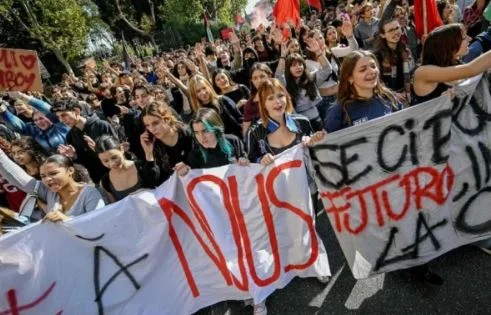
Millions of people across Italy took to the streets to protest rising inflation, increasing education costs and the growing housing crisis. Students, workers, farmers and people from various sectors joined nationwide demonstrations, demanding greater government investment in education, affordable housing and measures to reduce the cost of everyday necessities.
According to AFP, Friday’s demonstrations were among the largest protest movements witnessed in Italy in recent months. In several cities, students occupied school buildings and established temporary protest camps to highlight their concerns about educational facilities and their future prospects.
A nationwide general strike was also organised at the call of Italy’s USB trade union. Truck drivers, taxi drivers, farmers and workers from other industries participated in the action. These groups have also been protesting for several weeks against rising fuel prices and the government’s decision to increase defence spending.
The USB union told AFP that between 1 million and 1.5 million people participated in demonstrations across the country. However, authorities have not released official figures confirming the overall number of protesters.
Students Highlight Poor School Conditions and Financial Pressures
In the capital, Rome, 16-year-old protester Sofia Cataldi expressed concern over deteriorating conditions in educational institutions. She said her high school building was unsafe for students, citing problems such as falling windows and the presence of rats.
Students are demanding clean, safe and properly maintained educational facilities.
University student Beatrice Chelleli, 21, said students were struggling with both expensive tuition fees and rising accommodation costs. According to her, renting a single room in Rome can cost as much as €1,200 per month, an expense that many families are forced to cover for their children.
Major Demonstrations in Rome and Milan
In Rome, protesters began marching from the city’s central railway station, passing major landmarks including the Colosseum before reaching the area near the Ministry of Economy.
Demonstrators carried banners and flags, calling on the government to prioritise education, housing and public services instead of increasing military and defence expenditure.
Protests also took place in Milan, where students and workers from different sectors joined forces. One of the banners displayed during the demonstration read, “Take Back Your Future.”
Stefano De Fines, a 25-year-old protest participant, expressed hope that collective action by people from different backgrounds and industries could eventually lead to lasting changes.
Clashes Between Police and Protesters in Some Cities
Although most demonstrations remained peaceful, tensions between police and protesters were reported in several locations.
In Turin, police used batons and water cannons to disperse demonstrators. In Rome, some young protesters threw bottles, overturned rubbish bins and set one of them on fire towards the end of the demonstration.
The incidents came after clashes between young demonstrators and police in Milan on October 17 and 18.
Following those incidents, Prime Minister Giorgia Meloni’s government introduced stricter regulations governing public gatherings and eased certain rules concerning the detention of minors.
Government Aid Package and Proposed Bonuses for Young Workers
Italy’s government approved a €175.2 million support package last week for truck drivers, farmers and fishermen affected by rising fuel prices.
Meanwhile, several measures for young people and families are being considered as part of the proposed 2027 national budget.
One proposal includes an annual bonus of €2,500 for workers under the age of 30.
Prime Minister Giorgia Meloni has said she wants to address the concerns of young people who feel that the state is not paying sufficient attention to their difficulties.
However, she has made it clear that government assistance will not be extended to individuals involved in vandalism or violent activities.
The nationwide protests highlight growing frustration over the rising cost of living, unaffordable housing and pressure on Italy’s education system. With students, workers and farmers increasingly joining forces, the demonstrations have placed additional pressure on the government to address the economic and social challenges facing ordinary Italians.