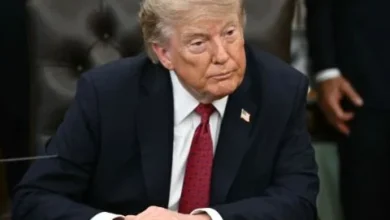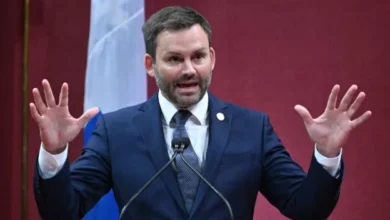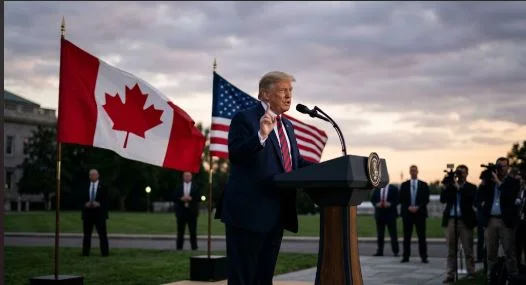
OTTAWA: US President Donald Trump has renewed his criticism of Canada, saying the country wants to enjoy the benefits of being a US state without actually becoming one. His latest remarks come as trade negotiations between Washington and Ottawa have broken down and the United States has imposed new 50 per cent tariffs on a range of Canadian products.
Trump’s comments have added further tension to an already strained relationship between the two countries, which are among each other’s most important trading partners.
Trump renews criticism of Canada
Trump made the remarks in a brief statement on his social media platform on Sunday morning, accusing Canada of imposing heavy tariffs on American farmers for years.
The US president said that such treatment would no longer continue. He also repeated his broader criticism that Canada seeks advantages associated with being part of the United States despite remaining an independent country.
Trump has previously suggested that Canada could become the 51st US state, a proposal that has been repeatedly rejected by Canadian political leaders.
Trade talks break down
Canadian Prime Minister Mark Carney said negotiations between the two countries ended after the US administration presented demands that Ottawa considered unacceptable.
Carney said Washington had asked Canada to make significant concessions without offering sufficient benefits in return.
According to the Canadian prime minister, another major point of disagreement was an apparent US effort to restrict Canada’s ability to negotiate and maintain independent trade agreements with other countries.
Ottawa has maintained that Canada must retain control over its own trade policy and economic decisions.
US imposes 50 per cent tariffs
Following the collapse of the negotiations, the United States imposed new 50 per cent tariffs on a range of Canadian products on Saturday.
The tariffs affect billions of dollars worth of goods, including plywood, cement, alcoholic beverages and hockey sticks, among other products.
The latest measures have significantly increased uncertainty for businesses on both sides of the border and raised concerns about the potential economic consequences of a prolonged trade dispute.
Canada announces retaliatory tariffs
Prime Minister Mark Carney has announced retaliatory measures in response to the new US tariffs.
The Canadian government plans to impose dollar-for-dollar tariffs on selected American products beginning September 8.
Carney described the US decision as a miscalculation and said Canadians remained united and capable of making decisions about their own future.
The Canadian government has argued that its response is intended to protect Canadian workers, businesses and the country’s economic interests.
Provincial leaders back Ottawa
Several Canadian premiers have supported the federal government’s decision not to accept what Ottawa considered an unfavourable trade agreement with Washington.
Ontario Premier Doug Ford said he was pleased that the Carney government had refused to accept a deal that he believed would not have been in Canada’s best interests.
Ford has also backed retaliatory measures against US tariffs, adding pressure on Washington from Canadian provincial governments.
Washington defends its position
US Trade Representative Jamieson Greer said Washington was not immediately planning to restart formal trade negotiations with Canada.
Greer said the US administration’s objective was to protect American workers and domestic supply chains.
He also claimed that the United States had offered Canada tariff reductions in several important sectors, including steel, automobiles and lumber, but that Ottawa had rejected the proposals.
Canadian officials, however, have disputed the US interpretation of the negotiations and maintained that the demands presented by Washington were not acceptable.
Opposition demands greater transparency
Pressure is also building on the Canadian government to provide more information about the failed negotiations.
Conservative MP Shuvaloy Majumdar has called on the government to release details of the proposed agreement that are not protected by negotiating confidentiality.
He argued that Canadians should be able to understand what Washington offered and why Ottawa decided not to accept the proposal.
The demand adds a domestic political dimension to the growing trade dispute, with opposition parties seeking greater clarity over the government’s negotiating strategy.
What comes next?
Despite the collapse of the latest talks, analysts say the possibility of future negotiations has not necessarily disappeared.
Canada’s retaliatory tariffs are not scheduled to take effect until September 8, leaving a period during which both governments could potentially work to reduce tensions.
Economic and political pressures could also influence Washington’s approach. Concerns over inflation in the United States and the political environment ahead of the November midterm elections could increase pressure on the administration to limit the economic impact of the trade dispute.
For now, however, Trump’s renewed criticism, the new 50 per cent US tariffs and Canada’s planned retaliation have pushed the long-standing US-Canada trade dispute into a significantly more serious phase.
The coming weeks will be critical as businesses and governments on both sides of the border assess the economic impact and determine whether another round of negotiations can prevent the dispute from escalating further.