The True Post (Web News)
Aman Ullah
August 31, 2026
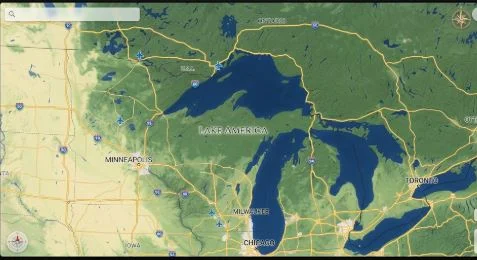
A controversial name change involving Lake Ontario has created confusion in Canada after several Canadian and government websites temporarily displayed the lake as “Lake America” on their digital maps.
The issue followed U.S. President Donald Trump’s executive order concerning the name of the lake and Google’s subsequent update to its mapping data based on changes to the U.S. government’s geographic names database.
The unexpected change was particularly noticeable because several Canadian public services use third-party mapping technology, including Google Maps and its application programming interfaces.
Canadian Government Websites Affected
According to reports, several Canadian websites temporarily displayed Lake Ontario under the name “Lake America.”
The affected platforms reportedly included Hydro One’s outage map, the Liquor Control Board of Ontario’s store locator, the GO Transit station finder and a federal government housing and infrastructure map.
The incident raised questions about how Canadian government services rely on mapping technologies provided by major foreign technology companies.
Google Confirms the Map Name Change
Google confirmed that it changed the lake’s name in its mapping system after the U.S. government officially updated its geographic names database.
The company explained that the change primarily applies to users accessing Google Maps from the United States.
However, the change also appeared on some Canadian websites that use Google’s mapping technology, creating confusion among Canadian users.
Hydro One Acknowledges the Problem
Hydro One, Ontario’s major electricity transmission and distribution company, acknowledged that the name was incorrectly appearing on its outage map.
A company spokesperson said Hydro One was aware of the issue and expressed regret over the situation.
The company explained that the problem was related to a third-party mapping service and that it was working with its technology provider to correct the issue.
GO Transit Temporarily Disabled the Map
Metrolinx, the Ontario government agency responsible for GO Transit, also became aware of the issue.
The agency said it was reviewing its websites to ensure that Lake Ontario was displayed under its correct name.
GO Transit later temporarily disabled the map feature on the affected webpage after the controversial name appeared.
The move was intended to prevent further confusion while the issue was being investigated and corrected.
LCBO Restores the Original Name
The Liquor Control Board of Ontario also appeared to be affected by the mapping issue.
At one point, the map on the LCBO website reportedly displayed “Lake America.”
The map was later updated, and the lake’s traditional name, Lake Ontario, was restored.
The incident demonstrated how a change in an underlying mapping database can quickly appear across multiple unrelated websites.
Why Did the Name Appear on Canadian Websites?
Google provided additional clarification about how its Maps technology works.
According to the company, developers who embed Google Maps into their websites can select a specific region for the map.
If a developer selects Canada as the relevant region, the lake should normally appear as Lake Ontario.
However, third-party websites and applications may use Google’s mapping services in different ways, meaning that the name displayed on an embedded map can sometimes differ from what a user sees when directly using Google Maps.
Third-Party Technology Created Additional Confusion
Technology analyst and journalist Carmi Levy suggested that the issue may be connected to the way Google’s mapping APIs are used by websites.
Although the affected websites belong to Canadian organizations and government bodies, the underlying mapping technology may be supplied by a U.S.-based technology company.
Application programming interfaces, commonly known as APIs, allow websites and applications to use external services such as maps, location data and geographic information.
However, the way these services display information can depend on settings such as the user’s location, selected region and the specific API being used.
Canadian Users May See a Different Result
People using Google Maps directly in Canada would generally be expected to see the traditional name, Lake Ontario, based on regional settings.
This means that a Canadian user could potentially encounter different names depending on whether they were using Google Maps directly or viewing a map embedded on another website.
Reports also indicated that some Canadian searches temporarily showed a location pin using the name “Lake America,” while the lake itself continued to be identified as Lake Ontario when viewed more closely on the map.
The Incident Raises Questions About Digital Sovereignty
The controversy has also renewed discussion about Canada’s digital sovereignty.
Technology analyst Carmi Levy pointed out that Canada does not operate a mapping platform on the same scale as Google Maps.
As a result, many Canadian public and private digital services depend on technology, infrastructure and data supplied by foreign companies.
The Lake Ontario incident illustrates how decisions made by an external technology provider can potentially affect digital services operated by Canadian organizations.
Ontario Government Reviews Its Websites
Ontario Minister of Public and Business Service Delivery and Procurement Stephen Crawford also acknowledged the issue.
The provincial government said it was reviewing its websites to ensure that Lake Ontario was correctly identified across its digital platforms.
The response highlighted the need for government agencies to monitor third-party services used on public websites, particularly when those services rely on external geographic databases.
MapQuest Rejects the Name Change
Not every mapping service followed Google’s approach.
U.S.-based online mapping service MapQuest said publicly that it would not change the lake’s name.
Apple has not issued a public position on the matter at the time of the reports.
The differing approaches among mapping companies mean that users could potentially see different names for the same geographic feature depending on which mapping platform they use.
Doug Ford Rejects the Name Change
Ontario Premier Doug Ford has also rejected the attempt to change the lake’s traditional name.
Speaking on a U.S. television program, Ford questioned whether the name-change effort would ultimately succeed.
He argued that the lake’s historical identity would remain Lake Ontario regardless of the U.S. administration’s decision.
Ford’s position reflects the broader Canadian view that the traditional name should continue to be used in Canada.
A Political Dispute Becomes a Digital Issue
The controversy over Lake Ontario’s name began as a political and administrative issue but has now expanded into the digital world.
The appearance of “Lake America” on Canadian websites demonstrates how closely government services can be connected to external technology platforms.
A change in a geographic database can potentially affect maps, location searches and other digital services used by millions of people.
The Bigger Question for Canada
Beyond the dispute over the name itself, the incident raises a broader question about Canada’s dependence on foreign technology infrastructure.
Governments increasingly rely on private companies for cloud services, mapping platforms, artificial intelligence, cybersecurity tools and other digital infrastructure.
The Lake Ontario case shows that technological dependence can sometimes create unexpected challenges, even when the underlying dispute has nothing to do with technology.
For Canada, the episode could strengthen calls for greater domestic digital capacity and more control over critical data and technology infrastructure.
For now, Lake Ontario remains the traditional name used in Canada, while the controversy surrounding the U.S. naming decision continues to attract political and public attention.