Muhammad Amanullah
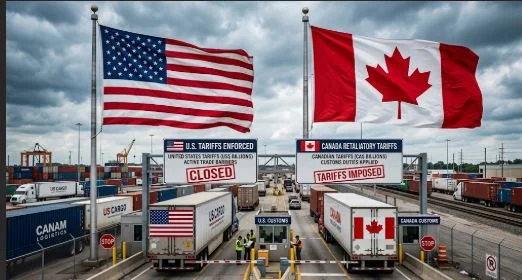
The True Post (Web News) — Trade tensions between the United States and Canada have intensified once again after the two countries failed to reach a trade agreement at the last minute. The United States has now imposed new and significantly higher tariffs on Canadian products.
The new tariffs came into effect at 12:01 a.m. on Saturday after several days of negotiations failed to produce a final agreement.
U.S. Trade Representative Jamieson Greer confirmed that talks between the two countries had failed to reach a final deal. According to Greer, the United States had offered Canada the most favorable trade treatment among major exporting economies. However, he said Canada introduced new conditions during the final stage of negotiations and backed away from some earlier commitments, disrupting the talks.
Canada Says U.S. Conditions Were Unacceptable
Canadian Prime Minister Mark Carney also confirmed that negotiations had failed. He said the terms proposed by the United States at the last minute were unfair and economically unacceptable to Canada.
Carney said Canada had therefore decided to suspend trade negotiations with the United States and instructed Canadian negotiators to return to Ottawa.
The Canadian prime minister also made it clear that Canada would respond to the new American tariffs. He said Canada would impose tariffs of its own in response to the U.S. measures in an effort to protect Canadian workers and businesses.
Read More: Canada and US Close to Finalizing Trade Deal, Delaying New Tariffs
Tariffs of Up to 50 Percent
Under the new U.S. policy, tariffs of up to 50 percent have been imposed on hundreds of products imported from Canada. The affected goods are reportedly worth more than US$28 billion in total.
The new tariffs cover a wide range of products, including lumber, plywood, cement, wine and hockey sticks.
The move could significantly damage the strong trade relationship that has existed between the United States and Canada for decades.
Previously, under North American free-trade arrangements, many products from Canada were subject to relatively low tariffs or were exempt altogether. However, the new U.S. policy has brought additional tariffs on several Canadian products that had previously met the requirements of the trade agreement between Canada, the United States and Mexico.
U.S. Accusations Against Canada
The Trump administration has argued that Canada took measures in response to U.S. trade policies that harmed American industries.
U.S. officials have repeatedly criticized Canadian policies affecting American dairy, wine and automobile industries.
Canada had already introduced several retaliatory measures against American products and services, including additional tariffs and restrictions on certain goods.
Jamieson Greer said Canada’s continued retaliatory measures against American goods and services were among the factors that contributed to the breakdown of negotiations.
Business Community Raises Concerns
The announcement of the new U.S. tariffs has caused concern among businesses on both sides of the border.
The Canadian Chamber of Commerce described the American tariffs as a major blow to North America’s competitiveness.
Canadian businesses have warned that it would be difficult to absorb tariffs of this magnitude for an extended period. Higher tariffs could increase production costs, raise consumer prices and negatively affect trade between the two countries.
Business experts say the economies of the United States and Canada are deeply interconnected. As a result, a prolonged trade dispute would not affect businesses in only one country. Industries, consumers and workers on both sides of the border could face consequences.
Electronics Sector Among Industries Facing Impact
Canada’s electronics sector is expected to be among the industries affected by the new U.S. tariffs.
Electronic equipment exported from Canada to the United States and now covered by the new tariffs is reportedly worth more than US$4 billion.
The affected products include various electrical boards, controllers and other electronic equipment. Some of these products are among Canada’s higher-value exports to the United States.
Plastics Industry Also Faces Pressure
Canada’s plastics industry could also face significant pressure from the new tariffs.
Products worth approximately US$3 billion, including bottles, flooring products and various household items, are reportedly included in the new tariff measures.
Experts warn that if the trade restrictions remain in place for an extended period, Canadian exporters could struggle to sell their products at competitive prices in the American market.
Risk of a Broader Trade War
Canada’s announcement that it will impose retaliatory tariffs has increased concerns about a broader trade war between the two countries.
A senior U.S. administration official has also warned that tensions could increase further if Canada introduces additional retaliatory measures.
Such a situation could put additional pressure on North American supply chains, manufacturing, exports and consumer prices.
The suspension of trade negotiations has also reduced hopes for an immediate compromise between Washington and Ottawa.
What Could Happen Next?
The latest developments mean the United States and Canada have once again entered a period of retaliatory trade measures despite diplomatic and economic efforts to reach an agreement.
If the tariffs remain in place for a prolonged period, businesses could begin adjusting supply chains, looking for alternative markets and passing some additional costs on to consumers.
For Canada, the challenge will be to protect domestic industries without further damaging its access to the U.S. market. For the United States, higher tariffs could also affect companies that depend on Canadian raw materials, components and other products.
The two economies are closely connected through cross-border supply chains, meaning that a prolonged trade conflict could have consequences far beyond the individual products directly targeted by the tariffs.
For now, negotiations between Washington and Ottawa remain suspended, while both sides prepare for the economic impact of the new measures. The coming weeks are likely to determine whether the dispute escalates further or whether the two countries return to the negotiating table.