Muhammad Amanullah | September 16, 2026
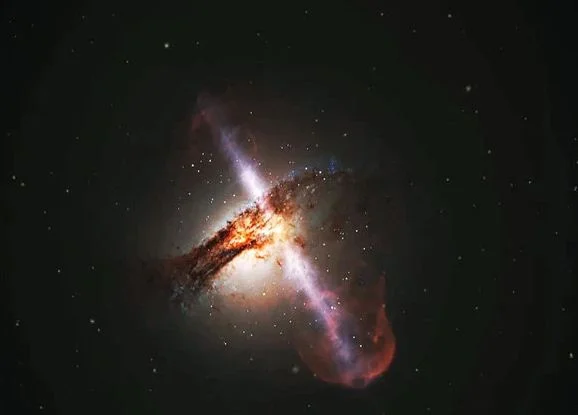
A new study suggests that rapidly growing supermassive black holes may not always suppress star formation in their host galaxies. Instead, they could potentially help trigger or increase the formation of new stars.
The findings offer a new perspective on the relationship between supermassive black holes and the galaxies that surround them, challenging the idea that the powerful energy released by black holes necessarily prevents stars from forming.
Observations of Nine Galaxies
Researchers studied nine galaxies using observations obtained with the MUSE instrument on the European Southern Observatory’s Very Large Telescope (VLT).
The observations allowed astronomers to examine regions around active galactic nuclei, or AGNs, where supermassive black holes are actively consuming matter and releasing large amounts of energy.
Evidence of Star Formation Around Black Holes
The researchers identified regions near the active galactic nuclei where new stars appear to be forming.
These areas included ring-like and curved structures, energetic cones of gas and high-speed shock waves.
The observations provide evidence that the powerful activity surrounding growing black holes may interact with the gas in their host galaxies in ways that can influence the formation of new stars.
Energy Outflows May Play a Key Role
Black holes are known for their ability to pull matter inward through their powerful gravitational fields. However, the material falling toward a black hole can also lead to the release of enormous amounts of energy and outflowing matter.
According to the researchers, these energetic outflows can collide with surrounding gas and produce shock waves.
Such interactions may compress some of the gas and potentially create conditions that encourage the formation of new stars.
A New Perspective on Galaxy Evolution
The study could help astronomers better understand how supermassive black holes influence the formation and evolution of their host galaxies.
For years, scientists have investigated whether the energy released by active black holes suppresses star formation by heating or disrupting the gas needed to create new stars.
The new observations suggest that the relationship may be more complex. Under certain conditions, black-hole-driven outflows may also contribute to the processes that lead to star formation.
Connection Between Matter Falling In and Energy Going Out
Astronomers say the process of matter falling toward a black hole and the subsequent release of matter and energy are closely connected.
Understanding this relationship could provide new insights into how supermassive black holes interact with their surrounding galaxies.
The findings suggest that black holes may play a more complicated role in galactic evolution than simply acting as mechanisms that consume matter.
Further observations and studies will be needed to determine how widespread this effect is and under what conditions black-hole activity can promote rather than suppress the formation of new stars.